If you have started shopping for a solar system in Nigeria, you have probably run into three confusing terms: grid-tied, off-grid, and hybrid.
Each one describes a completely different relationship between your solar panels, your batteries, and the national grid, and picking the wrong one can mean paying for equipment you do not need or, worse, having no power at all when NEPA (as many Nigerians still call the grid) goes off.
This article breaks down how each system works, where it makes sense, and how to decide which one fits your home, shop, or office.
What Is a Grid-Tied Solar System?
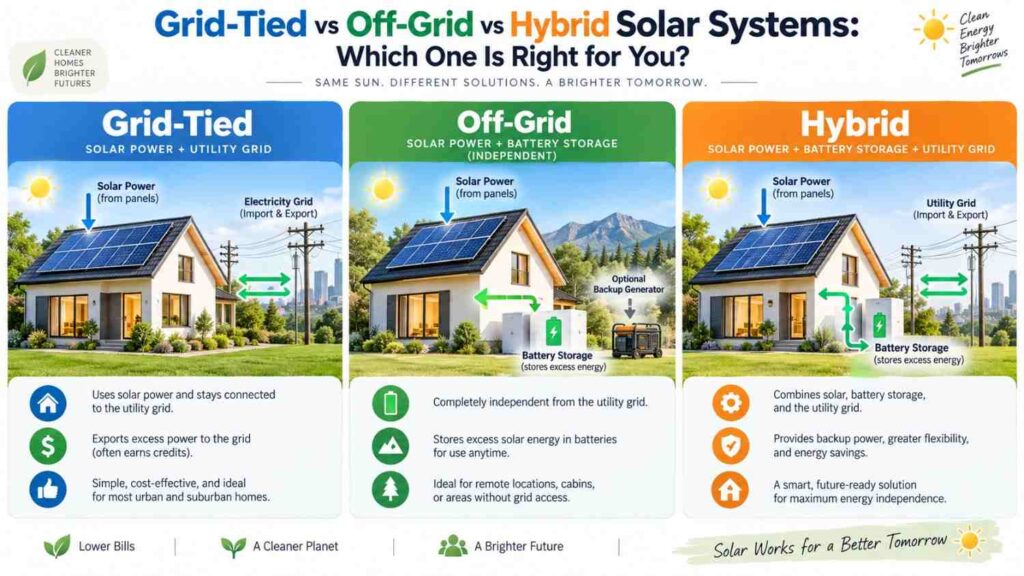
A grid-tied, or on-grid, system connects your solar panels directly to the public grid through a special inverter called a grid-tie inverter. There are no batteries involved. During the day, the panels generate power and feed your home directly; if you produce more than you use, the surplus can, in countries with net metering, be exported back to the utility for credit.
The moment the grid goes down, a grid-tied inverter is legally and technically required to shut off completely, a safety feature called anti-islanding that protects utility workers repairing the lines.
This is why grid-tied systems are rare in Nigeria. They are cheap to install since there is no battery bank, but they offer zero backup during outages, and given how frequent outages are here, that trade-off rarely makes sense outside areas with fairly stable supply.
What Is an Off-Grid Solar System?
An off-grid system is completely independent of the utility grid. Solar panels charge a battery bank through a charge controller (the MPPT vs PWM distinction is covered in our dedicated charge controller article), and an inverter draws power from the batteries to run your appliances.
Everything you use must come from what the panels generate and the batteries store, so correct sizing of the panel array and battery bank, as covered in our panel sizing article, is critical.
Off-grid setups are common in rural areas with no grid connection at all, or for buildings where the owner has deliberately decided to disconnect from the utility entirely. The downside is cost: because every watt you consume must be backed by stored energy, the battery bank needs to be large, and lithium or quality tubular batteries are not cheap in Nigeria.
What Is a Hybrid Solar System?
A hybrid system combines the best of both worlds. It has solar panels, a battery bank, and a connection to the grid, all managed by a hybrid inverter. During the day, solar power runs your loads and charges the batteries. When the sun goes down or clouds roll in, the system draws from the batteries.
If the batteries are low and the grid is available, the hybrid inverter can pull from the grid to keep things running or to top up the batteries. This flexibility is exactly why hybrid systems have become the dominant choice for Nigerian homes and small businesses, where grid power is present but unreliable.
Side-by-Side Comparison
| Feature | Grid-Tied | Off-Grid | Hybrid |
|---|---|---|---|
| Needs batteries | No | Yes, sized for full load | Yes, sized for backup hours |
| Works during outage | No | Yes, always | Yes, on battery power |
| Upfront cost | Lowest | Highest | Moderate to high |
| Best for | Stable grid areas | No grid access at all | Unreliable grid, most of Nigeria |
| Grid dependency | Full | None | Partial, as backup |
Why Hybrid Dominates in Nigeria
Grid power in most Nigerian cities is inconsistent rather than absent, which is exactly the scenario a hybrid system is built for. Instead of running a noisy, fuel-hungry generator every time supply drops, a hybrid system switches to battery power in milliseconds, often without the household even noticing.
Because the grid is still there as a fallback, homeowners do not need to oversize their battery bank the way a fully off-grid household would, keeping overall cost more manageable while still cutting generator fuel expenses.
Factors to Consider Before Choosing
- How reliable is grid supply in your specific area, not just your city in general.
- Your budget, since hybrid and off-grid systems cost significantly more than grid-tied due to the battery bank.
- Whether you want partial backup (a few essential circuits) or whole-house backup.
- Your monthly fuel spend on a generator, which helps calculate the payback period.
- Available roof space and sunlight exposure for the panel array.
- Local regulations or estate rules around grid connection and net metering, where applicable.
Sizing and Installer Considerations
Whichever system you choose, correct sizing still comes down to the same fundamentals discussed in our panel sizing and inverter and battery articles: know your daily energy consumption in kilowatt-hours, decide how many hours of backup you need, and size the battery bank and panel array around that figure rather than around a fixed budget.
A good installer in Nigeria will ask about your appliance list, your typical outage pattern, and whether you plan to expand later before recommending a hybrid inverter capacity. Many households also start with a smaller hybrid system and expand later, a route covered in our article on adding more panels to an existing system.
Common Misconceptions
- “Off-grid means the cheapest option since you cut ties with the utility.” Off-grid is usually the most expensive option because it requires a battery bank large enough to cover 100 percent of your needs with no grid fallback.
- “A hybrid system works exactly like a grid-tied system with extra batteries bolted on.” A hybrid inverter is a fundamentally different device that intelligently manages three power sources at once, not simply a grid-tie inverter with a battery attached.
- “Grid-tied systems still work when the power is off if you have panels installed.” Grid-tied systems shut down automatically during an outage as a safety measure and provide zero backup unless batteries are added, turning it into a hybrid system.
Frequently Asked Questions
Can I convert a grid-tied system into a hybrid system later?
In many cases yes, by replacing the grid-tie inverter with a hybrid inverter and adding a battery bank, though it is best confirmed with your installer since compatibility varies by brand.
Which system gives the fastest return on investment in Nigeria?
Hybrid systems typically give the best overall value because they cut generator fuel costs significantly while keeping upfront costs lower than a full off-grid setup.
Do I need a hybrid inverter if I already have batteries at home?
Yes, a standard grid-tie or off-grid inverter cannot intelligently switch between grid, solar, and battery power the way a hybrid inverter is designed to.
Final Thoughts
The right system depends less on which technology sounds most advanced and more on how reliable your grid connection actually is and what you can afford upfront. For most Nigerian households and businesses dealing with unpredictable NEPA supply, a hybrid system offers the most practical balance of backup power and cost.
Off-grid remains the right call only where there is genuinely no grid to fall back on, while grid-tied suits areas with unusually stable power where the goal is purely bill reduction. Whichever direction you lean, get your daily energy consumption and backup needs clearly worked out before an installer quotes you a price.