
Nationwide grid collapses have periodically affected Nigeria’s power system, generating significant public frustration and questions about why an entire national grid can fail simultaneously.
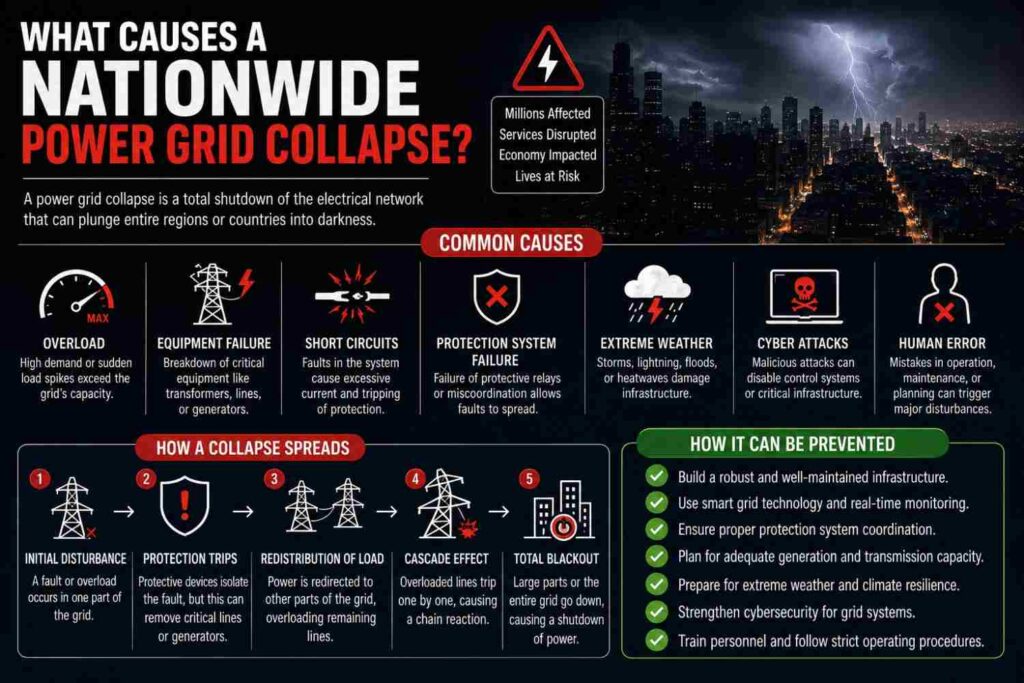
This article explains the genuine technical causes behind grid collapses and what they mean in practice.
What a Grid Collapse Actually Means
A grid collapse occurs when the interconnected national power system experiences a cascading failure that causes generation and transmission across the entire network, or a very large portion of it, to shut down essentially simultaneously, distinct from localized outages affecting only specific distribution areas, discussed in our dedicated transmission versus distribution article.
Why Interconnected Grids Are Vulnerable to Cascading Failure
A national grid operates as a single, interconnected system where generation and demand must remain continuously balanced; because all connected generators and loads are electrically linked, a significant disturbance at one point, whether a large generator tripping offline or a major transmission line failure, can cascade rapidly through the interconnected system if not contained quickly enough.
Common Underlying Causes of Grid Collapse
| Cause | How It Triggers Collapse |
|---|---|
| Sudden loss of major generation | Remaining generators can’t immediately cover the gap |
| Transmission line/equipment failure | Disrupts power flow and system balance |
| Frequency instability | Generators trip offline to protect themselves |
| Inadequate spinning reserve | Insufficient backup capacity to absorb sudden loss |
| Protection system malfunction | Fails to isolate faults before they cascade |
The Critical Role of Frequency Stability
Power grids must maintain a stable operating frequency (50Hz in Nigeria), with generation and demand kept in close continuous balance; when this balance is significantly disrupted, from a large generator tripping offline or a sudden major demand change, frequency deviates from its target, and if protective systems can’t restore balance quickly enough, cascading generator trips can rapidly escalate into a full system collapse.
Why Nigeria’s Grid Has Faced Particular Vulnerability
Nigeria’s national grid has historically faced specific vulnerability factors, a relatively limited number of large generating stations providing much of total capacity (meaning single failures represent a larger proportional loss), aging transmission infrastructure in some areas, and historically limited spinning reserve margins, all contributing factors that have made cascading collapse more likely than in grids with more diverse, distributed generation and stronger reserve margins.
How Grid Operators Work to Prevent and Contain Collapses
- Maintaining adequate spinning reserve capacity that can respond quickly to sudden generation loss.
- Coordinated protection systems designed to isolate faults before they cascade further.
- Grid infrastructure investment to strengthen transmission capacity and reliability.
- Diversifying generation sources, reducing dependence on any single large generating station.
What Happens During Grid Restoration After Collapse
Restoring power after a full grid collapse is a carefully sequenced process, not simply switching everything back on simultaneously, since generators must be restarted and gradually synchronized with careful frequency and load management to avoid triggering another cascading failure, explaining why full restoration after a major collapse can genuinely take considerable time rather than happening instantly.
The Genuine Economic Cost of Repeated Grid Collapses
Beyond the immediate inconvenience, repeated grid collapses carry substantial genuine economic cost, businesses losing productive hours, increased reliance on expensive generator fuel, discussed throughout our generator articles, and broader deterrents to industrial investment that depends on reliable power access, making grid stability a genuinely significant economic policy consideration well beyond the immediate technical engineering challenge of preventing cascading failures.
Common Misconceptions
- “Grid collapses happen randomly with no identifiable underlying cause.” They typically result from specific triggering events cascading through vulnerabilities in the interconnected system.
- “Restoring power after a collapse should be instant since generation capacity still exists.” Careful, sequenced restart and synchronization is genuinely necessary to avoid triggering a repeat collapse.
- “Grid collapse is a problem unique to Nigeria’s power system specifically.” Interconnected grids worldwide face genuine cascading failure risk, though the frequency and specific vulnerability factors vary by system.
Frequently Asked Questions
How long does a typical full restoration process take after a nationwide grid collapse?
This varies considerably based on the specific collapse’s scope and cause, but full restoration across an entire national grid can genuinely take many hours given the careful, sequenced synchronization process required.
Does having a personal generator or inverter, discussed throughout our generator and inverter articles, protect against grid collapse impact?
Yes, backup power systems provide genuine continuity during grid collapse events, which is part of why they remain so prevalent in Nigeria given historical grid reliability challenges.
Are grid collapses becoming more or less frequent over time in Nigeria?
This varies year to year based on infrastructure investment, generation capacity additions, and grid management improvements; checking current reporting from TCN and energy sector sources provides the most accurate, up-to-date picture.
Final Thoughts
Nationwide grid collapses result from cascading failures triggered by events like sudden generation loss or transmission faults, propagating through the interconnected grid faster than protective systems can contain them, with Nigeria’s specific infrastructure characteristics historically contributing to this vulnerability. Understanding these genuine technical causes provides valuable context for why these events occur and what ongoing infrastructure investment aims to address.