
It’s a frustrating and common scenario: your generator handles your lights, fans, and other appliances just fine, until you switch on the air conditioner, at which point it visibly struggles, the lights dim, or the generator stalls or trips entirely. This article explains exactly why air conditioners are such a demanding load for generators specifically.
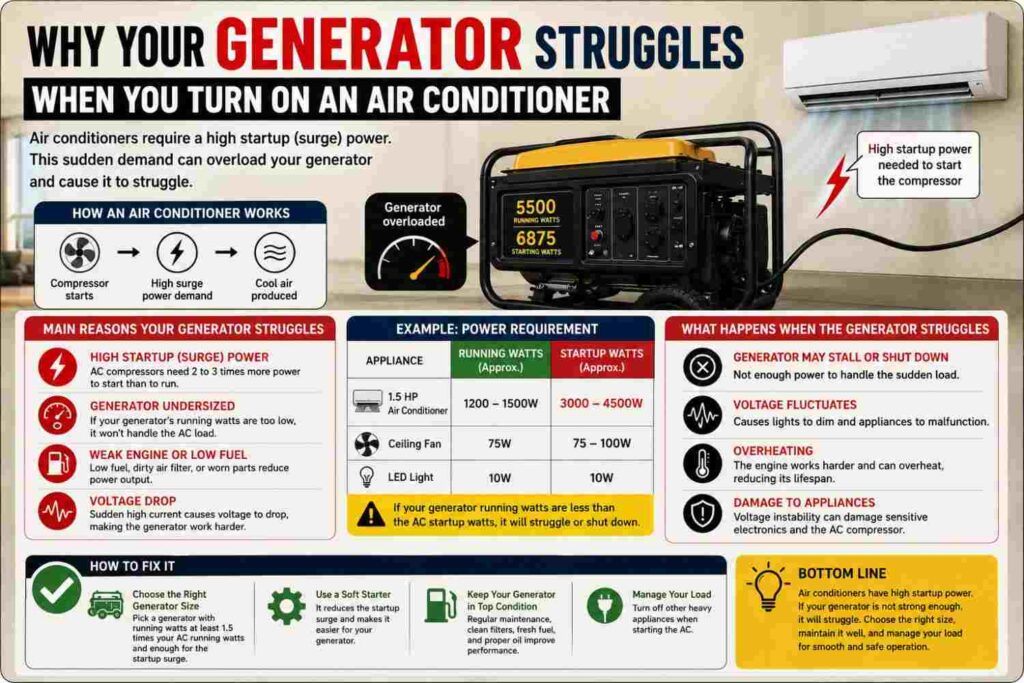
The Core Issue: Starting Surge, Not Running Load
As discussed in our dedicated inverter-and-AC article, air conditioner compressors draw a substantial starting surge, often 3-5 times their normal running wattage, for a brief moment when the compressor motor first engages; this surge is the actual culprit in most “generator struggles with AC” scenarios, not the AC’s steady-state running power, which the same generator might handle without any issue once the compressor is already running.
Why This Surge Specifically Challenges Generators
A generator’s engine and alternator need a moment to respond to a sudden, substantial increase in electrical demand; if the AC’s starting surge exceeds what your generator can deliver even momentarily, the result can be a significant voltage and frequency dip (visible as dimming lights), an overload trip if your generator has protective circuitry, or in more severe cases, the generator’s engine stalling entirely under the sudden electrical load.
Why This Happens Even When Running Wattage “Should” Be Fine
Many people calculate whether their generator can handle their AC using only the unit’s running wattage, comparing it against the generator’s rated continuous capacity, and conclude it should work, without accounting for the substantially higher, if brief, starting surge that represents the actual peak demand moment the generator must survive, a calculation gap explained in more depth in our dedicated generator sizing article.
Compounding Factors That Make This Worse
1. Other Loads Already Running
If your generator is already supplying other appliances when the AC attempts to start, less remaining surge capacity is available to absorb the AC’s additional starting demand, making struggles more likely than if the AC were the only thing running.
2. An Aging or Underperforming Generator
A generator that has lost some of its original performance capacity due to age, wear, or inadequate maintenance may struggle with surges it handled comfortably when newer, even if its rated capacity on paper hasn’t changed.
3. Multiple AC Units Starting Simultaneously or in Close Succession
If your generator serves multiple AC units, and more than one attempts to start around the same time (sometimes because they’re on a shared thermostat cycle or similar timing), the combined surge can significantly exceed what a single unit’s surge alone would require.
A Diagnostic and Solution Table
| Issue | Likely Cause | Possible Solution |
|---|---|---|
| Generator struggles/dims specifically at AC startup | Insufficient surge capacity | Upgrade generator size or reduce other simultaneous load |
| Struggles worse when other appliances already running | Insufficient remaining surge headroom | Stagger appliance use; start AC before other loads |
| Struggles has worsened over time with same generator | Generator wear/aging | Service or assess generator condition |
| Multiple AC units starting together | Combined surge exceeds capacity | Stagger AC unit startup timing |
Practical Solutions Beyond Simply Buying a Bigger Generator
Starting your AC unit first, before switching on other significant appliances, gives it access to your generator’s full available surge capacity rather than competing with other simultaneous demand. Considering an inverter-type AC unit, discussed in our dedicated AC-on-inverter article, with its gentler, more gradual startup surge compared to older fixed-speed compressor technology, can also meaningfully reduce the peak demand your generator needs to handle, sometimes resolving struggles without requiring a generator upgrade at all.
When Upgrading Your Generator Is the Right Answer
If your household’s genuine combined load, properly calculated including realistic starting surge as covered in our sizing article, simply exceeds your current generator’s capacity even after trying the mitigation strategies above, upgrading to an appropriately sized unit is the correct, durable solution rather than continuing to work around a fundamentally undersized generator.
Why Documenting the Exact Struggle Pattern Helps Diagnosis
Noting precisely what happens during a struggle, whether the generator dims briefly then recovers, trips its overload protection entirely, or stalls completely, along with what else was running at the time, gives a technician or knowledgeable seller much more useful diagnostic information than a general complaint that “the generator struggles with the AC,” helping distinguish a simple undersizing issue from a potential generator fault requiring separate attention.
Common Misconceptions
- “If my generator’s rated wattage exceeds my AC’s running wattage, it should handle it fine.” Starting surge, often several times running wattage, is the actual limiting factor in most struggle scenarios.
- “A generator that struggles with AC startup is simply broken.” Often the generator is functioning correctly but is simply undersized or overloaded for the specific surge demand being placed on it.
- “All air conditioners place the same startup demand on a generator.” Inverter-type AC units with variable-speed compressors place meaningfully less startup demand than older fixed-speed units of similar cooling capacity.
Frequently Asked Questions
Can a voltage stabilizer help my generator handle AC startup better?
A stabilizer primarily protects connected equipment from voltage fluctuation rather than increasing your generator’s fundamental surge capacity; it doesn’t resolve an underlying capacity mismatch, though it may help protect sensitive equipment from the fluctuation that occurs during a struggling startup.
Is it worth having a technician assess my specific generator’s actual surge capacity?
Yes, particularly if you’re unsure whether your struggles stem from genuine undersizing or a developing generator issue; a technician can test your generator’s actual real-world surge handling rather than relying solely on its rated specification.
Does running the generator for a few minutes before starting the AC help?
Allowing a generator to reach stable operating speed and warm up briefly before applying a heavy surge load is generally good practice and can modestly help, though it won’t overcome a fundamental capacity shortfall if your generator is genuinely undersized for your AC’s surge demand.
Final Thoughts
A generator struggling specifically when an air conditioner starts almost always comes down to the substantial but brief starting surge exceeding available capacity, not a general power shortfall or a fundamentally broken generator. Understanding this distinction, and applying the practical mitigation strategies discussed above, helps you determine whether adjusting your usage pattern or genuinely upgrading your generator is the right path forward.