
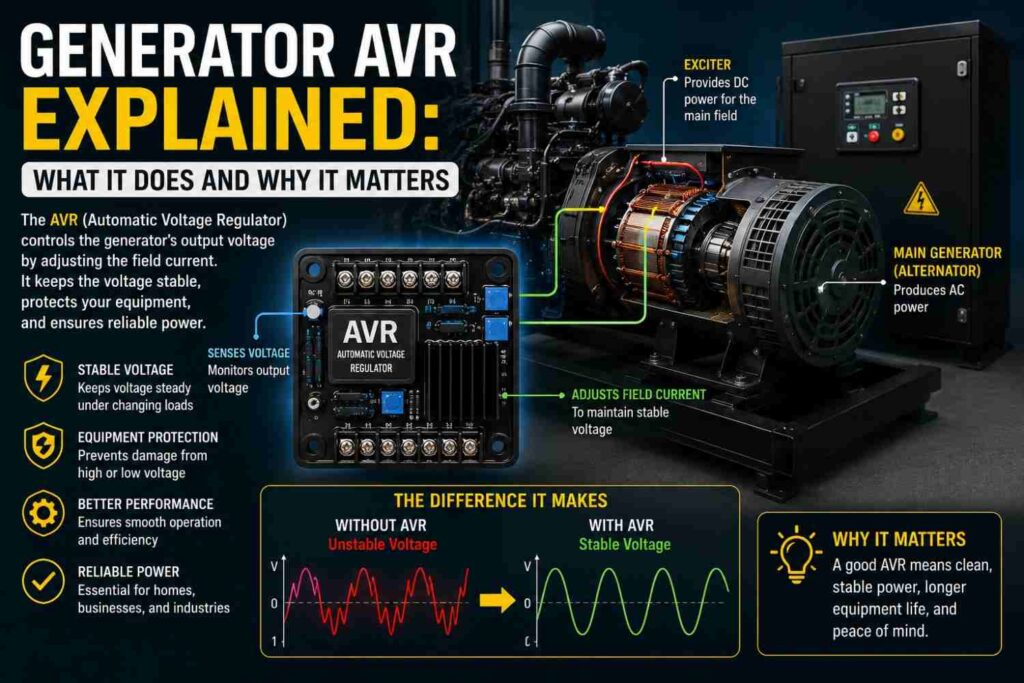
The Automatic Voltage Regulator, or AVR, is one of the most important yet least understood components in a generator, quietly doing the essential work of keeping your generator’s output voltage stable despite constantly changing conditions. This article explains exactly what an AVR does and why its proper function matters so much.
The Basic Problem an AVR Solves
A generator’s engine drives its alternator to produce electrical output, but the alternator’s natural output voltage varies with engine speed and electrical load conditions; without regulation, this would mean genuinely unstable, unpredictable voltage delivered to your appliances, exactly the fluctuation problem discussed in our dedicated voltage fluctuation article, making some form of voltage regulation essential for any generator intended to reliably power sensitive equipment.
How an AVR Actually Works
An AVR continuously monitors the generator’s output voltage and compares it against the desired target voltage (typically around 230V for standard Nigerian residential supply); when it detects output voltage deviating from this target, whether due to a load change, engine speed variation, or other factors, it adjusts the alternator’s excitation current, the current fed into the alternator’s field winding that determines how much voltage it generates, increasing or decreasing this excitation to bring output voltage back toward the target.
Why This Response Needs to Happen Quickly
Load changes, particularly the substantial starting surges from motor-driven appliances discussed in our AC-and-generator article, can happen within a fraction of a second, meaning a quality AVR must detect and respond to these changes rapidly to minimize the voltage dip or spike that would otherwise occur; slower or less capable AVR systems produce more noticeable, longer-lasting voltage disturbance during these transient load events.
Why AVR Quality Varies Significantly Between Generators
Not all AVR systems are engineered equally: better-quality generators typically include more sophisticated, responsive AVR circuitry capable of maintaining tighter voltage regulation across a wider range of load conditions, while budget generators may include more basic AVR systems that maintain voltage adequately under light, stable load but struggle more noticeably during significant load changes or heavier overall demand.
Common AVR Failure Modes
| Failure Mode | Resulting Symptom |
|---|---|
| AVR component degradation from age/heat | Gradually worsening voltage instability over time |
| AVR circuit board damage (moisture, physical damage) | Sudden, significant voltage regulation failure |
| Worn or damaged excitation winding | Reduced ability to properly regulate output |
| Loose or corroded AVR connections | Intermittent regulation problems |
Why AVR Problems Are Often Misdiagnosed
Because voltage instability symptoms can also stem from overloading (discussed in our dedicated overload article), engine speed issues, or fuel problems, AVR-specific faults are sometimes misdiagnosed as one of these other causes, particularly by owners without access to proper diagnostic equipment; a qualified technician testing the AVR’s actual excitation output and response behavior directly can more definitively isolate whether the AVR itself is the genuine source of a given voltage problem.
Protecting Your AVR Through Proper Generator Use
Avoiding chronic overloading, ensuring adequate ventilation and cooling for your generator (excess heat accelerates AVR component degradation), and having your generator serviced regularly by a qualified technician who checks AVR function as part of routine maintenance all help extend your AVR’s functional lifespan and catch developing issues before they cause significant voltage instability affecting your connected appliances.
Can a Failing AVR Be Repaired, or Does It Need Full Replacement?
Depending on the specific failure and generator model, AVR issues can sometimes be resolved through component-level repair, while in other cases full AVR module replacement is the more practical and reliable solution; a qualified generator technician can assess your specific situation and recommend the appropriate approach, often a considerably less expensive fix than replacing the entire generator.
How AVR Quality Factors Into Comparing Generator Brands
When comparing generator brands and models, particularly for households planning to run sensitive electronics or motor-driven appliances regularly, looking beyond simple rated capacity and price to actual voltage regulation specifications and independent reviews discussing real-world stability performance provides a more complete picture than capacity and price comparisons alone, since two generators with identical rated output can deliver meaningfully different real-world voltage stability depending on their respective AVR quality.
Common Misconceptions
- “All generators have essentially the same AVR quality regardless of price.” AVR sophistication and quality genuinely vary between generator models and price points, directly affecting real-world voltage stability performance.
- “Voltage fluctuation is always an AVR problem specifically.” While AVR issues are a common cause, overloading, engine speed instability, and fuel problems can also cause similar symptoms, making proper diagnosis important before assuming AVR failure.
- “A failing AVR always means the whole generator needs replacement.” AVR components or modules can often be repaired or replaced independently of the rest of the generator.
Frequently Asked Questions
Can I test my generator’s AVR function myself without professional equipment?
Basic voltage monitoring under varying load conditions using a standard multimeter can give you a general sense of stability, though definitively isolating AVR-specific faults from other potential causes typically requires a qualified technician’s more specialized diagnostic approach.
Does AVR quality affect fuel efficiency as well as voltage stability?
Indirectly yes; a generator maintaining stable, efficient operation through proper voltage regulation generally operates more efficiently overall than one experiencing frequent voltage instability and the associated engine strain discussed in our overload article.
Is AVR quality something I should specifically ask about when purchasing a new generator?
Yes, particularly if you plan to power sensitive electronics or motor-driven appliances; asking about AVR specifications and response characteristics, or researching reviews specifically discussing voltage stability for models you’re considering, is a worthwhile part of the purchase decision beyond just comparing rated capacity and price.
Final Thoughts
The AVR is a genuinely essential, if often overlooked, component responsible for the voltage stability that makes generator power actually usable for the full range of modern household appliances and electronics. Understanding what it does and how it can fail helps you both better diagnose voltage problems when they occur and appreciate why AVR quality is a genuinely important factor in choosing and maintaining a generator.