
Extension boxes are among the most heavily used and, unfortunately, most commonly abused electrical accessories in Nigerian homes, making them a frequent source of melting, burning and fire risk.
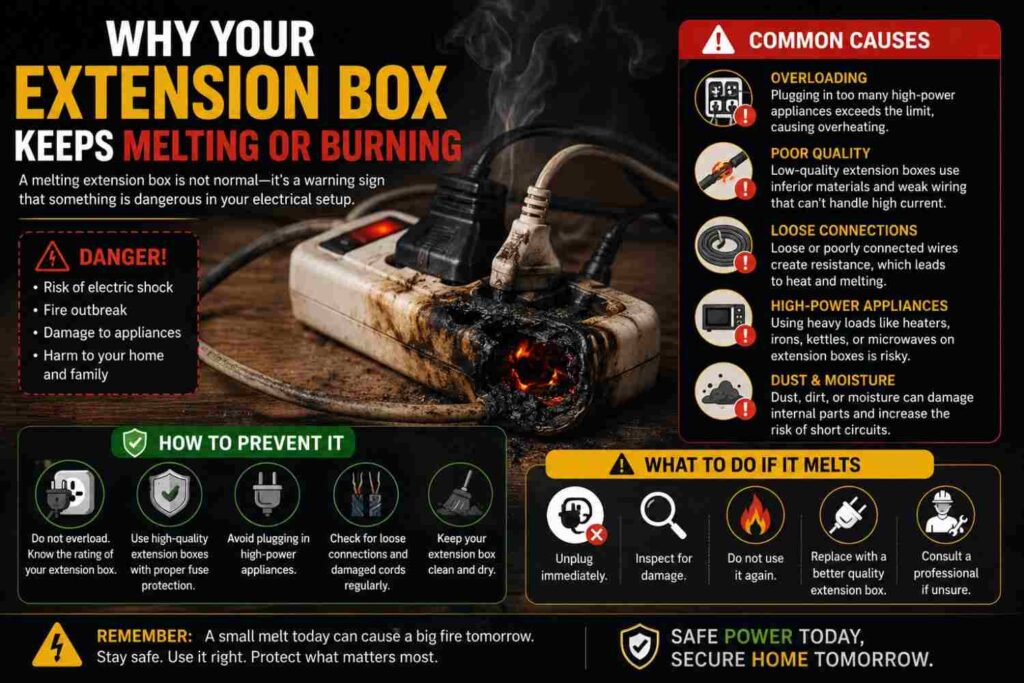
This article explains exactly why extension boxes fail this way, how to use them safely, and when it’s time to stop relying on them altogether for a particular application.
Why Extension Boxes Are Particularly Vulnerable
Extension boxes concentrate multiple appliance connections into a single point, meaning any weakness, undersized internal wiring, poor quality contacts, or a rating mismatched to actual use, gets amplified exactly where multiple current paths converge. Unlike a single wall socket typically serving one appliance, an extension box is specifically designed to be loaded with several devices at once, making overload risk and connection-point heating concerns, discussed throughout our wiring safety articles, especially relevant here.
Common Causes of Extension Box Melting
1. Overloading Beyond the Rated Capacity
Every extension box has a maximum rated current or wattage, often printed on the unit itself or its packaging, and connecting a combined load exceeding this rating, particularly with high-power appliances like irons, kettles or heaters, generates excess heat that the unit’s internal wiring and contacts were never designed to handle.
2. Poor Quality Internal Components
Substandard extension boxes, unfortunately common in some markets, may use undersized internal wiring, thin or low-quality contact material, and inadequate plastic housing, meaning they can overheat and melt even under loads that a quality unit would handle without issue.
3. Daisy-Chaining Multiple Extension Boxes
Plugging one extension box into another, sometimes done to reach appliances further from a wall socket or to add more connection points, compounds overload risk and adds additional weak connection points, each a potential source of heating.
4. Prolonged Use With High-Power Appliances
Even a quality extension box used at or near its rated capacity for extended periods, hours at a time with a kettle or iron, for example, experiences more cumulative thermal stress than the same box used briefly or with lighter loads.
5. Physical Damage or Wear
Cracked housing, loose or worn socket contacts, and damaged internal wiring from age, physical impact, or being stepped on or crushed under furniture, all reduce an extension box’s safety margin before overheating occurs.
How to Use Extension Boxes Safely
- Check and respect the rated capacity printed on the unit, and add up the wattage of everything you plan to connect before plugging in.
- Avoid connecting high-power appliances like kettles, irons, heaters and microwaves to extension boxes at all where possible; these should generally use a dedicated wall socket directly.
- Never daisy-chain multiple extension boxes together.
- Choose extension boxes with built-in overload protection (a small internal circuit breaker or fuse), a genuinely valuable safety feature worth prioritizing when purchasing.
- Inspect periodically for warmth, discoloration, looseness or damage, and replace immediately if any of these signs appear.
- Buy from reputable suppliers rather than the cheapest available option, given how directly extension box quality affects safety.
Extension Boxes vs Permanent Wiring: Knowing the Difference
Extension boxes are designed as a temporary or supplementary solution, not a substitute for adequate permanent wiring. A room that consistently relies on extension boxes to serve its actual appliance needs, rather than occasionally for temporary or portable equipment, likely has too few properly installed sockets for its real usage pattern, and would benefit from additional permanent sockets installed by a qualified electrician rather than a permanent reliance on extension boxes as a workaround.
Warning Signs an Extension Box Needs to Be Replaced Immediately
| Sign | Action |
|---|---|
| Warm or hot to the touch during normal use | Stop using; assess load and condition |
| Discoloration or visible melting on housing or sockets | Replace immediately, do not continue use |
| Loose-fitting plugs when inserted | Replace; poor contact is a heating risk |
| Burning smell during use | Unplug immediately; treat as urgent |
| Visible cracks or physical damage to housing | Replace; compromised insulation is a shock and fire risk |
Why Kitchens Are a Particular Hotspot for This Problem
Kitchens combine several risk factors that make extension box melting especially common there: a high concentration of high-power appliances (kettles, blenders, toasters, microwaves), frequent daily use, and sometimes limited numbers of properly positioned wall sockets relative to counter space and appliance placement, tempting reliance on extension boards as a permanent rather than occasional solution. Addressing this properly usually means having a qualified electrician assess and potentially add dedicated kitchen sockets, discussed further in our dedicated sockets-per-circuit article, rather than continuing to rely on extension boxes for daily kitchen appliance use.
How to Actually Calculate Your Load Before Plugging In
Most people never do the arithmetic before connecting several appliances to one extension box, relying instead on a rough sense of “this seems fine.” A more reliable approach: check each appliance’s wattage rating (usually printed on a label on the device itself), add them together, and compare the total against the extension box’s rated wattage or current capacity (multiply rated amps by your supply voltage, roughly 230V, to get rated watts). A kettle alone can draw 1,500 to 2,000 watts, meaning even one high-power appliance can consume most or all of a typical extension box’s capacity, leaving little or no safe margin for anything else plugged in alongside it. Making this calculation a habit, rather than an occasional afterthought, is one of the simplest, most effective ways to prevent overload-related melting before it happens.
Why Extension Box Fires Often Start Unnoticed
Extension boxes are frequently positioned in places that receive little regular attention, behind furniture, under desks, or along skirting boards, meaning the gradual heat buildup that precedes visible melting or fire can go unnoticed for longer than it would in a more visible location. This is part of why periodic physical inspection, actually reaching down and feeling whether a box is warm during active use, matters more for extension boxes than for most other electrical accessories in the home; by the time melting or discoloration is visible without deliberately checking, the unit has often already been generating dangerous heat for some time.
Choosing a Genuinely Safe Replacement
When replacing a failed or suspect extension box, prioritizing units with a clearly printed, reputable rating, individually fused or circuit-breaker-protected sockets, and a solid, undamaged housing matters considerably more than price or the number of socket outlets offered. Units from unbranded or unfamiliar sources, particularly those significantly cheaper than comparable branded alternatives, warrant extra caution, since the internal wiring and contact quality driving safe operation are exactly the components most likely to be compromised by manufacturing shortcuts that aren’t visible from the outside.
Extension Box Safety in Shared or Rented Accommodation
Tenants in shared or rented accommodation face a particular challenge with extension box safety, since they may have less control over the property’s underlying wiring and socket availability than a homeowner would, sometimes leading to greater reliance on extension boxes as a practical necessity rather than a choice. In this situation, the safe-use principles discussed throughout this article, respecting rated capacity, avoiding daisy-chaining, and choosing quality units, become even more important, since they represent the controllable half of the risk equation even when the underlying number and placement of permanent sockets isn’t something a tenant can easily change themselves.
A Quick Pre-Purchase Checklist
Before buying a new extension box, a short mental checklist helps avoid an unsafe purchase: confirm the rated current or wattage is clearly printed and matches or exceeds your intended use, check that the housing feels solid rather than flimsy or thin, look for individually protected or fused sockets if available, and favor units from brands with an established reputation over unfamiliar, unusually cheap alternatives. This checklist takes only moments to apply in-store but meaningfully reduces the odds of bringing home a unit that becomes a melting or fire hazard under normal household use.
Common Misconceptions
- “Any extension box can handle any combination of appliances as long as it fits.” Physical fit has nothing to do with electrical capacity; the rated current or wattage is what matters.
- “A more expensive extension box is always safe regardless of load.” Even quality units have genuine capacity limits that should be respected.
- “Extension boxes with individual switches are inherently safer.” Individual switches add convenience but don’t increase the unit’s overall current-carrying capacity or protect against overload on their own.
Frequently Asked Questions
Is it safe to leave an extension box plugged in and switched on when not actively using connected appliances?
Generally yes for low-power devices like chargers, but it’s good practice to unplug high-power appliances like irons and kettles when not in active use, both for safety and energy efficiency reasons.
How do I know an extension box’s rated capacity?
Check the label on the unit itself or its original packaging, usually expressed in amps or watts; if this information is missing or the unit seems unbranded and unrated, it’s safer to assume a conservative capacity or avoid using it for higher-power appliances.
Should extension boxes with surge protection be treated differently?
Surge protection, covered in our dedicated surge protector article, addresses a different hazard (voltage spikes) than overload; a surge-protected extension box still has its own current rating that must be respected separately.
Final Thoughts
Extension boxes are genuinely useful tools when used within their intended purpose and rated capacity, but they become a significant fire hazard the moment they’re treated as a permanent substitute for adequate wiring or pushed beyond their designed limits. Respecting their rated capacity, avoiding daisy-chaining, and replacing any unit showing warning signs promptly are simple habits that meaningfully reduce one of the more common and preventable household electrical fire risks.