
Before you can budget for recharge tokens, plan a backup power system, or even judge whether your DisCo’s bill looks reasonable, you need a realistic estimate of how much electricity your household actually consumes in a month. Many Nigerians either overestimate their usage out of fear or underestimate it because they never actually calculated it.
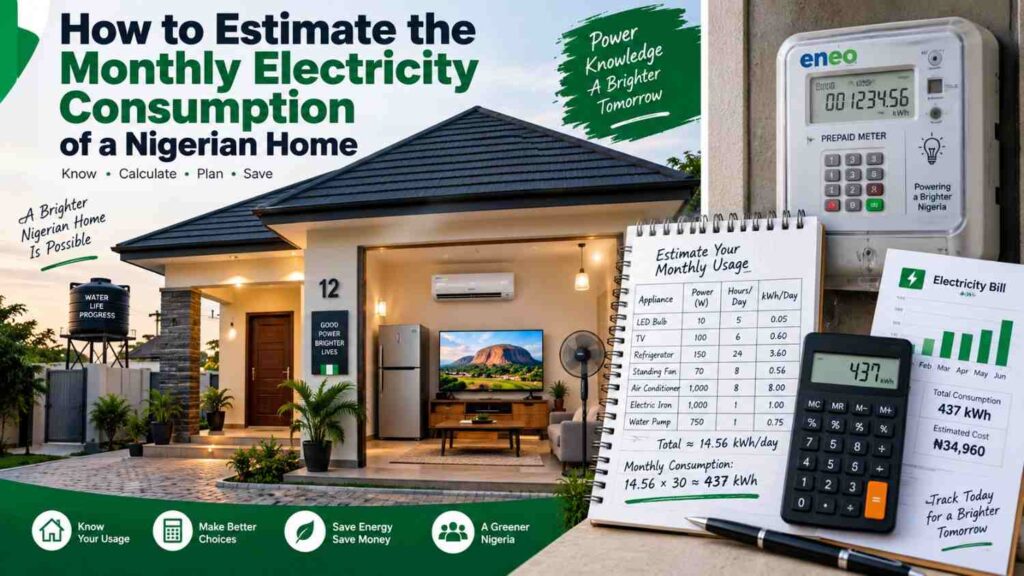
This article walks through a practical, step-by-step method for estimating monthly electricity consumption in a typical Nigerian home, using appliance wattages, hours of use, and a worked example you can adapt to your own house.
Why Estimating Consumption Matters
Knowing your approximate monthly kWh consumption is useful for several practical reasons beyond curiosity. It helps you budget recharge amounts more accurately, it lets you size a generator or solar inverter system correctly instead of guessing, and it gives you a baseline to notice when something unusual, such as a fault or an inefficient appliance, is driving your bills up. It also helps you plan ahead for seasonal changes, since consumption during the hot dry season is typically higher than during cooler months.
The Basic Formula
The starting point for any estimate is a simple formula applied to each appliance: wattage multiplied by hours of use per day, divided by 1000, gives you kilowatt-hours per day for that appliance.
Summing this across all appliances gives your total daily consumption, and multiplying by roughly 30 gives a monthly estimate. This method is the same one used in more detailed form in our appliance electricity consumption calculation article, and it works whether you are estimating for budgeting or for sizing backup power.
Listing Your Appliances and Realistic Hours of Use
The accuracy of your estimate depends entirely on being honest about how long appliances actually run each day, not how long you think they should run. A refrigerator, for example, does not run continuously at full power; its compressor cycles on and off, so a realistic estimate uses effective running hours rather than 24 hours of full wattage. Walk through your home room by room and note every appliance, its approximate wattage (often printed on a label or nameplate), and a realistic daily usage estimate.
A Worked Example for a Typical Nigerian Household
The table below shows a worked estimate for a modest household with common appliances, to illustrate how the numbers add up.
| Appliance | Wattage | Hours/Day | Daily kWh |
|---|---|---|---|
| Refrigerator | 150W | 8 (effective) | 1.2 |
| Ceiling fans (x3) | 75W each | 6 | 1.35 |
| LED bulbs (x8) | 10W each | 5 | 0.4 |
| Television | 120W | 5 | 0.6 |
| Water pump | 750W | 1 | 0.75 |
| Iron (occasional) | 1000W | 0.5 | 0.5 |
| Estimated Total | Approx. 4.8 kWh/day |
At roughly 4.8 kWh per day, this household would consume about 144 kWh in a 30-day month. A household with an air conditioner, a chest freezer, or multiple television sets would naturally see this figure rise significantly, sometimes doubling or tripling the monthly total.
Adjusting for Heavy Loads and Seasonal Variation
Air conditioners and electric water heaters are the biggest single drivers of high consumption in Nigerian homes, often using more electricity per hour than every other appliance in the house combined.
If your household uses these, calculate them separately and add them to your base estimate, and be prepared for your actual consumption to rise noticeably during the hottest months when cooling appliances run longer. It is good practice to build two estimates, one for a typical month and one for a peak-usage month, rather than relying on a single fixed number all year.
Cross-Checking Your Estimate Against Real Meter Data
Once you have a calculated estimate, the most reliable way to validate it is to compare it against your actual prepaid meter consumption over a week or two, a method explained in detail in our dedicated meter reading article.
If your tracked daily average is significantly higher than your calculated estimate, you may have appliances running longer than assumed, an inefficient older appliance, or a wiring issue worth investigating.
Using Your Estimate for Planning
A reliable monthly consumption figure becomes genuinely useful once you apply it to decisions. It lets you calculate roughly how much a recharge token needs to cover, it allows you to size a solar or inverter backup system that matches your real needs rather than an oversized and expensive system, and it gives you a factual basis for comparing electricity costs against alternatives like a generator, a topic covered further in our generators versus solar inverters article.
Common Misconceptions
- “An appliance’s nameplate wattage is what it always draws.” Many appliances, especially those with compressors like refrigerators and air conditioners, cycle on and off, so actual average draw is usually well below the nameplate figure.
- “Estimating consumption requires expensive equipment.” A basic wattage list combined with realistic hours of use and a pen and paper is enough to produce a useful estimate.
- “Every household in Nigeria uses roughly the same amount of electricity.” Consumption varies enormously based on appliance mix, household size, and whether cooling appliances like air conditioners are in use.
Frequently Asked Questions
How accurate is a manual wattage-based estimate compared to actual meter readings?
A careful manual estimate is usually within a reasonable range of actual readings, though real data from tracking your meter over time will always be more precise.
What is the biggest single factor that increases monthly consumption in Nigerian homes?
Air conditioning and electric water heating are typically the largest single contributors, often exceeding the combined consumption of all other household appliances.
Should I estimate consumption differently for the rainy season versus the dry season?
Yes, cooling and pumping loads generally rise during the hotter dry season, so it is useful to calculate a separate peak estimate for that period.
Final Thoughts
Estimating your monthly electricity consumption is a straightforward exercise once you break it down appliance by appliance, and the effort pays off in better budgeting, smarter backup power decisions, and an early warning system for unusual increases.
Start with a simple wattage and hours-of-use list, validate it against your actual prepaid meter data, and revisit the estimate whenever your household’s appliance mix changes. With this habit in place, electricity costs become predictable rather than a recurring source of surprise.