Flipping a light switch feels instantaneous and simple, but the electricity actually powering that light travels through a genuinely elaborate journey from its point of generation to your home.
This article traces that complete path step by step.
Stage One: Generation
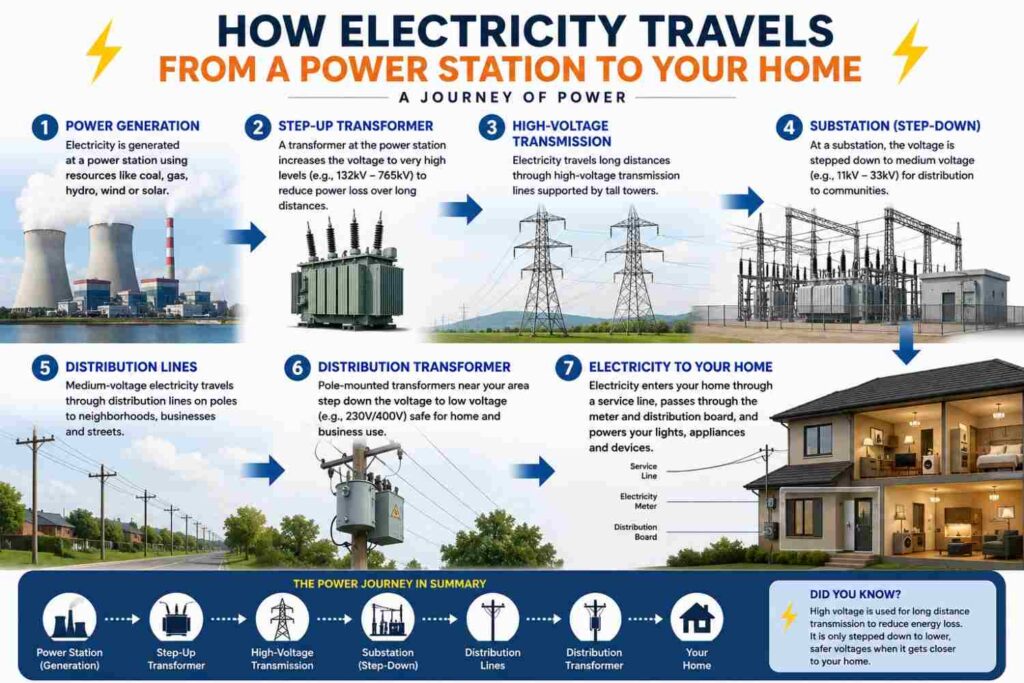
Electricity generation begins at power stations, whether gas-fired thermal plants, hydroelectric dams, or increasingly solar and other renewable sources, discussed throughout our solar energy articles, where mechanical or chemical energy is converted into electrical energy, typically produced at a relatively moderate voltage suited to the generator equipment itself.
Stage Two: Step-Up at the Generating Station
Before entering the transmission network, electricity is stepped up to very high transmission voltage through transformers at the generating station, discussed in our dedicated high-voltage transmission article, since transmitting at high voltage significantly reduces the energy losses that would otherwise occur carrying power over long transmission distances.
Stage Three: Long-Distance Transmission
High-voltage transmission lines, discussed in depth in our transmission versus distribution article, carry electricity often hundreds of kilometers from generating stations to major substations near population centers, using tall towers and specialized conductors specifically built for this efficient, long-distance bulk power transport role.
Stage Four: Step-Down at Substations
At substations, transformers step voltage back down from transmission levels to distribution-level voltage, preparing power for the local distribution network that will ultimately deliver it to individual consumers rather than remaining at the dangerously high voltage needed for efficient long-distance transport.
Stage Five: Local Distribution
| Stage | Typical Voltage in Nigeria |
|---|---|
| Generation | Varies by generator type (often 11-33kV) |
| Transmission | 132kV or 330kV |
| Primary distribution | 11kV or 33kV |
| Final delivery to homes | 415V (three-phase) / 230V (single-phase) |
Distribution lines carry this lower-voltage power through neighborhood networks, ultimately reaching local distribution transformers, discussed in our dedicated transformer articles, mounted on poles or in ground-level installations near groups of homes and businesses.
Stage Six: Final Step-Down and Delivery to Your Home
The local distribution transformer performs one final voltage step-down to the standard household voltage, after which service lines carry this final, usable voltage directly to your home’s electrical connection point, through your prepaid meter, discussed in our dedicated prepaid meter article, and into your home’s internal wiring system.
Why This Multi-Stage Journey Happens So Quickly
Despite this seemingly elaborate multi-stage journey, generation, transmission, step-down, distribution, and final delivery, electricity travels at close to the speed of light through conductors, meaning this entire path from generating station to your light switch effectively happens instantaneously from a practical, everyday perspective, even though the infrastructure spans potentially hundreds of kilometers.
Where Metering Fits Into This Journey
Your prepaid meter, discussed in depth in our dedicated prepaid metering article, sits at the very end of this journey, measuring actual energy consumption as it flows from the final distribution transformer into your home’s internal wiring, making it the specific point where this entire multi-stage generation-to-delivery journey becomes something you directly experience and pay for, rather than an abstract infrastructure process happening entirely out of view.
Common Misconceptions
- “Electricity travels directly from the power station to your home without intermediate steps.” It passes through multiple voltage transformation and transmission stages before final delivery.
- “The voltage used in your home is the same voltage generated at the power station.” Voltage is transformed multiple times, stepped up for transmission, then stepped down twice, for distribution and final household use.
- “This journey takes a noticeable amount of time given the distances involved.” Given electricity’s near-light-speed travel through conductors, the entire journey is effectively instantaneous in practical terms.
Frequently Asked Questions
Why can’t electricity be transmitted at the final household voltage directly from the power station?
Transmitting at household-level voltage over long distances would cause enormous energy losses and require impractically massive conductors, making the high-voltage transmission approach genuinely necessary for efficient long-distance power delivery.
Does this journey differ for homes using solar power or generators?
Solar and generator power, discussed throughout our solar and generator articles, typically bypasses much of this grid journey for the specific loads they serve, though grid-tied systems still interact with this broader infrastructure in various ways.
How many total voltage transformations does electricity typically undergo in Nigeria’s system?
Typically three to four transformations, step-up at generation, step-down at primary substations, and final step-down at the local distribution transformer before reaching your home.
Final Thoughts
Electricity travels through a genuinely elaborate multi-stage journey from generation through transmission, multiple voltage transformations, and local distribution before finally reaching your home, all happening at near-instantaneous speed despite the infrastructure spanning potentially vast distances. Understanding this complete path provides valuable context for appreciating the substantial infrastructure investment underlying something as seemingly simple as flipping a light switch.