
If your generator or inverter hums louder than usual, your transformer feels unusually warm, or certain electronic devices behave erratically even though the voltage reading looks normal, electrical harmonics may be the hidden culprit.
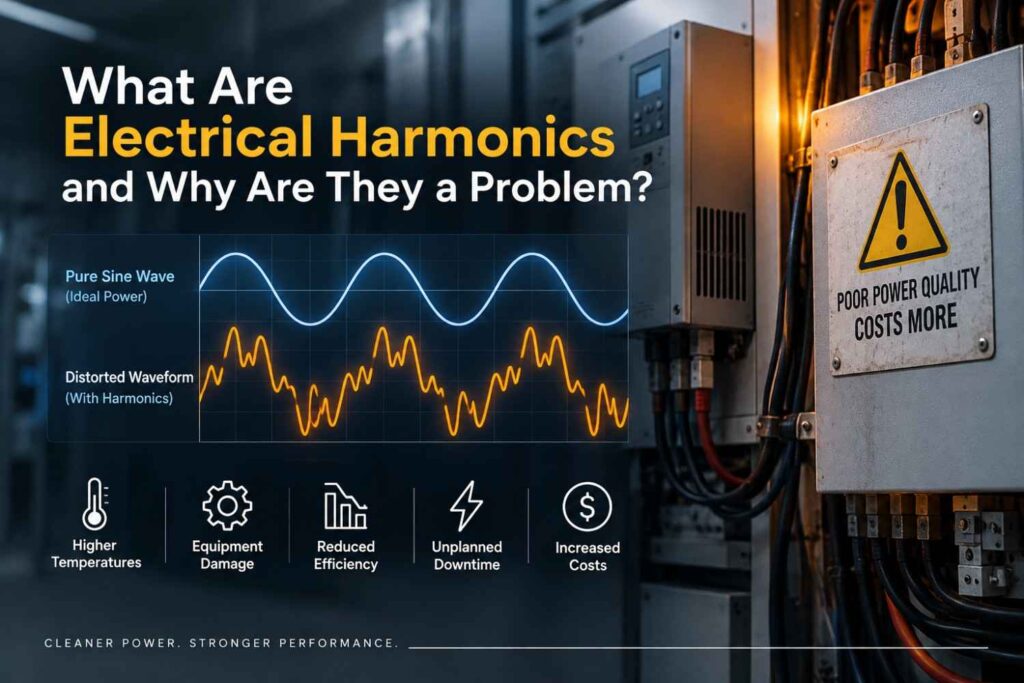
Harmonics are a less obvious power quality problem than outages or surges, but they quietly stress equipment, waste energy, and shorten the lifespan of transformers and motors.
This article explains what harmonics are, where they come from, and why they matter for anyone running sensitive or industrial equipment in Nigeria.
What Are Electrical Harmonics
In a healthy electrical system, voltage and current follow a clean, smooth sine wave at a fixed frequency, 50Hz in Nigeria’s grid. Harmonics are additional waveforms at multiples of that fundamental frequency, such as 100Hz, 150Hz, or 250Hz, that get superimposed on the clean sine wave, distorting its shape. Instead of a smooth curve, the resulting waveform becomes jagged or irregular, and this distortion is what electrical engineers refer to as harmonic distortion. The more harmonics present, and the larger their magnitude relative to the fundamental wave, the more distorted and problematic the power supply becomes.
What Causes Harmonics in an Electrical System
Harmonics are almost always produced by non-linear loads, meaning equipment that does not draw current in a smooth, proportional way relative to the applied voltage.
- Switch-mode power supplies used in computers, phone chargers, LED drivers, and modern televisions.
- Variable frequency drives used to control motor speed in pumps, fans, and industrial machinery.
- Fluorescent and LED lighting with electronic ballasts or drivers.
- Inverters and UPS systems, particularly older or lower quality units.
- Welding machines and other equipment using rectifiers or thyristor-based controls.
As more homes and businesses in Nigeria shift toward inverter systems, solar installations, and LED lighting to cope with unreliable grid supply, the overall harmonic content on many local networks has actually increased, since these very technologies are common sources of harmonic distortion.
Why Harmonics Are a Problem
Harmonics cause several practical problems that are not always immediately obvious. They generate extra heat in transformers and cables because the additional frequencies force conductors and windings to carry current they were not originally designed for, a stress on transformers explored further in our dedicated transformer article. They can cause neutral conductors in three-phase systems to carry unexpectedly high current, even when individual phases appear balanced, sometimes overheating a neutral wire that was sized assuming it would carry very little current. Harmonics also interfere with sensitive electronic equipment, causing malfunctions, inaccurate readings on some metering equipment, and increased audible noise or vibration in motors and transformers.
Common Symptoms of Harmonic Problems
| Symptom | Likely Explanation |
|---|---|
| Transformer or motor running unusually hot | Extra heating from harmonic currents |
| Neutral cable warmer than the phase cables | Triplen harmonics adding up on the neutral |
| Audible humming or buzzing from equipment | Harmonic-induced vibration |
| Nuisance tripping of circuit breakers | Harmonic currents exceeding expected levels |
| Inaccurate readings on some analog meters | Distorted waveform confusing the measurement |
How Harmonics Are Measured and Managed
Engineers quantify harmonic distortion using a figure called Total Harmonic Distortion, or THD, expressed as a percentage that compares the combined strength of the harmonic frequencies to the fundamental frequency. Most standards recommend keeping voltage THD below about 5 percent for general equipment to operate reliably. Measuring THD requires a power quality analyzer rather than a standard multimeter, since ordinary meters cannot distinguish a distorted waveform from a clean one.
- Identify major non-linear loads on the system, such as variable frequency drives or large inverter banks.
- Measure THD at key points using a power quality analyzer.
- Install harmonic filters where distortion exceeds acceptable levels, particularly near large non-linear loads.
- Size neutral conductors generously in three-phase systems with significant single-phase non-linear loads.
- Use isolation transformers or line reactors for particularly sensitive or particularly troublesome equipment.
Harmonics and the Nigerian Power Context
Because grid supply in many parts of Nigeria is already unstable, with frequent voltage drops and surges as discussed in our related power quality articles, many homes and businesses have added generators, inverters, and solar systems as backup. While these solve the outage problem, cheaper or older inverter and generator units, especially those without proper AVR and pure sine wave output, can introduce significant harmonic distortion into the very equipment they are meant to protect. This is one reason engineers generally recommend pure sine wave inverters over modified sine wave types for homes with sensitive electronics or motor-driven appliances.
Common Misconceptions
- “If the voltage reading looks normal, harmonics are not a problem.” A standard voltmeter cannot detect waveform distortion; harmonics can be significant even when the voltage magnitude reads within normal range.
- “Harmonics only matter for large industrial factories.” Homes with multiple inverters, solar systems, and LED lighting can also experience meaningful harmonic distortion, particularly on the neutral conductor.
- “A stabilizer removes harmonics from the supply.” A standard voltage stabilizer regulates voltage magnitude but does not correct waveform distortion; dedicated harmonic filters are needed for that.
Frequently Asked Questions
Can harmonics actually damage equipment, or are they just an inefficiency?
Harmonics can cause real damage over time, primarily through excess heating in transformers, motors, and cables, which accelerates insulation breakdown and shortens equipment lifespan.
How do I know if my building has a harmonics problem?
Warning signs include unusually warm neutral cables, humming transformers or motors, and nuisance breaker trips; a definitive answer requires testing with a power quality analyzer by a qualified technician.
Do LED bulbs cause harmonics?
Yes, most LED bulbs use electronic drivers that draw current in a non-linear way, making them a minor but widespread source of harmonics, though a single bulb contributes very little compared to larger equipment like variable frequency drives.
Final Thoughts
Electrical harmonics are an invisible but real power quality issue that becomes more relevant as Nigerian homes and businesses adopt more electronic and inverter-based equipment to cope with grid instability.
Left unaddressed, harmonics quietly overheat transformers, stress neutral conductors, and shorten the working life of motors and sensitive electronics, even when everything appears to be running normally on the surface.
Investing in quality pure sine wave inverters, properly sized neutral conductors, and periodic power quality checks for larger installations goes a long way toward keeping harmonic-related damage to a minimum.