
If you have ever bought an appliance from the United States and wondered why the box carries a small warning about “60Hz,” or noticed that your generator’s display shows a frequency reading alongside voltage, you have already brushed up against one of the more overlooked but fundamental properties of electricity: frequency.
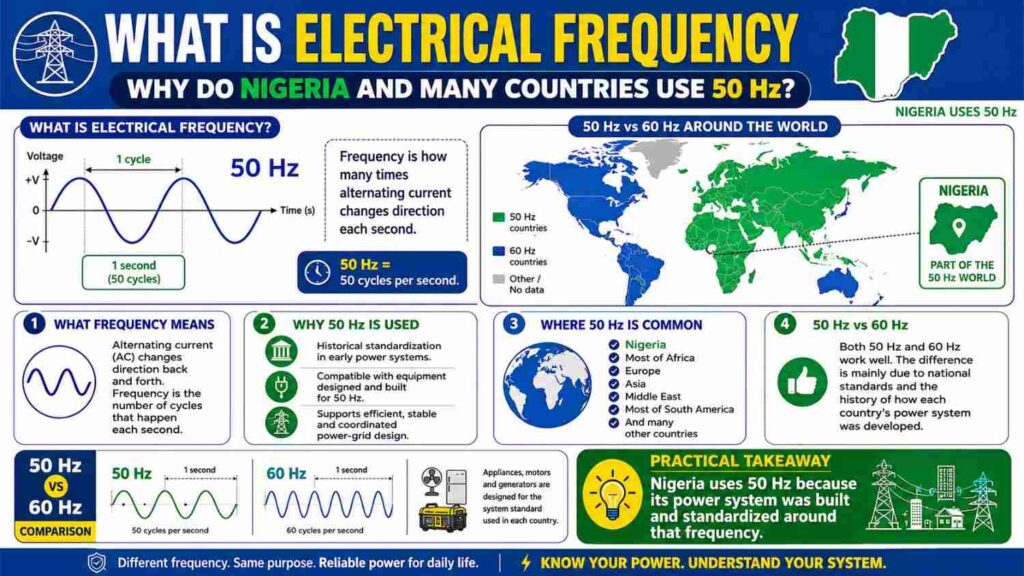
This article explains exactly what electrical frequency is, why alternating current has a frequency at all, why Nigeria and most of the world settled on 50Hz while a few countries use 60Hz, and why this number matters far more than most people realize.
What Is Electrical Frequency?
Electrical frequency, measured in hertz (Hz), describes how many complete cycles an alternating current (AC) waveform completes every second. In an AC system, voltage and current do not flow steadily in one direction like a battery’s DC output; instead, they continuously oscillate, rising to a positive peak, falling through zero to a negative peak, and returning to zero, over and over. A frequency of 50Hz means this complete back-and-forth cycle happens exactly 50 times every single second.
This oscillation is a direct result of how AC electricity is generated: inside a generator, a rotating magnet (the rotor) spins past stationary coils of wire (the stator), and as it rotates, it induces a voltage that naturally rises and falls in a smooth wave pattern, called a sine wave, matching the physical rotation of the generator.
Why Generators Produce a Fixed Frequency
The frequency of the electricity a generator produces is directly tied to its physical rotational speed and the number of magnetic poles built into its design, following the formula:
Frequency (Hz) = (Number of Poles × Rotational Speed in RPM) ÷ 120
For example, a two-pole generator needs to spin at exactly 3,000 RPM to produce 50Hz, while a four-pole generator achieves the same 50Hz at 1,500 RPM. This is precisely why maintaining a generator’s rotational speed is so critical to grid stability: any deviation in speed directly changes the frequency being produced, which is why large power stations use sophisticated governor and control systems to keep turbine speed, and therefore frequency, tightly regulated.
Why 50Hz? A Brief History
The choice between 50Hz and 60Hz traces back to the early decades of electrification in the late 1800s and early 1900s, when different regions and equipment manufacturers experimented with various frequencies before settling on standards. Europe largely converged on 50Hz, partly influenced by early German engineering standards (AEG, a dominant early electrical manufacturer, adopted 50Hz for practical reasons related to their generator and lighting equipment designs). As British and European colonial and trade influence spread, many countries in Africa, Asia and elsewhere, including Nigeria, adopted the 50Hz standard used by the equipment and expertise available to them at the time.
The United States, meanwhile, developed largely around 60Hz, influenced heavily by Westinghouse and the early American electrical industry’s own engineering choices. Once a country’s grid, generators and appliance manufacturing base became built around one frequency, switching later became prohibitively expensive and disruptive, which is why these regional differences have persisted for over a century.
50Hz vs 60Hz: What’s the Practical Difference?
| Feature | 50Hz Systems | 60Hz Systems |
|---|---|---|
| Common regions | Europe, Africa, most of Asia, Australia | North America, parts of South America, parts of Asia |
| Generator speed (2-pole) | 3,000 RPM | 3,600 RPM |
| Motor speed (typical) | Slightly slower | Slightly faster |
| Transformer/core size | Slightly larger for same rating | Slightly smaller for same rating |
For most everyday appliances like phone chargers, laptops and modern electronics with switch-mode power supplies, frequency differences are handled automatically and cause no issues. However, equipment with simple, frequency-dependent motors, older audio equipment, and certain clocks or timers can behave differently or run at the wrong speed if used on the wrong frequency without proper conversion equipment.
Why Frequency Stability Matters So Much
Maintaining a stable frequency close to the nominal 50Hz value is one of the most important jobs of grid operators like Nigeria’s Transmission Company of Nigeria (TCN), for several critical reasons:
- Generator synchronization: All generators feeding into a shared grid must run at the same frequency and be precisely synchronized in phase with each other; even a small frequency mismatch can cause damaging power surges between generators.
- Grid balance indicator: Frequency is a real-time indicator of the balance between electricity supply and demand across the entire grid. When demand exceeds generation, frequency tends to drop; when generation exceeds demand, frequency tends to rise.
- Equipment protection: Many industrial and grid-connected devices include frequency protection relays that automatically disconnect if frequency drifts too far outside acceptable limits, protecting equipment from damage.
- Motor speed consistency: Since many industrial motors run at a speed directly tied to supply frequency, frequency instability can cause inconsistent motor speeds in manufacturing processes that depend on precise timing.
Frequency and Grid Collapse in Nigeria
Frequency plays a direct role in the phenomenon of a national grid collapse, a topic covered in more depth in our dedicated article on what causes a nationwide power grid collapse. When a sudden loss of generation capacity occurs (a major power station tripping, for example) without an immediate matching reduction in demand, grid frequency begins to fall rapidly. If operators cannot quickly rebalance supply and demand, cascading protective trips can occur across the network as equipment disconnects to protect itself, potentially leading to a wider or total collapse of the grid. This is one of the key technical reasons grid operators closely monitor frequency in real time as an early warning indicator of developing instability, often taking corrective action, including deliberately shedding some load, well before frequency deviations become severe enough to trigger a wider collapse.
How Frequency Affects Motors and Transformers
Frequency directly affects the design and operation of motors and transformers in several ways. Induction motor speed is directly proportional to supply frequency (following the synchronous speed formula, closely related to the generator frequency formula above), which is why frequency changes can cause motors to run faster or slower than intended. Transformer core design is also frequency-dependent: transformers designed for 60Hz operation, if run at 50Hz instead without adjustment, may experience increased core losses and heating, because the core must handle the magnetic flux for a longer portion of each cycle at the lower frequency. This is one of several reasons imported equipment is not always a simple drop-in replacement across regions with different frequency standards, and why equipment specifications should always be checked carefully before importing generators, motors or transformers designed for a different frequency standard. Engineers and equipment buyers evaluating imported machinery should look specifically for a nameplate frequency rating, and where equipment is only rated for 60Hz, consult the manufacturer or a qualified electrical engineer about whether safe 50Hz operation is possible, rather than assuming compatibility based on voltage rating alone, since voltage and frequency compatibility are separate considerations that must both be checked independently.
How Generators and Inverters Handle Frequency
Modern generators used in Nigerian homes and businesses are designed to produce a stable 50Hz output under normal operating conditions, regulated by a governor system that adjusts fuel supply to maintain constant engine speed regardless of load changes. Inverters, meanwhile, generate their AC output electronically rather than mechanically, using power electronic switching circuits to synthesize a 50Hz sine wave from DC battery power, which is generally more precise and stable in frequency than a mechanical generator, though still dependent on good quality electronic design, discussed further in our dedicated article comparing pure sine wave and modified sine wave inverters.
How Frequency Is Measured and Monitored
Frequency is measured using a frequency meter, which can be a dedicated analog or digital instrument, or a built-in display on generators, UPS systems and modern digital multimeters. Grid operators like TCN monitor frequency continuously across the national network using sophisticated SCADA (Supervisory Control and Data Acquisition) systems, discussed in more depth in our dedicated article on SCADA, which provide real-time visibility into frequency and other key grid parameters across generating stations and substations nationwide. This continuous monitoring allows operators to detect developing imbalances between supply and demand within seconds, well before they become severe enough to threaten grid stability, and to take corrective action such as adjusting generation output or, in more serious situations, coordinating load shedding across specific areas of the network.
Frequency Deviation Limits and Why They Exist
Most grid codes, including standards applicable to Nigeria’s grid, specify an acceptable operating range around the nominal 50Hz value, often something in the order of plus or minus 0.5Hz under normal conditions, with wider emergency tolerances permitted briefly during disturbances before protective actions are triggered. Staying within this narrow band matters because most grid-connected equipment, from industrial motors to sensitive electronic protection relays, is designed and tested to operate correctly only within a specified frequency range. Operating too far outside this range for an extended period can cause motors to run at incorrect speeds, protection systems to behave unpredictably, and in the most severe cases, cascading equipment trips that can escalate a local disturbance into a much wider grid event. This is why frequency, despite being just a single number, is treated by grid engineers as one of the most important real-time health indicators of the entire power system, alongside voltage levels at key points across the network.
Why Some Equipment Includes a Frequency Selector Switch
Certain types of equipment, particularly some industrial machinery, audio equipment, and generators designed for export to multiple markets, include a physical or software frequency selector switch allowing operation on either 50Hz or 60Hz. This is typically achieved through internal design adjustments, such as different transformer tap settings or motor winding configurations, that compensate for the different frequency’s effect on the equipment’s magnetic and mechanical characteristics. When purchasing imported equipment, particularly generators, motors or transformers sourced from a 60Hz market like the United States, checking for proper 50Hz configuration, or confirming the equipment includes genuine dual-frequency support rather than simply being rebadged, is an important step to avoid performance problems or premature equipment failure once installed in Nigeria.
Common Misconceptions
- “Higher frequency always means more power.” Frequency and power are independent quantities; a 60Hz system is not inherently more powerful than a 50Hz system, they are simply different design standards.
- “Frequency differences only matter for imported appliances.” While most modern electronics handle frequency differences transparently, motor-driven equipment, some audio equipment, and precision timing devices can genuinely be affected.
- “A generator’s frequency reading is just for information and doesn’t matter.” Frequency stability is directly tied to how safely and correctly connected equipment operates, and significant deviations can indicate a developing mechanical or load problem with the generator itself.
Frequency’s Role in Renewable Energy Integration
As solar and other renewable energy sources become a larger part of the generation mix in many grids, frequency management takes on an additional layer of complexity. Traditional generators using large spinning turbines naturally provide what engineers call rotational inertia, a physical resistance to sudden frequency changes simply due to the mass and momentum of their spinning components. Solar inverters, by contrast, have no spinning mass and therefore no inherent inertia, meaning a grid with a very high proportion of solar generation relative to traditional spinning generation can, in principle, be more susceptible to rapid frequency swings following a sudden disturbance, unless specifically designed grid-support features are built into the inverter control systems. This is an active area of power systems engineering research and standards development worldwide, and is increasingly relevant as solar adoption continues to grow across Nigeria and other countries seeking to diversify their generation mix away from purely fossil-fuel and hydro sources.
Frequently Asked Questions
Can I use a 60Hz appliance safely in Nigeria’s 50Hz grid?
Many modern electronics with switch-mode power supplies (chargers, laptops, most modern TVs) handle both frequencies without issue, but motor-driven appliances, older equipment, and precision timing devices may run differently or require a frequency converter; always check the appliance’s rating label or manual before assuming compatibility.
Why does my generator’s display show a frequency reading?
It allows you to monitor whether the generator is maintaining a stable 50Hz output, which is an indicator of both correct governor operation and whether the generator is being run within its intended load range.
Does frequency affect my electricity bill?
Not directly; your bill is based on energy consumed in kWh, not frequency. However, poor frequency stability can indirectly affect equipment efficiency and lifespan over time.
What happens if grid frequency drops too low?
Protective systems are typically designed to shed load or disconnect generation in a controlled way to restore balance; in severe cases, uncontrolled frequency collapse can lead to a wider grid collapse, as covered in our dedicated article on that topic.
Why do some countries use 60Hz instead of 50Hz?
Largely due to historical engineering decisions made by early 20th-century electrical equipment manufacturers in different regions, which then became locked in as national infrastructure, manufacturing and appliance standards developed around each respective frequency.
Is 50Hz or 60Hz technically “better”?
Neither is definitively superior; each involves engineering trade-offs (for example, 60Hz systems can use slightly smaller transformer cores for the same power rating, while 50Hz systems have other design advantages), and in practice, both standards work perfectly well within their respective, well-established infrastructure ecosystems.
Why do some clocks and timers run fast or slow on a different frequency?
Older analog clocks and certain simple timer motors are designed to use the AC supply frequency itself as a precise timekeeping reference, counting cycles to track time. Running such a device on a different frequency than it was designed for, without adjustment, will cause it to run measurably fast or slow.
Does solar power generation have a frequency, given that solar panels produce DC?
Solar panels themselves produce DC electricity with no inherent frequency, but the inverter that converts this DC into usable AC for your home or the grid synthesizes an output at the standard 50Hz, synchronized with the grid frequency when operating in grid-tied mode, or generated independently at 50Hz when operating in standalone (off-grid) mode.
Final Thoughts
Electrical frequency might seem like a minor technical detail buried in a generator’s display or a spec sheet, but it is actually a fundamental property tying together how power is generated, how the grid stays balanced, and how motors, transformers and generators are designed. From the two-pole generator spinning at exactly 3,000 RPM in a power station, to the frequency reading quietly displayed on a home generator’s control panel, the same underlying 50Hz standard connects every stage of the journey electricity takes before it reaches your appliances. Understanding why Nigeria and most of the world use 50Hz, and what that number actually represents, offers a genuinely useful window into the deeper mechanics of how modern electrical power systems are built and kept stable every second of every day. It is a quiet, invisible heartbeat running through the entire grid, and keeping it steady at 50 beats per second is one of the most important, if least visible, jobs in the entire electricity supply chain.