
Among electrical hazards, few are as violent and as poorly understood by non-specialists as arc flash. Unlike a simple shock from touching a live wire, an arc flash is an explosive release of energy that can happen in a fraction of a second, producing intense heat, blinding light, and a pressure wave strong enough to injure someone standing several feet away without any direct contact at all.
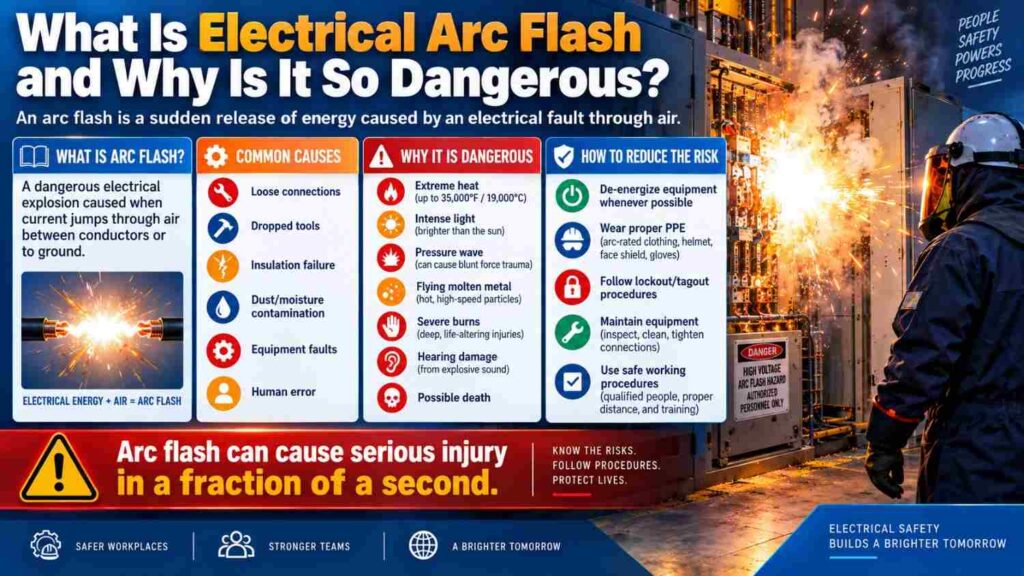
This article explains what causes an arc flash, why it is so dangerous, and how the risk is managed around electrical panels and equipment.
What an Arc Flash Actually Is
An arc flash occurs when electrical current escapes its intended path and flows through the air between two conductors, or between a conductor and earth, instead of through the normal circuit. Air is not naturally a good conductor, but under the right conditions, such as a small gap created by a loose connection, a dropped tool bridging live terminals, or insulation failure, current can ionise the air and form a conductive arc.
Once that arc establishes, it can carry enormous amounts of current, limited mainly by the capacity of the supply rather than any normal circuit resistance, releasing energy far beyond what the same fault would produce as a simple short circuit contained within a conductor.
Why Arc Flash Is So Dangerous
The danger of an arc flash comes from the sheer concentration of energy released in an extremely short time. Temperatures at the arc can exceed several thousand degrees, hotter than the surface of the sun for a brief moment, vaporising nearby metal and producing a blinding flash of light along with a loud, explosive sound.
This rapid vaporisation and expansion of air creates a pressure wave, sometimes called an arc blast, capable of throwing a person backward, rupturing eardrums, or causing severe burns even without direct contact with the arc itself. Molten metal droplets can also be ejected outward, adding a further burn and injury risk to anyone nearby.
Arc Flash vs Ordinary Electric Shock
| Feature | Electric Shock | Arc Flash |
|---|---|---|
| Requires Direct Contact? | Yes, current must pass through the body | No, injury can occur without touching anything live |
| Primary Hazard | Current passing through the body affecting the heart and nerves | Extreme heat, light, pressure wave, and molten material |
| Typical Injury | Internal burns, cardiac disruption, muscle contraction | Severe external burns, hearing damage, blast trauma, eye injury |
| Distance Risk | Limited to the point of contact | Can injure people standing a meter or more away |
Where Arc Flash Risk Is Highest
- Inside distribution boards, panels, and switchgear during maintenance or inspection while the equipment is still energised.
- Around industrial equipment with high fault current availability, such as facilities served directly by three-phase 400V supply or larger transformer connections.
- Any point where tools, meters, or bare conductors could accidentally bridge live terminals, particularly in poorly lit or cluttered electrical rooms.
- Older panels with degraded insulation, loose busbar connections, or signs of the overheating discussed in our dedicated electrical panels overheating article, all of which increase the chance of an arc developing.
How Arc Flash Risk Is Reduced
The most effective way to reduce arc flash risk is to avoid working on energised equipment altogether, which is why proper isolation procedures, covered in our dedicated electrical isolator article, exist in the first place. Whenever equipment absolutely must be inspected or tested while live, trained personnel use specific protective measures, including insulated tools rated for the voltage involved, arc-rated protective clothing, face shields, and maintaining a safe working distance appropriate to the equipment’s fault current level. Well-maintained equipment with tight, corrosion-free connections and correctly rated protective devices also reduces the likelihood of an arc developing in the first place, since many arc flash incidents originate from a fault condition that a healthy, properly protected system would have cleared safely before it escalated.
Why This Matters Beyond Industrial Settings
While arc flash is most commonly discussed in industrial and commercial contexts with high fault currents, the underlying risk exists to some degree wherever there is energised equipment and a possible path for current to jump through air, including household distribution boards, generator control panels, and workshop equipment. Homeowners and small business operators in Nigeria who attempt to inspect or work inside a live panel themselves, perhaps to save the cost of calling an electrician, are taking on a genuine arc flash risk without realising it, particularly around older, poorly maintained boards where loose connections are more likely.
Common Misconceptions
- “Arc flash only happens in large factories, not homes.” Any energised panel with a fault condition, including a household distribution board, can produce an arc flash under the right circumstances.
- “You have to touch a live wire for an arc flash to hurt you.” An arc flash can injure people standing nearby through heat, light, pressure, and flying molten material, without any direct contact.
- “Rubber gloves alone are enough protection when working near live panels.” Proper arc flash protection requires assessing the specific fault energy involved and using appropriately rated protective equipment, not just basic insulated gloves.
Frequently Asked Questions
Can an arc flash happen without any warning?
Yes, an arc flash typically occurs suddenly and without warning once the triggering fault condition occurs, which is why prevention through proper maintenance and isolation matters more than trying to react in the moment.
Is arc flash risk higher on three-phase systems than single-phase?
Generally yes, because three-phase systems, common in commercial and industrial settings running at 400V, typically have higher available fault current, which increases the potential energy released in an arc.
Should I ever open my distribution board myself while it’s live?
No, opening a live panel should only be done by a qualified electrician using appropriate precautions; for routine inspection, the board should be isolated first wherever possible.
Final Thoughts
Arc flash is a hazard that many people never think about until it happens, precisely because it does not require the direct contact people associate with electric shock, striking suddenly with heat, light, and force that can injure anyone standing nearby.
Understanding what causes it, faults bridging conductors through air, explains why proper maintenance, correct isolation procedures, and professional handling of live equipment matter so much.
This is not a risk to manage through caution alone; it requires trained personnel, the right protective equipment, and well-maintained electrical systems. Anyone dealing with a distribution board or panel that shows signs of damage, overheating, or age should have it assessed by a qualified electrician rather than opening it up themselves.