
Control systems engineering, focused on designing systems that automatically regulate and manage the behavior of other systems, underlies an enormous range of modern technology, from industrial manufacturing to automotive systems to household appliances, making it one of the most broadly applicable electrical engineering specializations. This article covers what this career genuinely involves.
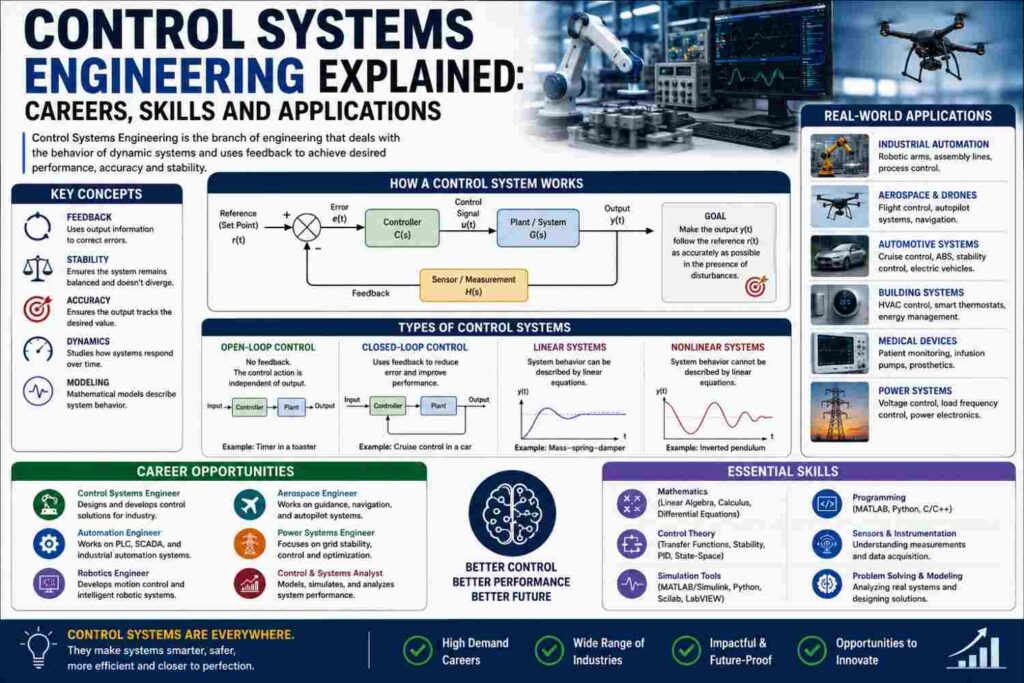
What Control Systems Engineers Actually Do
Control systems engineers design the feedback mechanisms and algorithms that allow systems to automatically maintain desired behavior despite disturbances and changing conditions, spanning industrial process control (maintaining temperature, pressure, or flow rate in manufacturing processes), robotics and automation, automotive control systems, and increasingly, control aspects of renewable energy systems and smart grid technology.
Core Technical Concepts This Field Genuinely Requires
Genuine competency in control systems requires solid understanding of feedback loop principles, transfer function analysis, stability theory, and controller design techniques (PID control and more advanced approaches), alongside genuine proficiency in MATLAB and Simulink, discussed in our dedicated software articles, for modeling, simulation, and controller design work.
The Mathematical Foundation Behind Control Systems
Control systems engineering involves genuinely significant mathematical modeling, differential equations, Laplace transforms, and frequency domain analysis, making strong mathematical foundations particularly important for this specialization compared to some more hands-on, hardware-focused electrical engineering paths, though this theoretical foundation directly enables genuinely practical, real-world system design.
Where Control Systems Engineers Actually Work
| Industry Sector | Typical Control Systems Applications |
|---|---|
| Manufacturing/industrial automation | Process control, robotics, PLC-based systems |
| Oil and gas | Process control, safety instrumented systems |
| Power systems | Grid control, generator control systems |
| Automotive | Engine control, increasingly electric vehicle systems |
| Aerospace | Flight control systems, guidance systems |
| Renewable energy | Solar inverter control, wind turbine control systems |
The Genuine Overlap With PLC Programming and Industrial Automation
Much practical control systems work in industrial settings involves implementing control algorithms through PLC programming, discussed in depth in our dedicated PLC beginner’s article, making genuine PLC competency a practically important complement to theoretical control systems knowledge for students interested in industrial applications specifically, rather than purely academic or research-oriented control systems careers.
How to Build Genuine Competency in This Specialization
- Master the theoretical foundations genuinely, transfer functions, stability analysis, and controller design principles, rather than simply memorizing formulas for exams.
- Build hands-on MATLAB/Simulink proficiency, applying theoretical concepts to actual modeling and simulation exercises.
- Seek practical PLC exposure if interested in industrial automation applications specifically.
- Pursue relevant internship or SIWES placements, discussed in our dedicated articles on both, in industries with genuine control systems needs.
- Work through real, practical control design problems beyond textbook exercises, ideally including physical or simulated systems you can actually test and observe.
Why This Specialization Increasingly Intersects With Software and Programming
Modern control systems implementation increasingly involves genuine software and programming skills, beyond PLC programming specifically, including embedded systems programming and increasingly, machine learning approaches to control problems, making broader programming competency, discussed in our dedicated skills article, a genuinely valuable complement to traditional control theory knowledge.
The Growing Role of Machine Learning in Modern Control Systems
Traditional control theory is increasingly complemented by machine learning-based approaches for complex systems where classical modeling proves difficult, an emerging area worth genuine awareness even for students focused primarily on classical control methods, since this intersection between control systems and data-driven approaches represents a genuinely growing direction within the broader field, particularly relevant for students interested in robotics or autonomous systems specifically.
Building a Portfolio of Control Systems Projects Worth Discussing
Beyond coursework alone, deliberately building a small portfolio of genuine control systems projects, a simple temperature or motor speed controller simulated in Simulink, a basic PID tuning exercise worked through independently, or a small PLC-based automation project, gives you concrete, specific material to discuss in internship and job interviews, distinguishing you from candidates who can only describe control theory in general textbook terms rather than demonstrating genuine, hands-on applied understanding.
Common Misconceptions
- “Control systems engineering is purely theoretical with limited practical, hands-on application.” The field has enormous genuine practical application across manufacturing, automotive, aerospace, and energy industries.
- “This specialization only applies to large-scale industrial systems.” Control systems principles apply across scales, from household appliance control to large industrial processes to aerospace systems.
- “Strong programming skills aren’t necessary if you understand the underlying control theory.” Practical implementation increasingly requires genuine programming competency alongside theoretical understanding.
Frequently Asked Questions
Is control systems engineering a good fit for students who enjoy mathematics specifically?
Yes, this specialization genuinely rewards strong mathematical aptitude and interest, given its significant reliance on differential equations, transfer function analysis, and related mathematical concepts, more so than some other electrical engineering specializations.
How does control systems engineering differ from instrumentation engineering?
While closely related and often overlapping in practice, control systems engineering focuses more on the algorithms and logic governing system behavior, while instrumentation engineering focuses more specifically on the sensors and measurement systems that feed information into those control systems.
What genuinely distinguishes a strong control systems engineering candidate to employers?
Demonstrated ability to apply theoretical control concepts to real, practical problems, through project experience, internships, or personal projects, generally matters more to employers than theoretical knowledge alone without practical application experience.
Final Thoughts
Control systems engineering offers a genuinely broad, mathematically rich specialization with substantial practical application across manufacturing, automotive, aerospace, and energy industries. Building genuine competency requires combining strong theoretical foundations with hands-on simulation and, where relevant, PLC programming skills, positioning students well for a specialization with consistently strong, diverse career opportunities.