
A multimeter is a genuinely safe tool when used correctly, but a handful of common mistakes account for the vast majority of blown fuses, damaged meters, and, far more seriously, injuries reported by beginners and even experienced users who get complacent.
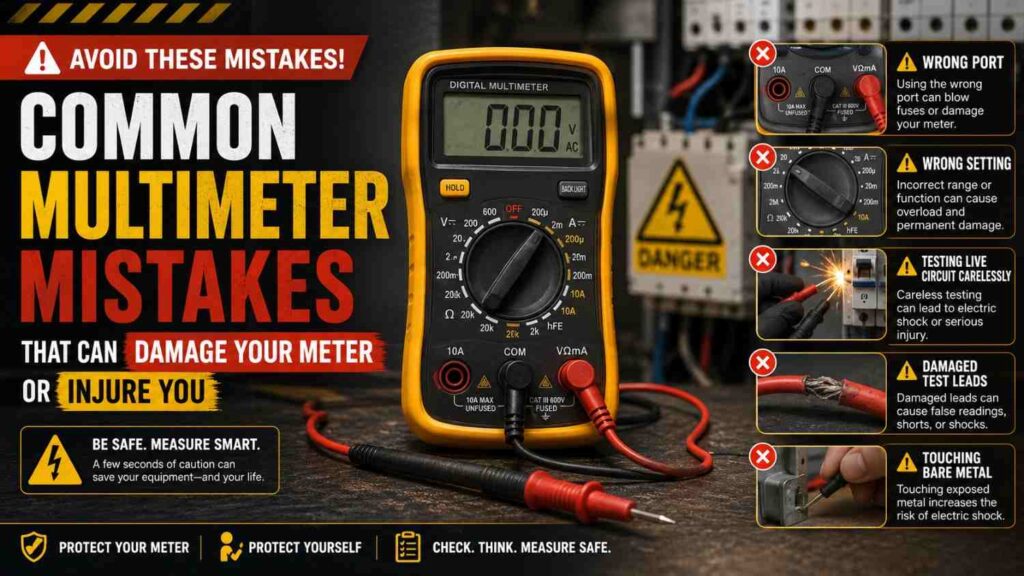
This article walks through the mistakes that cause the most damage and the most danger, so you can recognize and avoid every one of them.
Mistake 1: Using the Wrong Port for the Measurement
Most multimeter damage happens when the red probe is left in the current (A or mA) port while the dial is switched to measure voltage, then touched across a voltage source. Because the current port has very low internal resistance, this effectively creates a short circuit through the meter, instantly blowing its internal fuse and, on cheaper meters without adequate fusing, potentially damaging the meter permanently or even causing a small explosion inside the device. Always double-check probe placement matches your selected function before touching any live circuit, as detailed in our dedicated multimeter beginner’s guide.
Mistake 2: Measuring Resistance or Continuity on a Live Circuit
Resistance and continuity modes work by sending a small test current from the meter’s own internal battery through the circuit being tested, and this function assumes there is no external voltage already present. Testing continuity or resistance on an energized circuit can send unexpected current back into the meter, damaging its internal circuitry and giving completely unreliable readings in the process. Always confirm a circuit is fully de-energized, using the voltage test itself, before switching to resistance or continuity mode, a sequence explained further in our dedicated continuity testing article.
Mistake 3: Using an Inadequately Rated Meter on Mains or Higher Voltage
Multimeters carry CAT (category) safety ratings that indicate how much transient overvoltage they can safely withstand at different points in an electrical system, and using an uncategorized or low-rated meter on a household distribution board or three-phase supply is a genuine safety risk, not just a technicality. A cheap meter without adequate CAT III rating can fail catastrophically, sometimes explosively, if it encounters a voltage transient it wasn’t built to handle, which is exactly the scenario household distribution panels and industrial equipment can produce.
Mistake 4: Ignoring a Blown Internal Fuse
When a meter suddenly stops reading current correctly, or shows zero on a circuit you know is live, a blown internal fuse inside the meter itself is a common and overlooked cause. Continuing to use the meter without addressing this, or worse, bypassing the fuse entirely with a wire jumper as some people mistakenly do, removes a critical safety protection and turns the meter itself into a hazard during any future overload.
Mistake 5: Poor Probe and Body Positioning
Touching the metal tips of the probes while they remain in contact with a live circuit, or bridging both probes across your own body accidentally while working in a cramped panel, are surprisingly common causes of shock injuries. Keeping one hand behind your back or in your pocket while testing live circuits, holding probes only by their insulated grips, and never working alone on live circuits when it can be avoided are basic habits that meaningfully reduce risk.
A Quick Pre-Measurement Safety Checklist
- Confirm the dial setting matches what you actually intend to measure.
- Confirm the red probe is in the correct port for that function.
- Confirm the circuit is de-energized before switching to resistance or continuity mode.
- Confirm your meter’s CAT rating is adequate for the voltage and location being tested.
- Confirm probes, leads, and the meter casing show no visible cracks or damage.
- Keep one hand clear of grounded surfaces while testing live circuits.
Common Mistakes and Their Consequences at a Glance
| Mistake | Typical Consequence |
|---|---|
| Red probe left in current port during voltage test | Blown internal fuse, possible meter damage |
| Testing resistance/continuity on a live circuit | Unreliable readings, potential internal damage |
| Using an uncategorized meter on mains/panel work | Risk of meter failure and injury during a transient |
| Touching probe tips while measuring live voltage | Risk of electric shock |
| Ignoring a blown internal fuse or bypassing it | Loss of meter’s built-in overload protection |
Mistake 6: Skipping the Meter’s Own Self-Check
Experienced technicians routinely verify their meter is functioning correctly before relying on a reading, such as briefly touching the probes together on continuity mode to confirm a beep, or testing a known live source before assuming a “no voltage” reading means a circuit is truly dead. Skipping this habit means a silently failed meter, whether from a dead internal battery or a blown fuse, can give a dangerously false sense of safety, particularly relevant to the non-contact and voltage testing habits covered in our dedicated live-wire testing article.
Common Misconceptions
- “A blown fuse inside the meter means the meter is permanently broken.” Most multimeters use a simple, inexpensive replaceable fuse that restores full function once swapped for a new one of the correct rating.
- “Any digital multimeter is safe to use on any electrical panel.” Only meters with an adequate CAT rating for that specific voltage level and location should be used, since ratings vary significantly between models and price points.
- “Mistakes with a multimeter mainly just damage the meter, not the user.” Incorrect setup or careless probe handling on a live circuit can cause genuine electric shock injury, not merely equipment damage.
Frequently Asked Questions
How do I know if my multimeter’s internal fuse has blown?
A meter that reads zero current on a circuit you know is carrying current, despite correct setup, is the clearest sign; most meters also have a continuity check across the fuse holder if you open the case to inspect it directly.
Is it safe to use a cheap, unbranded multimeter for household electrical work?
Only if it carries a genuine, adequate CAT safety rating for the work involved; price alone is not a reliable indicator, and some inexpensive meters simply lack proper internal protection entirely.
What is the single most important habit to prevent multimeter mistakes?
Pausing to consciously confirm the dial setting and probe port placement match your intended measurement before every single use is the habit that prevents the majority of common mistakes.
Final Thoughts
Almost every multimeter mistake that damages a meter or injures a person traces back to a rushed setup step or a skipped safety habit, not a fundamentally difficult task. Building the simple checklist habits covered here, correct port, correct setting, de-energized circuit for resistance testing, and an adequately rated meter, turns a multimeter from a risky tool into one of the safest and most reliable instruments in your toolbox. Slow down on setup every single time, and the tool will serve you reliably for years without incident.