
Walk into any electrical tools shop in Nigeria and you will find both clamp meters and multimeters sitting side by side, often at similar prices, which leaves many buyers unsure which one they actually need. Both instruments measure electrical quantities, but they are built for different jobs, and understanding the difference will save you money and frustration.
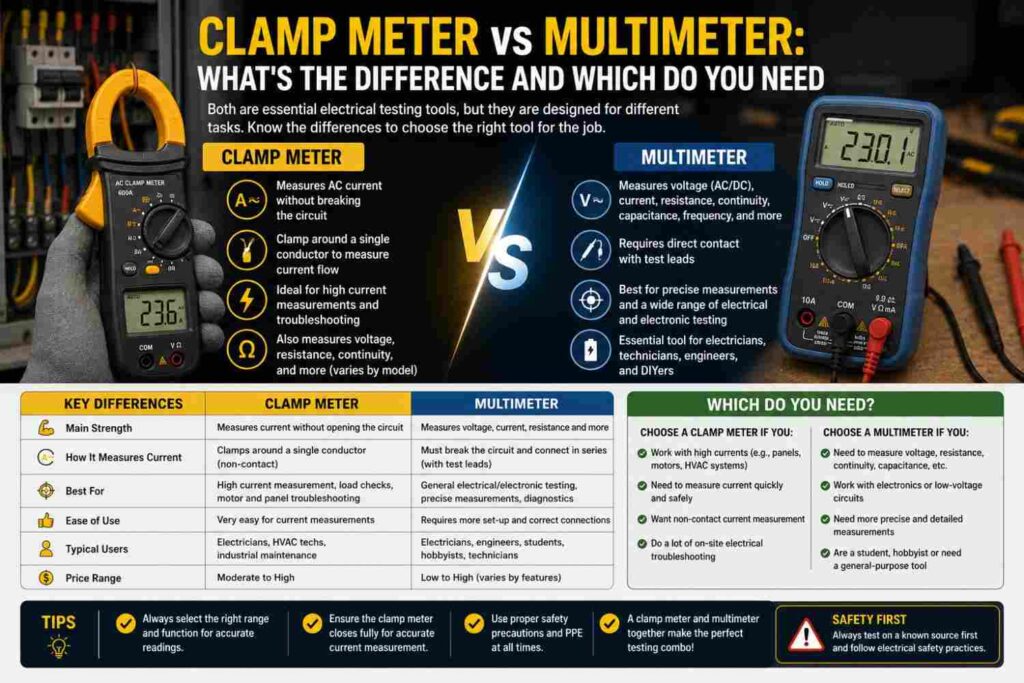
This article compares the two directly and helps you decide which belongs in your toolbox, or whether you need both.
What a Multimeter Is Built For
A multimeter is a general-purpose testing instrument that measures voltage, resistance, and continuity extremely well, and can measure current too, but only by breaking the circuit open and connecting the meter in series, as explained in our dedicated multimeter beginner’s guide. This makes it the right tool for diagnosing faults, checking whether a socket is live, testing a fuse, or confirming a wire has continuity. It is compact, affordable, and versatile, but current measurement with it is slower and riskier because you must physically interrupt the circuit.
What a Clamp Meter Is Built For
A clamp meter is designed around one main advantage: it measures current without touching the conductor directly or breaking the circuit at all. Its jaw opens, clamps around a single live wire, and reads the current flowing through it by sensing the magnetic field the current produces. This makes it dramatically faster and safer for checking how much current a generator, air conditioner, motor, or entire distribution panel is drawing, since you never need to disconnect anything.
Why the Clamping Method Matters
Because the clamp meter reads current through induction rather than direct contact, it is especially valuable for higher-current work, such as checking the load on a three-phase supply feeding a workshop, or measuring how much current your generator or inverter system is delivering under real load. Nigerian technicians working on 400V/415V three-phase installations rely heavily on clamp meters for exactly this reason, since opening a live three-phase circuit to insert a meter in series would be far more dangerous and impractical.
Side-by-Side Comparison
| Feature | Multimeter | Clamp Meter |
|---|---|---|
| Voltage measurement | Yes, precise and standard | Basic on most models, some none |
| Resistance/continuity | Yes | Usually yes on combo models |
| Current measurement method | In-series (circuit must be opened) | Clamp around wire, no contact needed |
| Best for high current jobs | Not ideal, awkward and risky | Excellent, fast, and safer |
| Typical Nigerian price range | 5,000 – 25,000 naira | 10,000 – 45,000 naira |
Situations Where You Genuinely Need Both
Most working technicians eventually carry both instruments, because they solve different problems. Use the multimeter for diagnostic work such as testing continuity in wiring, checking whether an RCD or earth leakage circuit breaker has tripped correctly as covered in our dedicated RCD article, or confirming a fuse has blown. Reach for the clamp meter when you need to know how much load a circuit, motor, or generator is actually carrying without shutting anything down first. Many modern clamp meters now include full multimeter functions built in, effectively combining both tools into one, though usually at reduced precision compared to a dedicated multimeter for fine measurements.
A Simple Way to Decide What to Buy First
- If you mainly troubleshoot household wiring, sockets, switches, and appliances, start with a good multimeter.
- If you regularly deal with generators, inverters, motors, or panel loads, a clamp meter (ideally a combo model) is worth the extra cost from the start.
- If your budget allows only one purchase and you want maximum flexibility, a combination clamp meter with full multimeter functions is usually the better single investment.
- If you are a student learning fundamentals, a basic multimeter alone is sufficient to start building core skills.
Accuracy and Reading Reliability
Dedicated multimeters generally offer tighter accuracy and finer resolution for small measurements, such as testing a weak battery or a capacitor’s value, than a clamp meter’s built-in multimeter functions do. If your work involves electronics, panel troubleshooting, or precise component testing, keep a proper multimeter on hand even after buying a clamp meter, rather than relying on the clamp meter’s secondary functions for everything.
Common Misconceptions
- “A clamp meter can replace a multimeter completely.” Most clamp meters offer only basic voltage and resistance functions, and dedicated multimeters remain more accurate for fine diagnostic work.
- “Clamp meters are only for professional electricians.” Homeowners checking generator load or appliance current draw benefit just as much from the no-contact convenience of a clamp meter.
- “You need to clamp around both wires of a cable to get a current reading.” Clamping around both the live and neutral together cancels the reading to near zero; the jaw must go around a single conductor only.
Frequently Asked Questions
Can a clamp meter measure the current an inverter or generator is supplying?
Yes, clamping around the single live output conductor gives a real-time current reading, which is one of the most practical uses covered in our dedicated inverter and generator articles.
Is a clamp meter safe to use on a live wire?
Yes, that is its main advantage, since the jaw never makes electrical contact with the conductor, though the insulation on the wire and the meter’s own rating must still be in good condition.
Which tool is better for a student just starting to learn electrical measurement?
A basic digital multimeter is the better starting point, since it builds fundamental skills in voltage, resistance, and continuity testing that apply to almost every later measurement task.
Final Thoughts
Neither tool is universally better; they are built for different tasks, with the multimeter excelling at diagnostic and low-current precision work, and the clamp meter excelling at fast, safe, high-current measurement without breaking a circuit. For most Nigerian households and technicians, starting with a solid multimeter and adding a clamp meter as your work expands into generators, motors, and panels is a sensible, budget-friendly path. Understanding this distinction from the start means you buy the right tool the first time, rather than discovering its limitations mid-job.