
Buying a generator without properly calculating your actual power needs is one of the most common and costly mistakes Nigerian households and businesses make, leading either to a chronically undersized unit that can’t reliably handle real loads, or an oversized, wastefully expensive unit burning far more fuel than necessary. This article walks through the actual calculation process for choosing the right size.
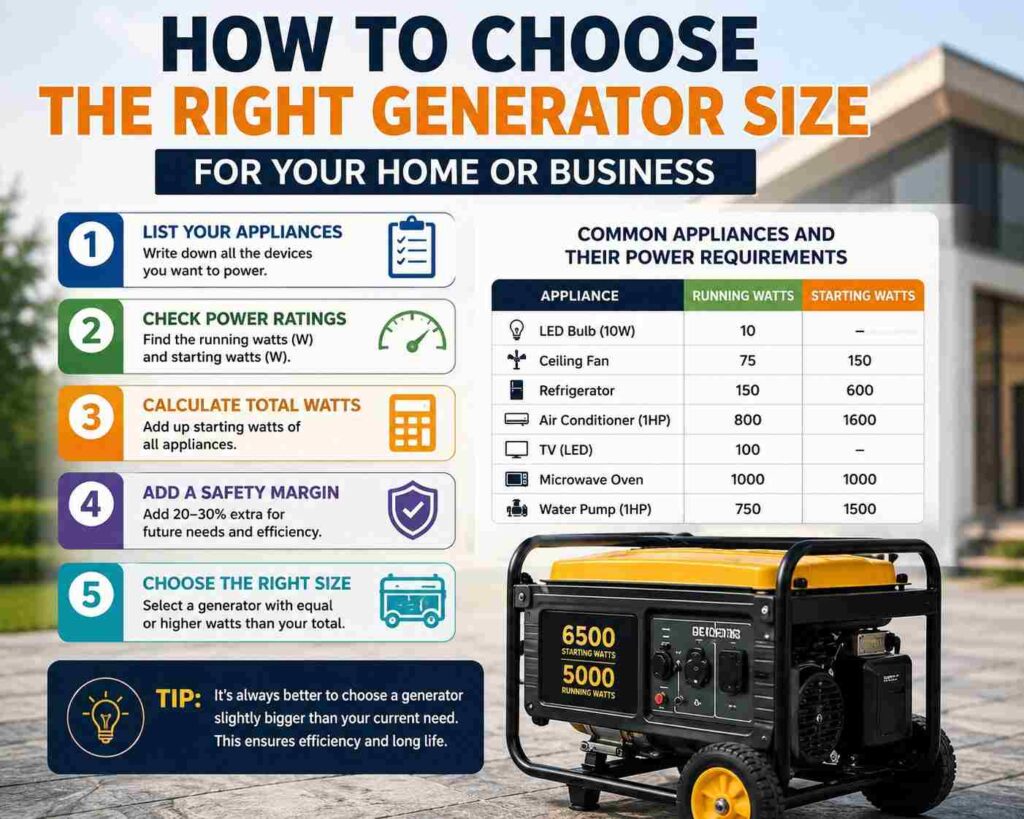
Step 1: List Every Appliance You Intend to Power Simultaneously
Start with a complete, honest list of everything you’d realistically want running at the same time during generator use, not just your single largest appliance, since generators must handle your total simultaneous load, not just your biggest individual device.
Step 2: Note Both Running and Starting Wattage
For each appliance, particularly motor-driven ones like refrigerators, air conditioners, and pumps, note both running wattage and starting wattage (often significantly higher due to motor startup surge, discussed in our dedicated inverter-and-AC article), since your generator must handle the combined starting surge of whichever appliances might start simultaneously, not just your total running wattage alone.
Step 3: Calculate Total Running Load
Sum the running wattage of everything you intend to power simultaneously; this total, converted to kVA (accounting for typical power factor, usually estimated by dividing total watts by roughly 0.8), gives your baseline continuous capacity requirement.
Step 4: Account for Starting Surge
Identify your single largest starting surge (typically from whichever motor-driven appliance draws the most at startup) and add this surge amount, minus that appliance’s own running wattage already counted in step 3, to your baseline figure, since your generator needs enough surge capacity to handle this peak moment even though it’s brief.
Step 5: Add a Reasonable Safety Margin
Adding roughly 20-25% additional capacity beyond your calculated total provides headroom for future appliance additions, ensures your generator isn’t running at its absolute maximum capacity continuously (which accelerates wear and reduces efficiency), and provides margin for real-world variations in actual appliance power draw.
A Worked Example
| Appliance | Running Watts | Starting Watts |
|---|---|---|
| Refrigerator | 150W | 600W |
| 1HP Air Conditioner | 800W | 2,800W |
| Lighting (various) | 200W | 200W |
| TV and electronics | 250W | 250W |
| Total Running | 1,400W | |
| Largest Surge (AC) Addition | +2,000W (surge minus running already counted) | |
| Subtotal | ~3,400W | |
| With 25% Margin | ~4,250W (~4.25-5kVA generator) | |
Why Oversizing Also Has Real Costs
While undersizing causes obvious functional problems, significantly oversizing your generator relative to actual typical load also carries genuine costs: generators run less fuel-efficiently at low load relative to their rated capacity, and the higher upfront purchase cost of an unnecessarily large unit represents capital that could have been better allocated elsewhere, making accurate calculation valuable in both directions rather than simply “buying bigger to be safe.”
Business and Commercial Considerations
Businesses face additional sizing considerations beyond typical household calculations: equipment with different duty cycles, the cost implications of downtime if the generator proves inadequate during critical operations, and often a need for redundancy or backup generator capacity for genuinely critical operations, all factors worth discussing explicitly with a qualified generator supplier familiar with commercial sizing rather than applying residential rules of thumb.
Why It’s Worth Getting a Second Calculation From a Supplier
Given how consequential proper sizing is to both function and cost, having a reputable generator supplier independently verify your calculation, ideally walking through your specific appliance list with you rather than simply offering a generic recommendation, provides valuable confirmation before committing to a purchase, particularly for larger or more complex households and businesses with varied equipment.
Common Misconceptions
- “Bigger is always safer, so oversizing is fine.” Oversizing wastes money both upfront and through reduced fuel efficiency at partial load.
- “Running wattage alone is what matters for sizing.” Starting surge from motor-driven appliances is often the actual limiting factor, not continuous running wattage.
- “The same generator size works for any household of similar size.” Actual appliance mix and usage pattern, not just house size, determine genuine power needs.
Frequently Asked Questions
Should I size my generator for my absolute maximum possible load or my typical usage?
Generally your realistic typical simultaneous load plus a reasonable safety margin, rather than every appliance you own running at once, which is rarely a realistic scenario worth designing around.
Does altitude or ambient temperature affect generator sizing in Nigeria?
Generator output can be modestly affected by high ambient temperatures, relevant during Nigeria’s hottest periods; checking your specific generator’s derating specifications for high-temperature operation is worth confirming with your supplier.
Can I start with a smaller generator and upgrade later if needed?
This is a reasonable approach for households uncertain about their exact needs, though keep in mind that generators, unlike some solar components, generally aren’t easily “added to” incrementally; upgrading typically means replacing the unit entirely rather than expanding it.
Final Thoughts
Properly sizing a generator requires a genuine calculation accounting for both running load and starting surge across everything you intend to power simultaneously, not a rough guess based on house size or budget alone. Taking the time to work through this calculation properly, as outlined above, is the difference between a generator that reliably serves your actual needs and one that either disappoints through chronic undersizing or wastes money through unnecessary oversizing.