Given how often the grid goes off in Nigeria, this is one of the most practical questions any prospective solar buyer can ask, and the honest answer is: it depends entirely on how your system is set up. A lot of people assume that simply owning solar panels guarantees power the moment NEPA cuts out, only to be disappointed during their first real outage.
This article explains exactly when solar keeps your lights on during a blackout and when it does not.
Why Some Solar Systems Shut Down During an Outage
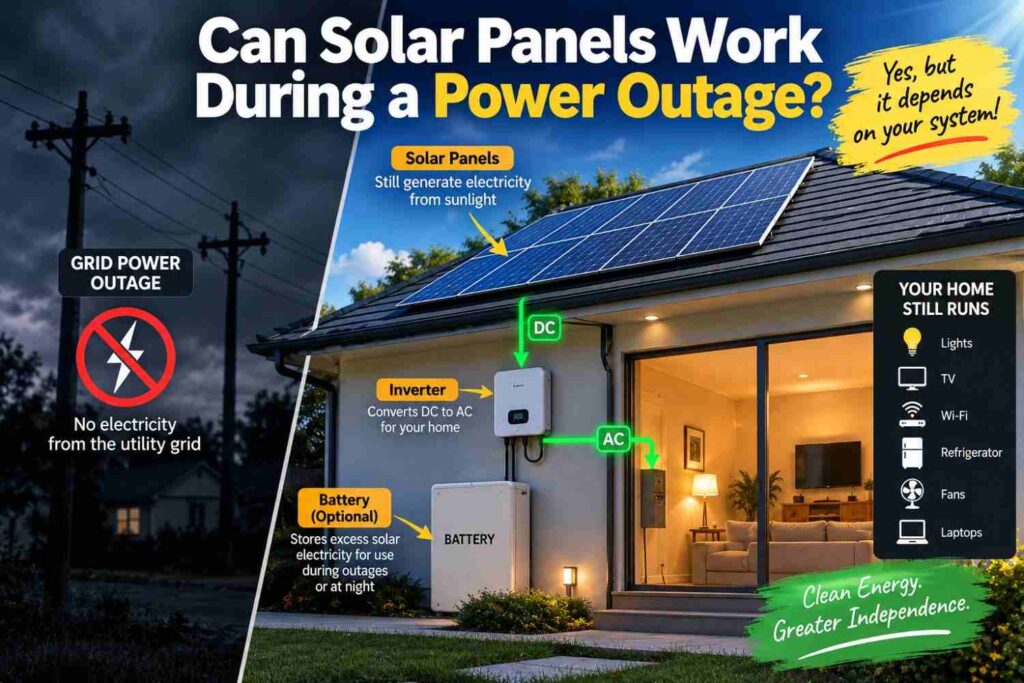
Grid-tied solar systems, which have no battery bank and feed power directly alongside the utility connection, are required to shut down automatically the instant the grid loses power.
This is a deliberate safety feature called anti-islanding, designed to prevent your panels from feeding electricity back into lines that utility workers may be actively repairing during the outage.
It means that even with the sun blazing overhead, a grid-tied system with no batteries goes completely dark the moment the grid fails, which surprises many first-time buyers who assumed panels alone were enough. This distinction is explored more fully in our grid-tied versus off-grid versus hybrid article.
Why Battery-Backed Systems Keep Working
Off-grid and hybrid systems behave completely differently because they include a battery bank and an inverter designed to operate independently of the grid. When the grid drops, a hybrid inverter automatically switches to drawing power from the batteries, keeping your appliances running with barely a flicker, often within milliseconds.
If the outage happens during daylight hours, the solar panels continue charging the batteries and running loads simultaneously, so the system is not just surviving on stored reserves, it is actively replenishing them.
What Determines How Long You Stay Powered
The length of time a battery-backed system can keep your home running during an extended outage depends on a few interacting factors: how large your battery bank is, how much load you are running, whether it is daytime with the panels actively contributing, and how deeply your batteries can safely be discharged, a topic covered in our inverter and battery articles regarding depth of discharge for tubular versus lithium batteries.
A well-sized hybrid system with a reasonable battery bank can often ride out an outage indefinitely during the day and comfortably through the night as long as loads are kept reasonable.
| System Type | Works During Outage? | Why |
|---|---|---|
| Grid-tied, no batteries | No | Shuts down automatically for safety (anti-islanding) |
| Off-grid | Yes, always | Never depended on the grid in the first place |
| Hybrid, with batteries | Yes | Automatically switches to battery and solar power |
| Hybrid, battery depleted | Partially | Can still use solar directly during daylight if wired for it |
What Happens Overnight During a Prolonged Outage
Nighttime is where battery sizing really gets tested. Without sunlight, the system relies entirely on whatever charge is stored in the batteries, so a household that has been running heavy loads like air conditioning throughout the day may find its battery reserves significantly depleted by the time night falls.
This is why installers usually ask about your evening and nighttime load pattern specifically when sizing a battery bank, since a system that performs beautifully during the day can still leave you in the dark by midnight if the batteries were undersized for overnight consumption.
Steps to Confirm Your System Will Actually Work During an Outage
- Confirm with your installer whether your system is grid-tied, off-grid, or hybrid before assuming any outage backup exists.
- Check your battery bank’s usable capacity, not just its total rated capacity, since depth of discharge limits reduce what is actually usable.
- Test the system during a real outage on a low-load day to see how the automatic switchover actually performs.
- Identify which circuits are wired to the backup system versus which remain grid-only, since many hybrid installations only back up selected essential loads.
- Review your typical outage duration pattern in your area and size your battery bank around the worst realistic case, not the average one.
Partial Backup vs Whole-House Backup
Not every hybrid installation backs up the entire house. To manage cost, many Nigerian homeowners choose to wire only essential circuits, such as lighting, refrigeration, fans, and a few sockets, to the battery-backed side of the system, while heavier loads like air conditioners or electric cookers remain grid-only or generator-dependent.
This is a perfectly reasonable way to control battery bank size and cost while still guaranteeing that the essentials stay on during an outage, so it is worth clarifying with your installer exactly which loads are covered before you assume “the whole house” is protected.
Common Misconceptions
- “Owning solar panels automatically means power during any blackout.” Without batteries, a grid-tied system is required to shut down completely during an outage as a safety measure.
- “A hybrid system will power everything in the house indefinitely during an outage.” Backup duration and coverage depend on battery size and which circuits were actually wired to the backup side of the system.
- “Solar panels stop producing power just because the grid is down.” The panels themselves keep generating electricity in daylight regardless of grid status; it is only the inverter’s grid-tied safety behaviour that determines whether that power reaches your home.
Frequently Asked Questions
Will a grid-tied system ever provide backup power?
Not without adding batteries and a compatible inverter, which effectively converts it into a hybrid system.
How can I check if my existing system will work in an outage?
Ask your installer directly whether it is grid-tied, off-grid, or hybrid, and if hybrid, which specific circuits are connected to the battery backup.
Does an outage during the night mean I lose power immediately?
Only if your battery bank is already depleted; otherwise stored battery power continues running your backed-up loads through the night.
Final Thoughts
Whether solar keeps your lights on during a power outage comes down entirely to system type, not the mere presence of panels on your roof. Grid-tied systems without batteries go dark for safety reasons the moment the grid fails, while off-grid and hybrid systems with a properly sized battery bank keep running with barely any interruption.
If reliable backup during Nigeria’s frequent outages is your main reason for going solar, make sure you are specifically choosing a hybrid or off-grid setup, and confirm with your installer exactly which loads and how many hours of runtime your battery bank is actually designed to cover.