
Depth of Discharge, commonly abbreviated DoD, is one of the most important yet frequently misunderstood concepts in battery-backed power systems, directly affecting both how much usable capacity you actually get from your battery and how long that battery will last before needing replacement.
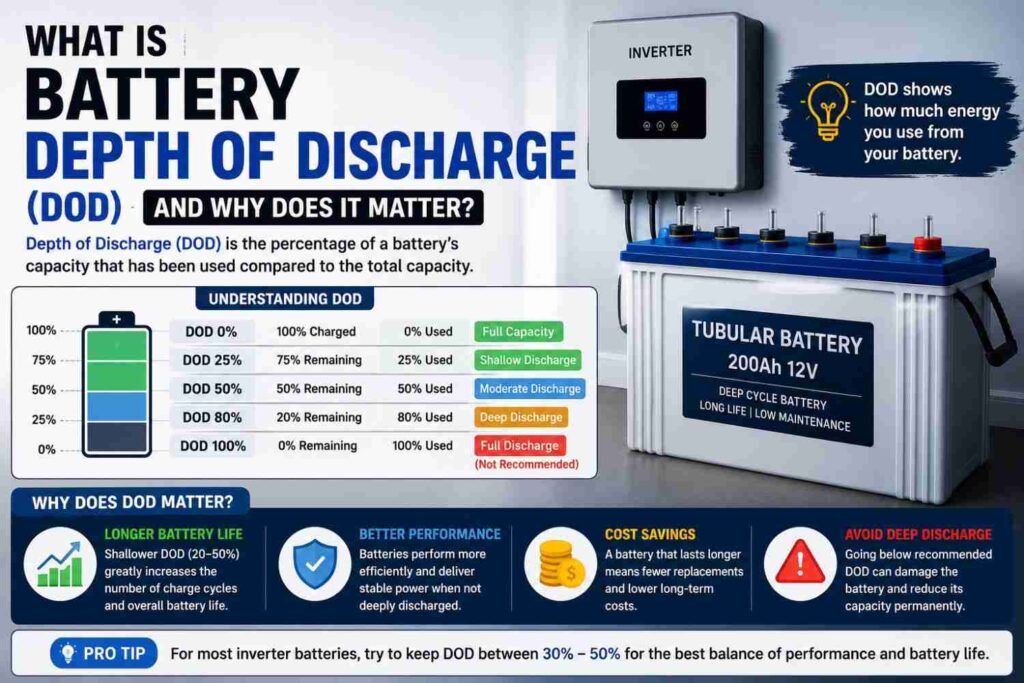
This article explains what DoD actually means and why getting it right matters so much.
What Depth of Discharge Actually Measures
Depth of Discharge refers to the percentage of a battery’s total capacity that has been used, or discharged, at any given point, expressed as the inverse of its remaining state of charge; a battery discharged to 30% DoD still has 70% of its capacity remaining, while a battery at 80% DoD has only 20% remaining. This single number is central to understanding both how much power you can actually draw from your battery and how that usage pattern affects its long-term health.
Why Discharging Too Deeply Damages Batteries
Repeatedly discharging a battery too deeply accelerates internal chemical degradation processes specific to each battery chemistry, generally causing faster capacity loss over time and a shorter overall cycle life than the same battery would achieve if consistently discharged more conservatively. This is why manufacturers specify recommended maximum DoD limits for their batteries, representing a genuine engineering tradeoff between using more of a battery’s capacity in the short term versus preserving its long-term health and total lifetime energy delivery.
Why Different Battery Chemistries Tolerate Different DoD Levels
As discussed in our lithium vs lead-acid comparison, lead-acid batteries, including tubular variants, are generally recommended to discharge no more than about 50% to achieve reasonable lifespan, while lithium (LiFePO4) batteries tolerate considerably deeper discharge, often 80-90% or more, without proportionally accelerating degradation, a fundamental chemistry difference that significantly affects how much of a battery’s rated capacity is genuinely usable in practice across different technologies.
The Relationship Between DoD and Cycle Life
Battery cycle life figures, the total number of charge-discharge cycles a battery can deliver before significant capacity loss, are typically specified at a particular DoD level, and shallower typical discharge generally yields meaningfully more total cycles than deeper, more aggressive discharge patterns. A battery cycled to only 30% DoD regularly might achieve two or three times the total cycle count of the same battery consistently cycled to 80% DoD, illustrating why understanding and managing DoD is genuinely central to maximizing your battery investment’s total lifetime value.
A DoD Reference Table
| Battery Type | Recommended Max DoD | Approximate Usable Capacity |
|---|---|---|
| Flooded lead-acid (flat plate) | ~30-50% | Lower |
| Tubular lead-acid | ~50% | Moderate |
| Sealed AGM/gel lead-acid | ~50-60% | Moderate |
| Lithium (LiFePO4) | ~80-90% | High |
How DoD Affects Your System Sizing Calculations
When sizing a battery bank for your actual household needs, using rated Ah or kWh capacity directly, without adjusting for your battery’s recommended DoD, will overestimate genuinely usable capacity considerably, particularly for lead-acid systems where only about half the rated capacity should realistically be counted as available for daily use, a factor essential to incorporate into the broader system sizing calculations discussed in our solar panel-count article.
How Modern Inverters and Controllers Help Manage DoD Automatically
Many modern inverters and charge controllers include configurable low-voltage cutoff settings specifically designed to automatically disconnect the load before your battery discharges beyond its recommended safe DoD, protecting your investment from accidental over-discharge even during periods of extended, unmanaged use, though these settings should be properly configured for your specific battery chemistry and capacity to function as intended.
Practical Daily Habits That Help Manage DoD Effectively
Beyond relying solely on automatic low-voltage cutoff protection, developing household habits like monitoring your inverter’s battery percentage display during extended outages and proactively reducing non-essential load before reaching very low charge levels, rather than waiting for automatic shutdown to intervene, helps keep your typical discharge pattern shallower and more consistent with your battery’s recommended range, extending its genuine service life beyond what passive reliance on automatic protection alone would achieve.
Common Misconceptions
- “A battery’s rated capacity is fully and safely usable every cycle.” Recommended DoD limits mean genuinely usable capacity is considerably less than rated capacity for most battery types, particularly lead-acid.
- “Occasionally discharging deeper than recommended causes no meaningful harm.” While occasional deep discharge is less damaging than a consistent pattern, repeated deep discharge cycles measurably shorten battery lifespan over time.
- “DoD recommendations are the same across all battery chemistries.” Lithium and lead-acid batteries have meaningfully different safe DoD ranges due to their different underlying chemistry and degradation mechanisms.
Frequently Asked Questions
Can I safely adjust my inverter’s low-voltage cutoff to allow deeper discharge than recommended?
Technically possible on many systems, but doing so trades short-term additional usable capacity for accelerated long-term battery degradation, generally not a worthwhile tradeoff unless facing a genuine short-term emergency need.
Does DoD affect charging behavior as well as discharging?
Indirectly yes; a more deeply discharged battery requires a longer, more substantial recharge to return to full capacity, affecting how quickly your system recovers between discharge cycles, particularly relevant for solar-charged systems with limited daily charging windows.
How can I track my actual DoD pattern without specialized monitoring equipment?
Many modern inverters display real-time battery percentage or voltage; consistently noting these readings during typical use gives a reasonable practical sense of your actual discharge patterns, though dedicated battery monitoring systems provide more precise, detailed tracking if available for your setup.
Final Thoughts
Depth of Discharge is a genuinely central concept for understanding both how much usable power your battery system actually delivers and how long that battery will last before replacement becomes necessary, directly connecting your daily usage habits to your long-term equipment costs. Understanding and respecting your specific battery chemistry’s recommended DoD limits, rather than simply using capacity until an automatic shutdown intervenes, is one of the most impactful habits for maximizing the genuine value of your battery investment.