
Every battery sold with a cycle life rating, whether it says 500 cycles or 3,000 cycles, is telling you something specific about how long it will realistically last under normal use, yet many buyers focus only on Ah capacity and ignore this number entirely.
Cycle life is one of the clearest ways to compare the long-term value of different batteries, especially now that lithium and lead-acid options sit side by side on the same shop shelf.
This article explains exactly what a charge cycle is, how manufacturers calculate cycle life ratings, and how to use that number to estimate how many years a battery will realistically serve you.
What Counts as One Charge Cycle
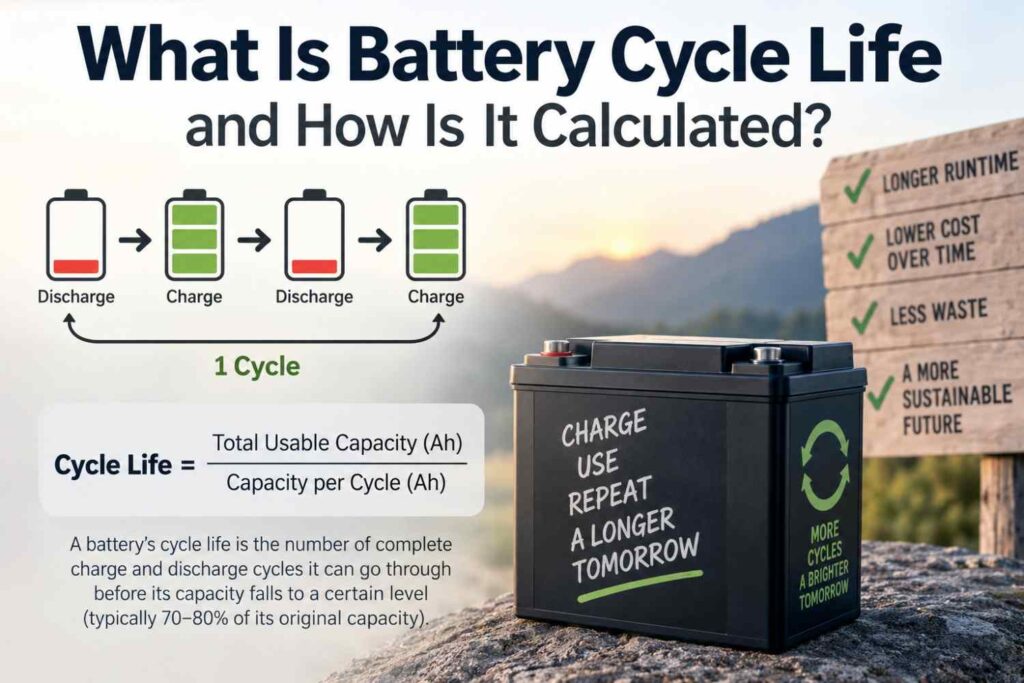
A single charge cycle is generally defined as discharging a battery by a total of 100 percent of its capacity and then fully recharging it, but that 100 percent does not have to happen in one sitting. If you discharge a battery by 40 percent one day and another 60 percent the next day before recharging, that combined 100 percent still counts as one full cycle.
This partial-cycle accounting matters a lot for inverter batteries, since most Nigerian households do not fully drain and fully recharge their battery every single day, they use it in smaller, irregular chunks depending on how long NEPA power is out.
How Manufacturers Calculate Cycle Life Ratings
Manufacturers test batteries in controlled lab conditions, repeatedly charging and discharging them at a specified depth of discharge (often 80 percent or 100 percent) and specified temperature, then counting how many cycles the battery completes before its capacity drops to a defined threshold, usually 80 percent of its original rated capacity.
A battery rated for 2,000 cycles at 80 percent depth of discharge, for example, is expected to retain at least 80 percent of its original capacity after 2,000 such cycles. This is why cycle life numbers are always tied to a specific depth of discharge, a relationship covered in more detail in our dedicated depth of discharge article, and comparing cycle life ratings tested at different depths of discharge is not a fair comparison.
Cycle Life Varies by Chemistry
| Battery Type | Typical Cycle Life (to 80% capacity) | Typical Test Depth of Discharge |
|---|---|---|
| Flooded lead-acid | 200 to 300 cycles | 50 percent |
| Tubular lead-acid | 300 to 500 cycles | 50 percent |
| AGM/Gel lead-acid | 400 to 600 cycles | 50 percent |
| Lithium iron phosphate (LiFePO4) | 2,000 to 3,500+ cycles | 80 to 100 percent |
Turning Cycle Life Into Real Years of Service
Cycle life ratings only become meaningful once you convert them into a realistic timeframe for your own household. If your battery goes through roughly one full-equivalent cycle per day (a reasonable estimate for a home relying on the inverter daily during outages), a battery rated for 500 cycles would last roughly 500 days, a little over a year, while one rated for 2,000 cycles would last around five and a half years.
Households with more stable grid power that rely on their inverter less frequently will stretch these numbers out further, since fewer cycles are consumed per week.
Worked Example: Estimating Years of Service
- Determine the battery’s rated cycle life from its datasheet, for example 1,500 cycles.
- Estimate your average number of equivalent full cycles per day based on outage frequency and usage pattern, for example 0.7 cycles per day.
- Divide cycle life by daily cycles: 1,500 ÷ 0.7 ≈ 2,143 days.
- Convert to years: 2,143 ÷ 365 ≈ 5.9 years.
This is only an estimate, since real-world factors like heat, charging quality, and depth of discharge per cycle all influence actual results, but it gives a far more useful figure than the raw cycle number alone.
Factors That Shorten Real-World Cycle Life
Laboratory cycle life ratings assume controlled, ideal conditions that rarely match daily life in a Nigerian home.
Consistently discharging deeper than the rated depth of discharge, exposing the battery to high ambient heat common in many parts of the country, charging with a poorly regulated inverter or generator, and leaving a battery partially discharged for long periods all reduce the number of usable cycles you actually get.
This gap between rated and real-world cycle life is closely related to the broader question of why batteries lose capacity as they age, which is covered in its own dedicated article.
Why Cycle Life Matters More Than Warranty Period Alone
Many buyers focus on a battery’s warranty length, often one or two years, without realizing that warranty period and cycle life are two different things measuring different risks.
A battery can easily outlive its warranty in calendar time while still having plenty of cycles left, or it can be used so intensively that it exhausts its rated cycles well before the warranty period ends. Understanding cycle life gives you a more accurate sense of when to start budgeting for replacement, rather than relying on the warranty sticker alone.
Common Misconceptions
- “A charge cycle only counts if you drain the battery to zero.” A cycle is counted by total cumulative discharge adding up to 100 percent, not by a single full drain in one sitting.
- “A battery stops working completely once it reaches its rated cycle count.” The rated cycle count marks the point capacity typically drops to about 80 percent, not the point the battery dies; it usually still functions afterward, just with reduced capacity.
- “Cycle life ratings are directly comparable across all batteries regardless of test conditions.” Ratings are only comparable when tested at the same depth of discharge and similar conditions, otherwise the numbers are not measuring the same thing.
Frequently Asked Questions
Does shallow discharging really extend cycle life significantly?
Yes, discharging a battery less deeply per cycle generally allows it to complete many more cycles before reaching the same capacity threshold, which is why depth of discharge and cycle life are closely linked.
Can a battery still be used after it passes its rated cycle count?
Usually yes, though its usable capacity will have declined, meaning shorter backup time per charge even though the battery still functions.
Is cycle life the same as calendar life?
No, calendar life refers to how long a battery lasts based on age alone, even with minimal use, while cycle life refers to how many charge-discharge cycles it can handle; both factors limit a battery’s usable lifespan.
Final Thoughts
Cycle life gives you a much more practical way to compare batteries than Ah rating or price alone, since it directly relates to how many years of real service you can expect from a given battery under your household’s usage pattern.
Remember that rated cycle life is tested under specific depth of discharge conditions, and real-world factors like heat and irregular charging typically shorten the number you actually get. When shopping for a replacement battery, ask for the cycle life rating and its associated test depth of discharge, then do a rough calculation based on your own daily usage before comparing prices.
This turns an abstract manufacturer number into a realistic estimate of years of service, which is ultimately what matters to your pocket.