
Many Nigerians have noticed that a fan spins faster in the afternoon than it does at 7pm, or that the electric iron seems to take longer to heat up in the evening compared to midday, even though nothing about the appliance itself has changed.
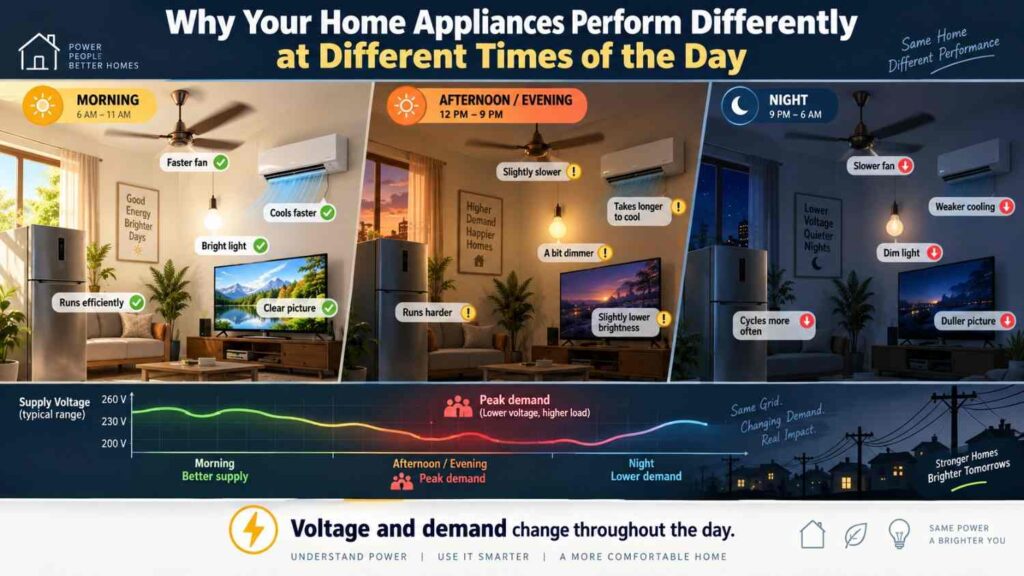
This is not imagination or a faulty appliance, it is a direct result of how electricity demand and supply interact throughout the day.
This article explains why home appliances genuinely perform differently depending on the time of day, and what you can do about it.
The Real Reason Behind the Time-of-Day Effect
Electricity supply is not a fixed, unlimited resource delivered at constant voltage regardless of how much everyone is using at once. Instead, the voltage available at your socket is influenced by how much total load is being drawn from the same transformer and feeder that supplies your neighborhood at that particular moment. When demand rises sharply, and supply cannot keep pace, voltage across the shared network tends to sag, a version of the voltage drop phenomenon explained in more detail in our dedicated voltage drop article, just occurring at a wider, neighborhood-wide scale rather than within a single building’s wiring.
Why Evenings Are the Worst Time for Appliance Performance
Across most of Nigeria, electricity demand follows a fairly predictable daily pattern, and it peaks in the evening, typically between about 6pm and 10pm, when people return from work and school, turn on lights, televisions, air conditioners, freezers, and pumping machines almost simultaneously.
| Time of Day | Typical Demand Level | Common Effect on Appliances |
|---|---|---|
| Early morning (5am to 8am) | Moderate, rising | Generally stable performance |
| Midday (11am to 3pm) | Low to moderate | Best appliance performance, most stable voltage |
| Evening peak (6pm to 10pm) | Highest of the day | Dimmer lights, slower fans, compressor strain |
| Late night (11pm to 4am) | Lowest of the day | Often the most stable voltage of the whole day |
When every household on a shared transformer switches on similar heavy loads within the same few hours, the cumulative demand can exceed what the local transformer and feeder were comfortably designed to carry smoothly, causing voltage to sag across the whole group of connected homes.
Why the Effect Varies From Street to Street
Not every neighborhood experiences this to the same degree, and this is closely tied to the condition and loading of the specific transformer and feeder serving that area, a subject explored further in our article on why power is available on one street but not the next. A newer, properly sized transformer serving relatively few homes will sag far less during peak hours than an older, overloaded transformer serving a dense cluster of houses, all drawing power through the same limited infrastructure. Customers located further along a feeder, away from the substation, also tend to feel the evening dip more strongly than those closer to the source, simply due to the added voltage drop distance introduces along the way.
Which Appliances Are Most Affected
- Fans and blenders slow down noticeably as motor speed depends directly on supplied voltage.
- Refrigerator and air conditioner compressors struggle to start and may hum before finally kicking in.
- Electric irons, kettles, and water heaters take longer to reach their target temperature.
- Incandescent bulbs dim visibly, though LED bulbs are generally more tolerant of moderate voltage sag.
- Pumping machines deliver reduced water pressure and flow rate.
Why This Matters Beyond Simple Inconvenience
Beyond the immediate annoyance of slower appliances, the repeated daily cycle of voltage sagging during peak hours and recovering overnight puts motors and compressors through repeated stress cycles, contributing to the gradual wear discussed in our voltage drop and appliance damage article. Appliances forced to draw more current to compensate for lower voltage generate more heat internally each evening, and over months and years this accelerates insulation breakdown in windings, even if no single evening causes an obvious failure.
How to Manage This as a Homeowner
- Schedule heavy, flexible loads such as ironing, washing machines, and water heating outside the 6pm to 10pm peak window where practical.
- Install a voltage stabilizer for sensitive or motor-driven appliances to smooth out the evening dip.
- Consider a generator with a properly functioning AVR as backup during the most severe evening sags, as covered in our dedicated AVR article.
- Where a specific street or transformer consistently shows poor evening performance, report the pattern to your distribution company, since persistent transformer overload is something they can address.
- Space out the startup of multiple heavy appliances within your own home rather than switching them all on at once during peak hours.
Common Misconceptions
- “My appliance is faulty because it works differently at different times.” In most cases the appliance is fine and simply responding normally to genuine voltage fluctuation caused by shared network demand.
- “This only happens with NEPA supply, not with a generator.” An undersized or improperly loaded generator can show the same time-of-day style strain if too many appliances are switched on simultaneously.
- “Since it happens to everyone, there is nothing that can be done about it.” While the underlying grid demand pattern is outside an individual homeowner’s control, stabilizers, load scheduling, and reporting persistent transformer overload can meaningfully reduce the impact.
Frequently Asked Questions
Does this time-of-day effect happen everywhere in Nigeria equally?
No, it varies significantly depending on transformer capacity, feeder length, and how many households share the same local supply infrastructure, so some areas experience it far more severely than others.
Can a stabilizer completely eliminate the evening performance dip?
A good stabilizer can compensate for a meaningful range of voltage sag, but if the incoming voltage drops too far below the stabilizer’s regulating range, it cannot fully restore normal performance.
Is it better to run my generator during peak evening hours instead of relying on grid supply?
Many households do exactly this, since a well-loaded, properly maintained generator with a working AVR often delivers more stable voltage during peak hours than an overloaded local transformer.
Final Thoughts
The way appliances behave differently throughout the day is a real, measurable consequence of how electricity demand and supply interact on a shared network, not a sign of faulty equipment.
Understanding that evening peak hours place the greatest strain on local transformers and feeders helps explain patterns that many Nigerian households have noticed for years without quite knowing why.
With sensible load scheduling, voltage stabilization, and awareness of your specific area’s supply quality, it is possible to reduce both the inconvenience and the long-term appliance wear this daily cycle causes.