
Every appliance you plug into a wall socket falls into one of three electrical load categories: resistive, inductive or capacitive. Understanding the difference is not just an academic exercise for engineering students.
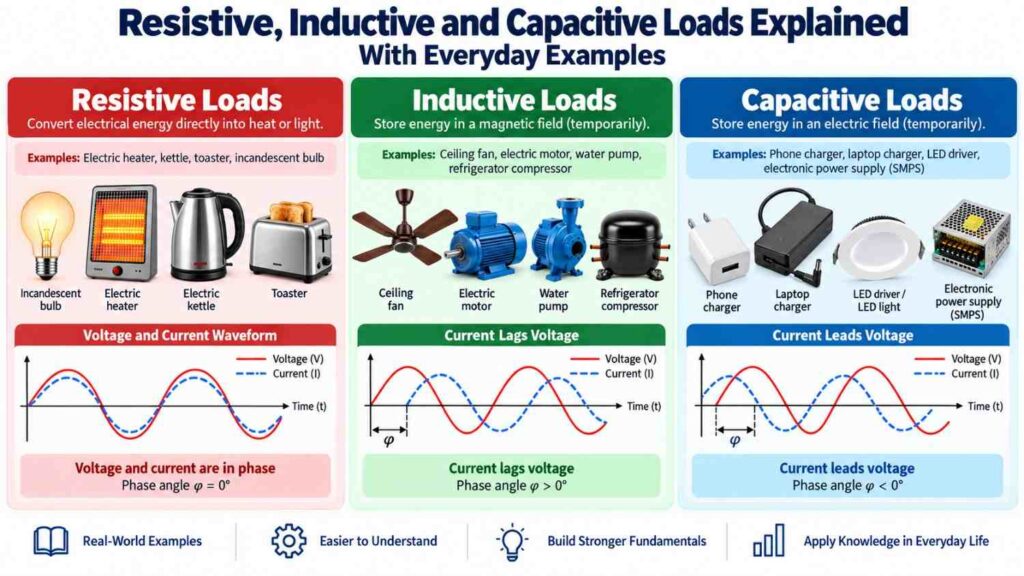
It explains why some appliances heat up instantly while others hum and vibrate, why your inverter or generator can be sized correctly on paper yet still trip when you switch on certain devices, and why the electricity bill for a workshop full of motors looks so different from a home full of lightbulbs and heaters.
This article breaks down what resistive, inductive and capacitive loads are, how each one behaves, and how to recognize them in your own home or business.
What Is a Resistive Load?
A resistive load is any device that converts electrical energy directly into heat or light through pure electrical resistance, with no magnetic or electrostatic effects involved. Current and voltage rise and fall together, perfectly in step, which is why engineers say resistive loads have a power factor of 1, also called unity power factor.
Common examples include incandescent bulbs, electric kettles, toasters, electric irons, immersion heaters and simple resistive space heaters.
When you switch on an iron, it draws current smoothly and converts almost all of that energy into heat, with essentially nothing wasted or stored. This is the simplest load type to work with, and it is also the easiest to size cable and breakers for, since the current drawn is stable and predictable from the moment the load switches on until it switches off.
Resistive loads also have a useful property that many people never think about: they draw exactly the current you would calculate using a simple watts-divided-by-volts formula, with no surprises, no surges and no lag. A 1000W kettle on a 230V supply will always draw close to 4.3A, whether it has just been switched on or has been running for ten minutes.
What Is an Inductive Load?
An inductive load contains a coil of wire, usually wound around an iron or ferrite core, which creates a magnetic field when current flows through it. This is the operating principle behind motors, transformers, fans, compressors, pumps, welding machines and fluorescent light ballasts.
Because building and collapsing that magnetic field takes energy and time, the current in an inductive load lags behind the voltage. This phase difference is called a lagging power factor, and it is one of the main reasons power factor becomes an issue in buildings with lots of motors.
Inductive loads also draw a large surge of current the moment they start, often five to seven times their normal running current, before settling down once the motor reaches full speed and the magnetic field stabilizes.
This is why a refrigerator compressor or an air conditioner can make the lights dim for a split second when it kicks in, and why inverters and generators need to be sized for starting current, not just running current, when powering motor-driven appliances.
The larger the motor, the more dramatic this effect becomes. A small ceiling fan barely registers a starting surge, while a borehole pump motor or a large air conditioning compressor can momentarily demand several kilowatts more than its running rating, even if only for a fraction of a second.
What Is a Capacitive Load?
A capacitive load stores energy in an electric field between two conductive plates separated by an insulating material, rather than in a magnetic field. In a capacitive load, current actually leads the voltage, which is the mirror opposite of what happens with inductive loads.
Pure capacitive loads are less common as standalone household appliances, but capacitors are working quietly behind the scenes almost everywhere: in power factor correction equipment, in the start and run circuits of single-phase motors, in electronic power supplies, in fluorescent and LED lighting ballasts, and in surge suppression circuits.
Because capacitive current leads voltage while inductive current lags it, the two effects can actually cancel each other out on the same circuit. This is exactly the principle used in capacitor banks to correct poor power factor caused by too many inductive loads, a topic covered in more detail in our guide on how capacitor banks improve power factor in electrical systems.
The Power Triangle: How the Three Loads Relate to Each Other
Engineers often explain the relationship between these load types using something called the power triangle. Real power, measured in kilowatts (kW), is the power that actually does useful work, such as producing heat, light or mechanical rotation.
Reactive power, measured in kilovolt-amps reactive (kVAR), is the power that inductive and capacitive loads use to build and collapse their magnetic or electric fields, without doing any permanent useful work. Apparent power, measured in kilovolt-amps (kVA), is the combination of the two, and it is the total current your wiring, breakers and generator actually have to carry.
A purely resistive load has zero reactive power, so its real power and apparent power are the same number. An inductive load adds lagging reactive power, pushing its apparent power above its real power. A capacitive load adds leading reactive power, which works in the opposite direction and can offset the reactive power created by inductive loads elsewhere on the same supply.
Side-by-Side Comparison
| Property | Resistive Load | Inductive Load | Capacitive Load |
|---|---|---|---|
| Relationship between current and voltage | In phase | Current lags voltage | Current leads voltage |
| Power factor | Unity (1.0) | Lagging (less than 1.0) | Leading (less than 1.0) |
| Energy conversion | Converted to heat/light | Stored in a magnetic field | Stored in an electric field |
| Starting current behavior | Stable from switch-on | High inrush current at start | Brief inrush while charging |
| Everyday examples | Kettle, iron, incandescent bulb, heater | Fan, fridge compressor, pump, transformer | Power factor correction units, some electronic supplies |
Why the Difference Matters on a Real Circuit
In a building with only resistive loads, the apparent power in kVA and the real power in kW are the same number, so every unit of electricity you pay for is doing useful work. Once inductive loads enter the picture, some of the current flowing through your wiring is being used to build magnetic fields rather than do useful work, which means the apparent power is higher than the real power.
That gap between the two is exactly what power factor measures, and it is why a workshop full of motors can have a much higher current draw for the same amount of useful work compared with a building full of heaters and bulbs.
This also explains why cable and breaker sizing for inductive loads needs extra care. A motor rated at 2kW does not simply draw the same current as a 2kW heater.
Because of its lagging power factor and its inrush current on starting, the motor circuit needs to be sized with both of those factors in mind, not just the nameplate wattage, as explained further in our guide on choosing the right cable size for your electrical installation.
Effect on Your Electricity Bill and Meter Readings
Most households in Nigeria are billed in kWh, which measures real energy consumed rather than apparent power, so a home full of resistive loads and one full of inductive loads with the same wattage rating will generally show similar readings on a standard energy meter.
The difference becomes far more significant for commercial and industrial customers on demand-based or maximum demand tariffs, where poor power factor caused by heavy inductive loads can lead directly to higher bills or penalty charges, since the utility still has to generate and deliver the extra reactive current even though it is not converted into billable useful energy at the household level.
This is one of the reasons workshops, factories and commercial buildings with large numbers of motors often install capacitor banks. The upfront cost of the correction equipment is usually recovered within a relatively short period through reduced demand charges and better equipment performance.
A Simple Worked Example
Imagine a small workshop with a 3kW resistive heater and a 3kW induction motor, both connected to a 230V single-phase supply. The heater, being resistive with a power factor of 1.0, draws a straightforward 13A, calculated as 3000W divided by 230V. The motor, however, typically runs at a power factor of around 0.8 lagging.
To deliver the same 3kW of real power, the motor’s apparent power works out to 3.75kVA, which means it draws around 16.3A, noticeably more current than the heater for the same wattage rating. This extra current still has to be carried by the cable, the breaker and the generator or inverter feeding the circuit, even though it is not converted into extra usable output.
Now extend that example to a small building with five similar 3kW motors running at once, all at 0.8 power factor. The combined real power is 15kW, but the combined apparent power is closer to 18.75kVA, and the total current drawn is proportionally higher than a simple wattage calculation would suggest. This is exactly why generator and inverter sizing sheets ask for the power factor of connected equipment, not just the total wattage.
How to Identify Load Type Without Opening the Appliance
You rarely need to open an appliance to know what type of load it is. Anything that produces heat directly from a resistance wire, such as kettles, irons, electric heaters, toasters, water heaters and incandescent bulbs, is resistive. Anything containing a motor, compressor, pump or transformer, including fans, refrigerators, air conditioners, washing machines, pumping machines and power tools, is inductive.
Devices with internal electronic power supplies, such as computers, televisions, LED drivers and some modern appliances, often behave as a mix, with a mild capacitive or non-linear component layered on top of whatever their main function is.
For a precise reading, technicians use a power factor meter or a clamp meter with power factor measurement built in, which shows the phase relationship between current and voltage directly rather than requiring you to guess from the appliance type.
Common Misconceptions
- “Wattage tells you everything you need to know about a load.” Wattage only tells you the real power. Two appliances rated at the same wattage can draw very different currents depending on whether they are resistive or inductive.
- “Capacitive loads are rare, so they don’t matter.” While purely capacitive appliances are uncommon in the home, capacitors are working quietly inside countless devices, from motor start circuits to LED drivers, and they play a direct role in correcting the power factor problems caused by inductive loads elsewhere in the same building.
- “A generator rated in kVA and one rated in kW are interchangeable.” They are not, and confusing the two is one of the most common sizing mistakes for anyone running inductive equipment on backup power.
- “If the lights don’t flicker, there’s no inrush current happening.” Voltage dips from motor starting are not always visible to the eye, especially on a well-designed supply, but the current surge is still there and still needs to be accounted for in cable and breaker sizing.
- “Power factor problems only affect big factories.” Even a home with several air conditioners, a borehole pump and a large refrigerator can have a noticeably lagging power factor, which matters more once that home starts running on an inverter or generator with limited capacity.
Why This Matters for Generators, Inverters and Solar Systems
Sizing a generator, inverter or solar power system correctly depends heavily on knowing what mix of resistive, inductive and capacitive loads it will need to carry.
A generator that looks adequately sized for a home’s total wattage on paper can still stall or trip when a fridge compressor, air conditioner or borehole pump starts, simply because the starting surge from those inductive loads was not accounted for. This is one of the most frequent reasons customers come to us reporting that their “correctly sized” generator or inverter keeps cutting out.
Inverters are particularly sensitive to this issue because their surge capacity is usually a fixed, published figure, unlike a generator engine which has some natural tolerance for brief overload. When we size a system, we deliberately factor in the lagging power factor and inrush current of every motor-driven appliance on the circuit, not just its running wattage, which is the only way to avoid nuisance trips and premature equipment wear on both the inverter and the appliances it feeds.
Frequently Asked Questions
Can a single appliance have more than one type of load?
Yes. A washing machine, for example, has resistive heating elements for hot water, an inductive motor for the drum, and capacitors in its control electronics, all in one appliance.
Why do motors cause lights to flicker when they start?
The inrush current a motor draws at startup can be several times its running current, and this brief current spike causes a momentary voltage dip on the circuit, which shows up as a quick flicker in nearby lights.
Is a leading power factor better than a lagging one?
Neither is ideal on its own. The goal in most buildings is to get power factor as close to unity as possible, and utilities typically penalize both significantly lagging and significantly leading power factors.
Do LED bulbs behave like the old incandescent bulbs?
Not entirely. Unlike incandescent bulbs, which are purely resistive, LED bulbs contain internal driver circuitry that can introduce a mild reactive or non-linear component, though it is usually small compared with motors.
How can I tell if an appliance is mostly inductive?
Anything with a motor, a compressor, a transformer or a magnetic coil, such as fans, fridges, air conditioners, pumps and washing machines, is inductive. Anything that simply produces heat with a wire element, such as kettles, irons and heaters, is resistive.
Does load type affect how quickly a breaker trips?
It can. Breakers designed for motor circuits often have a slightly different trip curve than those for purely resistive circuits, precisely to avoid nuisance tripping from the brief inrush current that inductive loads produce at startup.
Practical Tips for Managing Mixed Loads at Home or in a Small Business
- Stagger the start-up of large motors. If a fridge, air conditioner and pump all try to start at the exact same moment on a generator or inverter, their combined inrush current can trip the system even if the total running wattage is well within capacity. Staggering start times, even by a few seconds, avoids stacking multiple surges together.
- Ask your installer for the power factor, not just the wattage, of major equipment. This single number makes a significant difference when sizing cables, breakers and backup power correctly, and most equipment nameplates list it directly.
- Separate heavy inductive loads onto their own circuit where practical. Grouping large motors together, away from sensitive electronics, makes voltage dips from starting surges less noticeable elsewhere in the building.
- Consider power factor correction if you run several motors continuously. For workshops and small factories in particular, a properly sized capacitor bank can noticeably reduce apparent power demand and improve overall system efficiency.
Final Thoughts
Knowing the difference between resistive, inductive and capacitive loads makes it far easier to understand your electricity bill, size backup power correctly, and troubleshoot why certain appliances behave the way they do on your circuit.
Resistive loads are the simplest and most predictable, inductive loads bring starting surges and lagging power factor into the picture, and capacitive loads quietly work behind the scenes, often to correct the very imbalance inductive loads create.
Understanding all three is one of the most practical pieces of electrical knowledge a homeowner, business owner or student can have, and it is usually the first concept worth mastering before moving on to power factor, demand factor and generator sizing in more depth.