
Confusion between electrical engineers and electricians is common in Nigeria, partly because both work with electricity and partly because job titles are used loosely in everyday conversation.
Yet the two are genuinely different career paths, with different training routes, different day-to-day work, and different regulatory bodies overseeing them.
This article clarifies exactly how electrical engineers and electricians differ, and why understanding that difference matters whether you are choosing a career path or hiring for a job.
Different Training Pathways
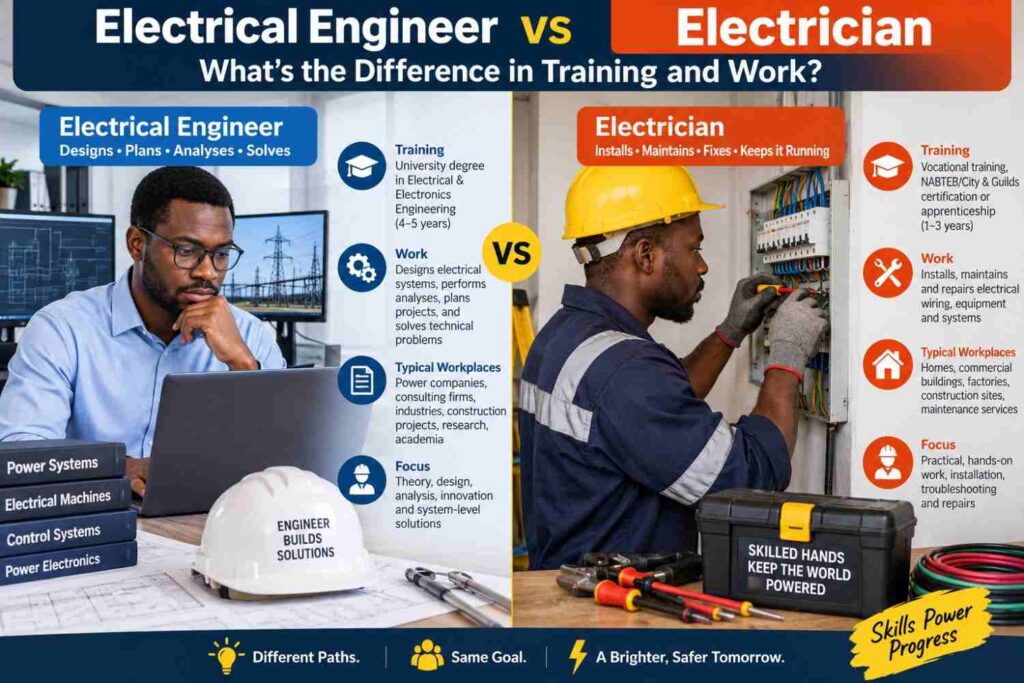
An electrical engineer typically follows a university degree program, usually a Bachelor of Engineering or Bachelor of Science in Electrical/Electronic Engineering, which covers theory-heavy subjects such as circuit analysis, power systems, control systems, and electromagnetic theory, alongside practical laboratory work and an industrial attachment period known as SIWES.
An electrician, by contrast, typically trains through a trade or vocational route, such as a technical college, an apprenticeship under an experienced tradesperson, or a vocational training centre, focusing heavily on hands-on wiring, installation, and maintenance skills from the outset rather than extensive mathematical theory.
Different Focus in Day-to-Day Work
Electrical engineers are generally involved in designing systems, analysing power networks, specifying equipment, overseeing projects, and solving problems that require applying theoretical principles to real-world constraints, often working in offices, plants, or on larger project sites. Electricians, meanwhile, are the hands-on professionals who install, wire, maintain, and repair electrical systems directly, whether in a home, a commercial building, or an industrial facility. In many real Nigerian work settings, especially smaller companies, these roles overlap significantly, with engineers doing hands-on installation work and skilled electricians handling tasks that border on design decisions.
A Side-by-Side Comparison
| Aspect | Electrical Engineer | Electrician |
|---|---|---|
| Typical training route | University degree (4-5 years), including SIWES | Technical college, apprenticeship, or vocational training |
| Core focus | Design, analysis, systems planning, project oversight | Installation, wiring, maintenance, hands-on repair |
| Typical work settings | Power companies, oil and gas, manufacturing, consulting firms | Residential and commercial sites, construction, industrial maintenance |
| Professional body (Nigeria) | Council for the Regulation of Engineering in Nigeria (COREN) | Trade associations and, for larger jobs, NEMSA-related certification |
| Entry into role | Degree plus, for chartered status, professional registration | Trade certification and demonstrated practical competence |
Regulatory Bodies and Professional Recognition
In Nigeria, practicing electrical engineers who wish to be formally recognised as professional engineers typically register with the Council for the Regulation of Engineering in Nigeria (COREN), which sets standards for engineering practice and title use.
Electricians, on the other hand, are more commonly associated with trade certifications and, depending on the scale of work, inspection and certification requirements from bodies such as the Nigerian Electricity Management Services Agency (NEMSA), which focuses on the safety and technical standard of electrical installations rather than academic qualification.
Understanding which body governs which role helps clarify why the two career paths, while related, are treated distinctly at a professional level.
Career Progression Differences
Electrical engineers often progress into roles involving system design, project management, technical consulting, or specialised fields such as power systems or control systems engineering, paths explored further in our electrical engineering career specializations article.
Electricians often progress by building deep hands-on expertise, taking on more complex installation or industrial maintenance work, eventually running their own installation business or supervising teams of junior electricians on larger sites.
Both paths offer genuine long-term career growth, but the trajectory and the skills that drive advancement differ meaningfully.
Which Path Suits Different People
- Those who enjoy mathematics, theory, and system-level problem solving often find engineering training more aligned with their interests.
- Those who prefer hands-on, immediate, practical work often find the electrician trade route more satisfying and faster to start earning from.
- Some professionals combine both, using an engineering background to eventually oversee installation teams or a trade background to move into technical supervisory roles.
- Both paths require ongoing learning, since electrical codes, materials, and technologies such as solar and smart systems continue to evolve.
Where the Two Roles Work Together
On most real projects, from building a shopping complex to setting up an industrial facility, electrical engineers and electricians work as a team rather than in competition.
Engineers typically handle the design, load calculations, and technical specifications, while electricians execute the physical installation according to that design, with the best outcomes arising when both understand and respect the other’s expertise.
Recognising this collaborative relationship is useful whether you are choosing which path to pursue or hiring for a project that needs both skill sets.
Common Misconceptions
- “Electrical engineers know more about wiring a house than electricians.” Electricians typically have far more direct hands-on installation experience; engineers bring design and systems-level knowledge that complements, rather than replaces, that practical skill.
- “You need a university degree to have a respected electrical career in Nigeria.” Skilled electricians build long, respected, and financially rewarding careers through trade training and hands-on experience without a university degree.
- “The two titles are interchangeable and mean the same thing.” While related, the training, regulatory oversight, and typical scope of work differ meaningfully between the two roles.
Frequently Asked Questions
Can an electrician become an electrical engineer later in their career?
Yes, some electricians pursue further formal education to become engineers, though it typically requires completing a recognised degree program alongside their practical experience.
Do electrical engineers need hands-on wiring skills to succeed?
Practical exposure, often gained through SIWES and site experience, significantly strengthens an engineer’s effectiveness, even though their core role is design and systems-focused.
Which career path pays better in Nigeria, engineering or the electrician trade?
Both can be financially rewarding depending on specialisation, experience, and whether the individual builds a business; well-established electricians and experienced engineers in specialised fields can both earn strong incomes.
Final Thoughts
Electrical engineers and electricians occupy distinct but complementary places in Nigeria’s electrical industry, one grounded in design and systems theory, the other in direct hands-on installation and maintenance skill.
Neither path is inherently superior, and the right choice depends on personal interests, learning style, and how quickly you want to enter the workforce.
Whichever direction you choose, building genuine competence, staying current with evolving standards, and understanding how the two roles work together will serve your career well.