As grid unreliability pushes more Nigerian households and businesses toward solar power, demand for competent solar installers has grown steadily across the country.
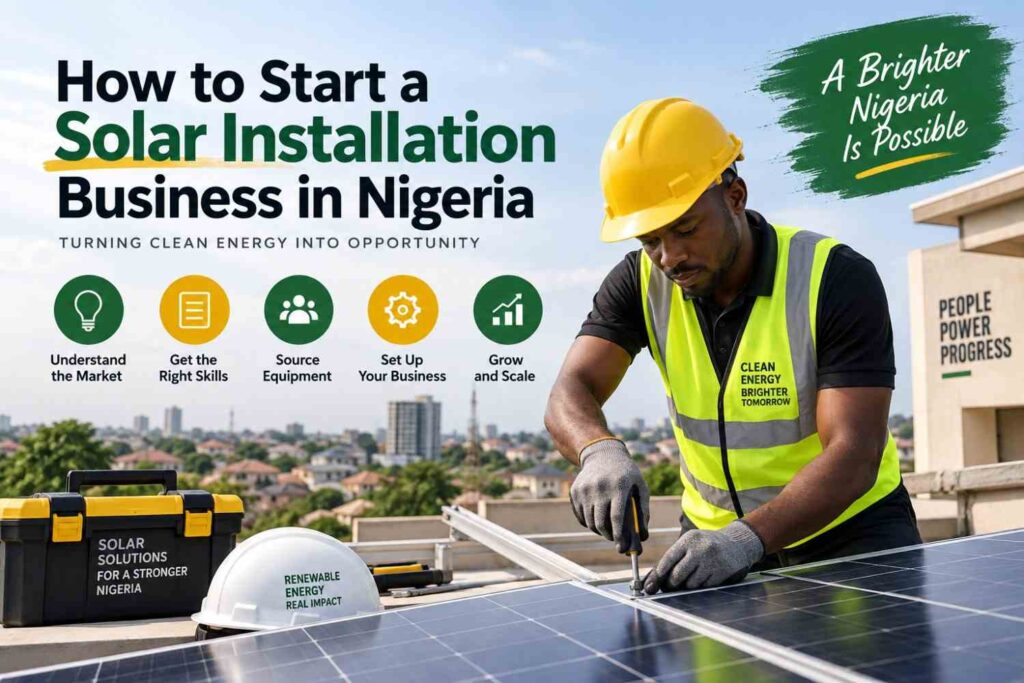
Starting a solar installation business is attractive because entry barriers are lower than many people assume, but doing it properly requires real technical understanding, not just the ability to mount panels.
This article covers what it takes to build a credible solar installation business in Nigeria, from training and tools to sourcing equipment and pricing jobs.
Build Genuine Technical Competence
Solar installation involves more than fixing panels to a roof; it requires understanding system design, battery sizing, inverter selection, wiring safety, and how to match a system to a client’s actual load.
Many installers build this competence through a combination of electrical engineering training, vocational solar-specific courses, and hands-on experience working under an established solar company before going independent.
If your background is largely theoretical, prioritise practical installation experience, since sizing and wiring mistakes are the most common source of failed systems and unhappy clients.
Understanding the Core Components You Will Work With
A functioning solar installation business requires fluency with the main components of a solar power system: photovoltaic panels, charge controllers, batteries (increasingly lithium-based, though lead-acid remains common at lower price points), inverters, and the wiring and protection devices that tie them together.
Understanding how these interact, and how to size each component against a client’s actual consumption, distinguishes a professional installer from someone simply assembling a kit. This sizing exercise depends directly on knowing a client’s real electricity consumption, a process explained in our monthly electricity consumption estimation article.
Registering and Positioning the Business
As with any formal Nigerian business, registering with the Corporate Affairs Commission (CAC) gives your solar installation business the credibility needed to work with serious clients, apply for financing, or partner with equipment suppliers.
Beyond registration, positioning matters: some installers focus on residential backup systems, others on small commercial and industrial solar, and others on off-grid rural electrification projects, each requiring a somewhat different skill set, equipment relationship, and client approach.
Deciding your focus early helps you build the right expertise and supplier relationships rather than trying to serve every market at once.
Sourcing Equipment and Managing Quality
One of the biggest risks in the Nigerian solar market is the prevalence of substandard panels, batteries, and inverters sold at attractive prices. Building relationships with reputable importers and distributors, and learning to check component specifications and certifications, protects both your clients and your business reputation.
Being associated with poor-quality installations, even when the fault lies with the components rather than your workmanship, damages your credibility just as much as an installation error would.
A Simple Framework for Sizing and Quoting Client Systems
| Step | What It Involves |
|---|---|
| 1. Load assessment | List client’s essential appliances, wattages, and hours of use to determine daily energy need |
| 2. Battery sizing | Calculate storage capacity needed to cover the required backup duration |
| 3. Panel sizing | Size the array to recharge the battery bank within available daily sunlight hours |
| 4. Inverter selection | Choose an inverter rated for the combined running and starting load of the client’s appliances |
| 5. Costing and quote | Combine equipment, labour, transport, and margin into a clear, itemised quote |
Tools and Skills Beyond the Technical Basics
- Proper roof mounting and structural assessment skills to ensure panels are securely and safely installed.
- Comfort with basic wiring diagrams and the ability to explain a system’s design clearly to a non-technical client.
- Understanding of battery maintenance and realistic lifespan expectations to set correct client expectations.
- Basic project management skills for coordinating delivery, installation timelines, and after-sales support.
- An understanding of relevant safety and installation standards, similar to those referenced by SON and NEMSA for general electrical work.
Pricing Your Installations Honestly
Because solar systems involve significant upfront equipment cost, clients are often price-sensitive and prone to comparing quotes purely on total price without understanding component quality differences.
Educating clients on why a properly sized system with quality components costs more than a cheaper alternative, while still providing a transparent, itemised quote, builds trust and reduces the risk of disputes later.
Avoid the temptation to win jobs by undersizing systems just to hit a lower price point, since an underperforming system will damage your reputation far more than losing that one job.
After-Sales Support and Long-Term Client Relationships
Solar systems require occasional maintenance, battery replacement over time, and troubleshooting when performance drops. Building a business around one-off installations without after-sales support limits both client trust and repeat business.
Offering simple maintenance check-ins, being reachable when a client’s system underperforms, and honestly explaining component lifespans, especially for batteries, builds the kind of reputation that generates referrals in a market where word of mouth carries significant weight.
Common Misconceptions
- “Solar installation is just mounting panels and connecting wires.” Correct system design, load calculation, and component sizing are what actually determine whether a system performs reliably.
- “The cheapest components always make the most competitive business.” Substandard batteries and panels lead to poor performance and damaged reputation, often costing more in lost trust than the initial savings.
- “Solar and generator businesses are direct competitors with nothing in common.” Many successful installers offer hybrid solutions combining solar with existing generator setups, a comparison explored further in our generators versus solar inverters article.
Frequently Asked Questions
Do I need an electrical engineering degree to start a solar installation business?
It is not strictly required, but strong technical training, whether through engineering study or dedicated solar and electrical courses, is essential for safe and reliable system design.
How do I avoid selling clients an undersized or oversized system?
Base every quote on an honest assessment of the client’s actual load and required backup duration rather than a generic package, and communicate trade-offs clearly.
What is the most common reason solar installation businesses fail in Nigeria?
Poor quality control on components and inaccurate system sizing are common causes, since both lead to underperforming systems and damaged client trust.
Final Thoughts
A solar installation business in Nigeria can be genuinely rewarding given the country’s growing reliance on alternative power, but success depends on technical competence, honest sizing and pricing, and a commitment to quality components over shortcuts.
Registering formally, building supplier relationships you can trust, and offering real after-sales support set apart installers who build lasting businesses from those who struggle with one-off jobs and damaged reputations. With the right foundation, this is one of the more future-proof directions to build a career and a business around in Nigeria’s current power landscape.