
Unreliable grid supply is one of the biggest operating costs Nigerian small business owners face, whether you run a provisions store, a barbing salon, a cold room, or a small workshop.
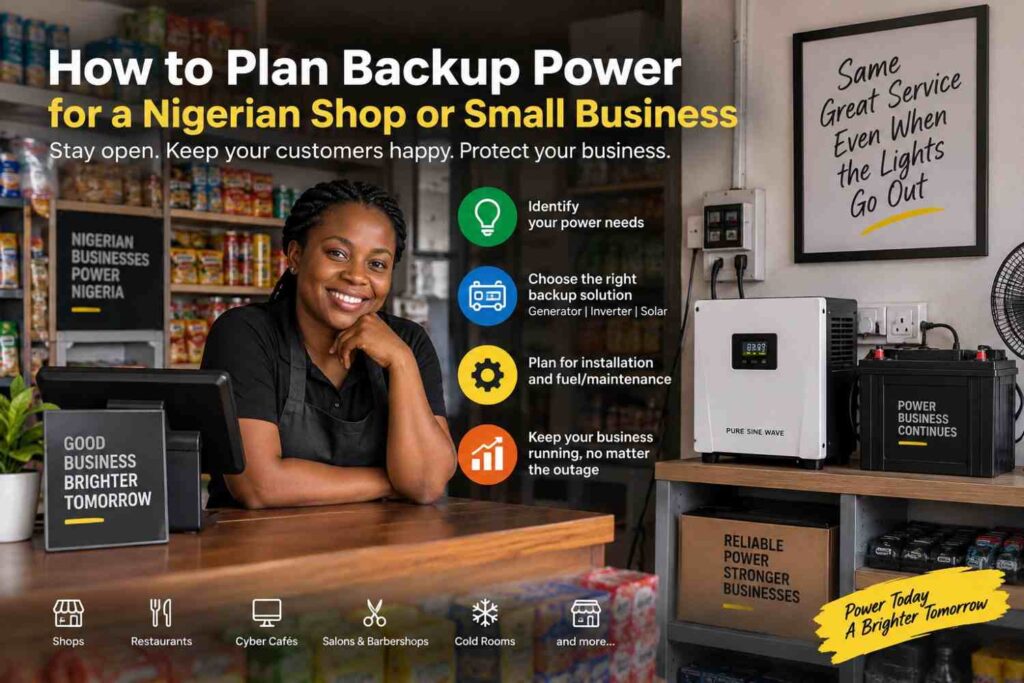
Getting backup power planning wrong means either wasting money on an oversized system or losing sales every time the grid goes off because your setup cannot carry your real load.
This article walks through a practical approach to sizing and planning backup power for a Nigerian shop or small business, from listing your critical loads to choosing between a generator, an inverter system, or a hybrid setup.
Start by Identifying Your Critical Loads
The first step is not choosing equipment, it is deciding what actually needs to stay powered when the grid goes off. For most small businesses, this list is shorter than owners initially assume.
A provisions shop may only need lighting, a freezer, and a POS terminal, while a salon may need lighting, clippers, and a few fans. Separate your loads into essential (must run during an outage) and non-essential (can wait until grid power returns), since this distinction directly determines how large and how expensive your backup system needs to be.
Calculating Your Load in Practical Terms
Once you have your essential load list, estimate the wattage of each item and how many hours it needs to run during a typical outage.
This calculation follows the same logic used for estimating household consumption, covered in more detail in our appliance electricity consumption calculation article, but for a business you are typically sizing for continuous operating hours during business hours rather than a full day.
A small shop with a freezer, lights, and a fan might have a combined running load of 800 to 1200 watts, while a business with air conditioning or heavier equipment will need considerably more.
Comparing Backup Power Options
Nigerian small businesses generally choose between a petrol or diesel generator, a battery-and-inverter system (often charged from the grid, solar, or both), or a combination of the two.
Each option has a different balance of upfront cost, running cost, noise, and reliability, summarised in the table below. A fuller comparison is available in our dedicated generators versus solar inverters article.
| Option | Upfront Cost | Running Cost | Best Suited For |
|---|---|---|---|
| Petrol generator | Low to moderate | High, fuel-dependent | Occasional, short outages; backup for light loads |
| Diesel generator | Moderate to high | Moderate, more efficient than petrol for heavier loads | Businesses with longer or frequent outages and higher loads |
| Battery inverter (grid-charged) | Moderate to high | Low, mainly electricity cost | Quiet, frequent short outages; sensitive equipment |
| Solar-charged inverter system | High | Very low after installation | Businesses with consistent daytime sun exposure and long-term cost focus |
| Hybrid (generator + inverter) | Highest | Balanced | Businesses needing both reliability and reduced fuel dependence |
Sizing Your System Correctly
Undersizing leads to a system that trips or fails under load, while oversizing wastes capital that could be used elsewhere in the business.
As a general approach, size your generator or inverter capacity with a reasonable buffer above your calculated running load, typically allowing extra headroom for appliances with motors, such as freezers and pumps, which draw a higher starting current than their running current.
If you are unsure how to translate your load list into a specific generator or inverter capacity, it is worth getting a proper assessment rather than guessing, since incorrect sizing is one of the most common and costly mistakes small business owners make.
Building a Simple Backup Power Plan
- List all essential loads and their wattage.
- Estimate how many hours per day each load needs backup power during an outage.
- Calculate total running load and add a buffer for motor-driven appliances.
- Compare generator, inverter, and hybrid options against your budget and outage pattern.
- Factor in ongoing costs, including fuel, battery replacement, and maintenance.
- Install with proper wiring and, where relevant, a change-over switch to avoid backfeeding the grid.
- Review and adjust the plan as your business grows or your equipment changes.
Maintenance and Safety Considerations
A backup power system is only as reliable as its maintenance. Generators need regular servicing, oil changes, and proper ventilation, while battery systems need protection from excessive heat and should be installed with correct wiring to avoid fire risk.
Businesses that run generators should also ensure a proper change-over switch is installed so grid and generator power cannot be connected simultaneously, which is both a safety hazard and a common cause of equipment damage.
Budgeting for the Real Cost of Backup Power
Many small business owners focus only on the upfront cost of a generator or inverter and underestimate the ongoing cost of fuel, battery replacement, or maintenance over a year.
When comparing options, calculate an approximate cost per month of running each system at your expected outage frequency, not just the purchase price, since a cheaper generator can end up costing more over time than a pricier but more efficient inverter system, depending on how often and how long your area experiences outages.
Common Misconceptions
- “A bigger generator is always the safer choice.” An oversized generator running well below its rated capacity is often less fuel-efficient and wastes money compared to a correctly sized unit.
- “Solar backup only works for large businesses with big budgets.” Small solar-inverter setups can be scaled to match modest loads like lighting, fans, and a freezer, making them accessible for many small businesses.
- “Backup power planning is a one-time decision.” As a business grows and adds equipment, the backup system should be reassessed, since the original sizing may no longer match actual load.
Frequently Asked Questions
How do I know if my business needs a generator, an inverter, or both?
It depends on your outage duration and budget; short frequent outages often favour a quiet inverter system, while longer outages or heavier loads may require a generator or a hybrid setup.
What is the most common mistake small business owners make with backup power?
Sizing the system based on guesswork rather than an actual load calculation, which leads to either an underpowered system that trips or an oversized one that wastes money.
Do I need a professional to install backup power for my shop?
For anything beyond a very small plug-in inverter, proper installation with correct wiring and a change-over switch should be handled by a qualified electrician to ensure safety and reliability.
Final Thoughts
Backup power planning for a Nigerian small business comes down to knowing exactly what needs to keep running, sizing your system to match that load with a sensible buffer, and budgeting honestly for ongoing costs rather than just the purchase price.
Whether you choose a generator, an inverter, or a hybrid system, the businesses that avoid costly mistakes are the ones that plan deliberately rather than buying equipment based on what a neighbour has. Getting this right protects both your daily operations and your long-term bottom line.