
Staring at the small screen on your prepaid meter after a recharge and wondering exactly how many days that alert will last is a familiar experience for most Nigerian households.
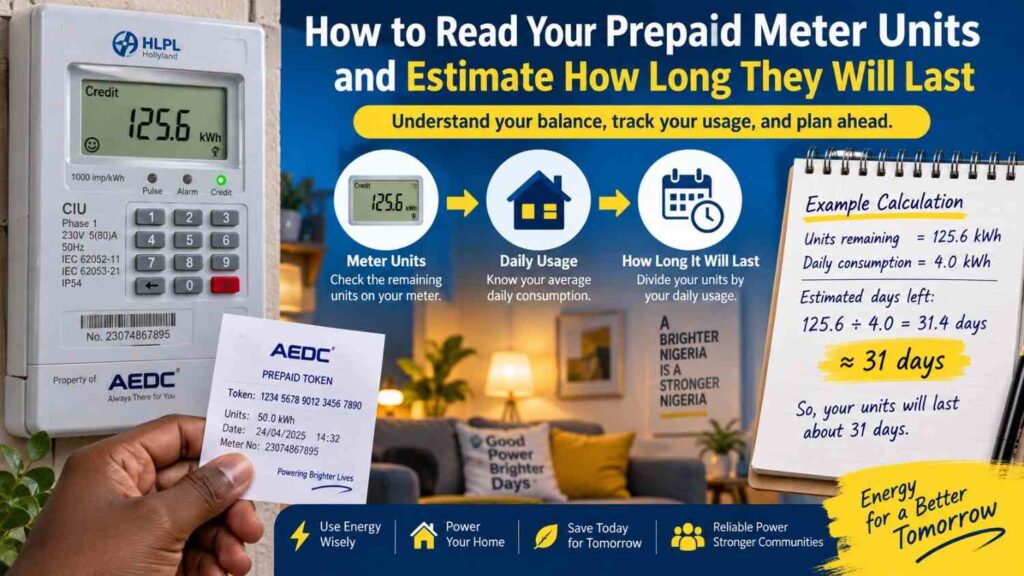
Understanding what the numbers on your meter actually mean, and how to turn them into a realistic estimate of remaining days, can save you from the frustration of a sudden power cut in the middle of the night.
This article breaks down how to read your meter correctly, how to track your usage pattern, and how to build a simple, reliable estimate of how long your units will last.
Understanding What Your Meter Display Is Showing
Most prepaid meters used by Nigerian DisCos, whether single-phase or three-phase, display a running figure in kilowatt-hours (kWh), commonly just called “units.” This number decreases as your household consumes electricity, and it is the same unit used to calculate your tariff.
Some meters cycle through a few screens when you press a button, showing token history, tariff class, or an alert threshold, in addition to the main balance. It helps to know your meter’s tariff band, since bands billed under Nigeria’s tariff structure differ, and the same number of units can represent different amounts of money depending on your band.
Reading the Recharge Token Correctly
When you buy a recharge token, the amount you pay is not the same as the units credited to your meter, because charges such as VAT and, in some cases, fixed charges or debt recovery deductions are taken out before the balance is converted to units.
This is one reason many customers feel their units “disappear too fast,” a concern also discussed in our dedicated prepaid meter consumption article.
After entering the 20-digit token and confirming acceptance, always note the new balance shown on the display rather than assuming it equals the naira value you paid, since that gap is the actual number you should track over time.
Tracking Your Daily Consumption Rate
The most reliable way to estimate how long your units will last is to observe your own consumption pattern rather than relying on a generic average, because every household’s appliance mix and usage hours are different.
Write down your meter balance at the same time each day for about a week, ideally in a small notebook or a phone note, and calculate the difference from one day to the next.
This daily average, measured in kWh per day, becomes your personal benchmark, and it is far more accurate than any online calculator that doesn’t know your specific home.
A Simple Table for Estimating Remaining Days
Once you know your average daily usage, dividing your current balance by that average gives you a rough number of days left. The table below shows a worked example for a typical home with different daily usage levels, assuming a balance of 100 units after a recharge.
| Average Daily Usage (kWh) | Estimated Days Remaining (100 units) | Typical Household Profile |
|---|---|---|
| 3 kWh/day | About 33 days | Lights, TV, phone charging, small fridge |
| 6 kWh/day | About 16 days | Fridge, fans, TV, occasional iron |
| 10 kWh/day | About 10 days | Fridge, freezer, AC unit used part-time |
| 15 kWh/day | About 6-7 days | Multiple AC units, heavy appliance use |
These figures are illustrative only, and your own numbers from tracking will always be more accurate than any table, since actual consumption depends heavily on which appliances you run and for how long, a topic covered in more depth in our appliance electricity consumption calculation article.
Adjusting Your Estimate for Seasonal and Behavioural Changes
Your daily average is not fixed throughout the year. During the hottest months, fans and air conditioners run longer, refrigerator compressors work harder, and overall consumption rises noticeably, which shortens the life of the same number of units.
Conversely, during cooler periods or when household members travel, usage often drops. It is worth recalculating your daily average every month or two, especially if you notice your units finishing faster or slower than your last estimate predicted.
Using the Low-Balance Alert Wisely
Most Nigerian prepaid meters beep or flash when the balance drops below a set threshold, often around a specific number of units. Treat this as a planning window rather than a last-minute emergency signal.
As soon as the alert starts, use your daily average to calculate roughly how many days remain, and plan your next recharge around that window rather than waiting until the meter goes to zero, which can happen at an inconvenient time such as late at night or during a public holiday when vending points may be less accessible.
What to Do When Estimates Consistently Fail
If your units are consistently finishing much faster than your calculated estimate suggests they should, this may point to an issue beyond normal consumption, such as a faulty appliance drawing excess current, a wiring fault, or in some cases a metering discrepancy that should be reported to your DisCo.
Before assuming the meter itself is at fault, first rule out the more common causes, such as an old refrigerator, a faulty pumping motor, or an appliance left running unnecessarily.
Common Misconceptions
- “The naira amount I pay equals the units I get.” Deductions such as VAT reduce the units credited, so the number on your meter after recharge is always less than a simple naira-to-unit conversion would suggest.
- “All households use electricity at the same rate.” Consumption depends entirely on your specific appliances and habits, so estimates should be based on your own tracked average rather than a generic figure.
- “The low-balance alarm means the power is about to cut off immediately.” The alarm is usually an early warning at a set threshold, giving you a real window of days to plan a recharge, not an instant cutoff.
Frequently Asked Questions
Why do my units finish faster in some months than others?
Seasonal changes in appliance use, especially fans and air conditioners during hot periods, increase daily consumption and shorten how long the same units last.
Can I check my meter balance without entering my house?
Yes, most meters display the balance directly on the screen, and some DisCos also offer SMS or app-based balance checks linked to your meter number.
Is it normal for units to drop even when I am not using major appliances?
A small baseline consumption from standby devices, refrigerators, and modems is normal, but a large drop with minimal appliance use may indicate a fault worth investigating.
Final Thoughts
Reading your prepaid meter accurately and building a personal daily average turns an unpredictable guessing game into a manageable routine.
Rather than reacting to a sudden power cut, a few minutes of tracking each week gives you the confidence to plan recharges ahead of time. Combine this habit with an understanding of which appliances drive your consumption, and you will find both your budgeting and your power planning become far more predictable.