
Almost every electronic device you own, from your phone charger to the power supply inside a desktop computer, needs direct current to operate, yet the electricity supplied by the grid or a generator arrives as alternating current.
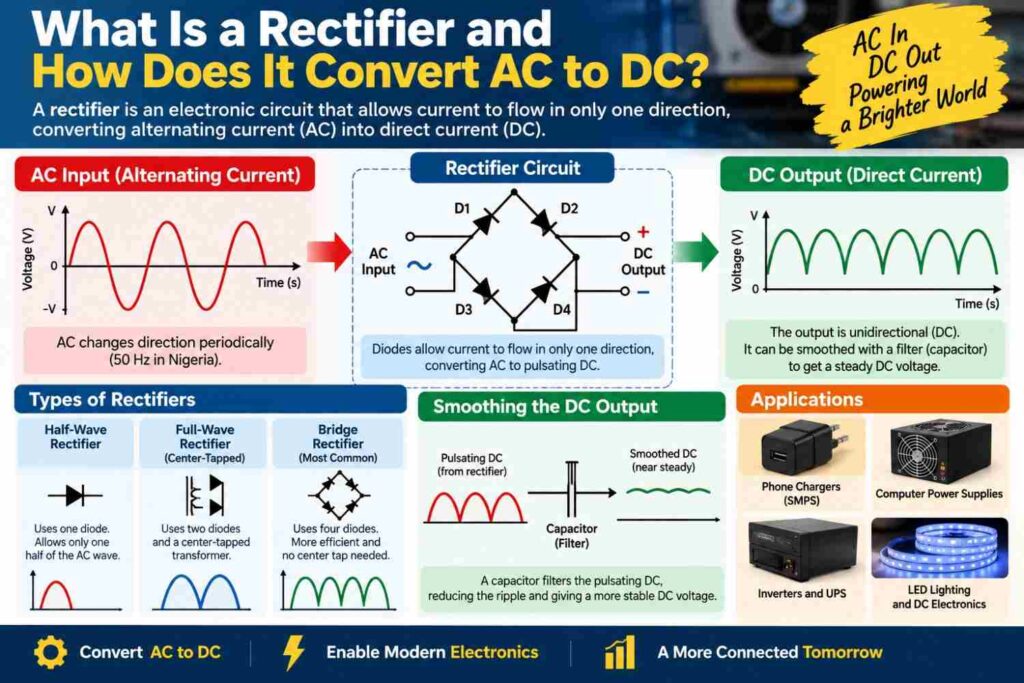
The component responsible for bridging that gap is the rectifier, one of the most fundamental building blocks in power electronics.
This article explains what a rectifier is, how it converts AC to DC, and why this conversion matters so much in real Nigerian electrical systems.
Why AC to DC Conversion Is Necessary
Alternating current, or AC, is the form of electricity generated by power stations and delivered through the national grid, as well as the output of most portable generators used across Nigeria. AC periodically reverses direction, oscillating at a fixed frequency, typically 50 hertz in Nigeria.
Many electronic components, however, including microcontrollers, batteries, LEDs, and most semiconductor circuits, require direct current, or DC, which flows steadily in one direction. Without a way to convert AC to DC, none of these devices could run directly from mains or generator power, which is exactly the problem a rectifier solves.
What a Rectifier Actually Is
A rectifier is an electrical circuit, typically built from one or more diodes, that converts alternating current into a pulsating direct current by allowing current to flow in only one direction.
A rectifier does not, by itself, produce a perfectly smooth DC output; it produces a series of one-directional pulses that follow the shape of the original AC waveform but no longer reverse polarity.
This pulsating output is then usually smoothed further using additional components, most commonly a capacitor, to produce the steady DC voltage that sensitive electronic circuits need.
The Role of the Diode
The core component that makes rectification possible is the diode, a semiconductor device that allows current to flow easily in one direction while blocking it almost entirely in the other, a behavior explored in full detail in our dedicated diode article.
By arranging diodes in specific configurations, engineers can control exactly how the AC waveform gets converted, which leads to the two main rectifier types you will study early in any electronics course: half-wave and full-wave rectifiers, compared directly in our half-wave versus full-wave rectifier article.
Basic Stages of an AC to DC Power Supply
A rectifier rarely works entirely alone in a practical power supply. It is usually just one stage in a longer chain of components that together convert raw AC mains power into clean, usable DC voltage.
- A transformer first steps the AC voltage up or down to a level appropriate for the intended DC output.
- The rectifier circuit, built from diodes, converts the AC waveform into pulsating DC by blocking current flow in one direction.
- A filter capacitor smooths out the pulsating DC into a more stable voltage by charging during peaks and discharging during dips.
- A voltage regulator, if included, holds the output voltage steady despite variations in load or input voltage.
- The final smoothed and regulated DC output is delivered to the actual electronic load, such as a microcontroller board or a battery charging circuit.
Where Rectifiers Show Up in Everyday Nigerian Electronics
Rectifiers are everywhere once you start looking for them. Every phone charger and laptop adapter contains a rectifier stage to convert mains AC into the DC voltage the device battery needs.
Inverter systems, extremely common in Nigerian homes and businesses due to unreliable grid power, use rectifiers as part of their battery charging circuitry when converting incoming AC from the grid or a generator into DC to charge the battery bank. Even automatic voltage regulators on generators often include rectifier stages as part of their sensing and control circuitry.
Comparing Rectifier Circuit Configurations
| Configuration | Diodes Used | Output Characteristic |
|---|---|---|
| Half-wave rectifier | 1 diode | Uses only one half of the AC cycle |
| Full-wave (center-tapped) | 2 diodes | Uses both halves, needs a center-tapped transformer |
| Full-wave bridge rectifier | 4 diodes | Uses both halves, no center-tapped transformer needed |
Each configuration has trade-offs in efficiency, output smoothness, and component cost, which is why the bridge rectifier has become the standard choice in most modern power supplies.
Building and Testing a Simple Rectifier Circuit
For students in Nigerian electronics labs or working on a home bench, building a basic rectifier circuit is a common and valuable early exercise. A step-down transformer reduces mains voltage to a safer level, a small set of diodes forms the rectifier stage, and a capacitor smooths the output.
Testing the circuit with a multimeter or, better yet, an oscilloscope reveals the pulsating waveform before filtering and the much smoother waveform after the capacitor is added, giving a clear visual understanding of what “smoothing” actually accomplishes.
Common Misconceptions
- “A rectifier alone produces perfectly smooth DC.” A rectifier only converts AC into pulsating one-directional current; additional filtering, usually with a capacitor, is needed to produce genuinely smooth DC.
- “All rectifiers use the same number of diodes.” Different rectifier configurations, such as half-wave, center-tapped full-wave, and bridge rectifiers, use different numbers of diodes and produce different output characteristics.
- “Rectifiers are only found in large industrial power supplies.” Rectifiers are present in nearly every small AC-powered charger and adapter, not just large industrial equipment.
Frequently Asked Questions
What is the difference between a rectifier and a transformer?
A transformer changes the voltage level of an AC signal while keeping it as AC, whereas a rectifier converts AC into DC; they typically work together in a power supply, but they perform entirely different functions.
Why is filtering needed after rectification?
Rectification alone produces a pulsating output that still rises and falls, so a filter, usually a capacitor, is needed to smooth these pulses into a steadier DC voltage suitable for sensitive electronics.
Can a rectifier be built without a transformer?
Yes, a rectifier can be connected directly to an AC source without a transformer, though this is less common in low-voltage electronics because it does not allow the voltage level to be adjusted or provide isolation.
Final Thoughts
Rectifiers solve one of the most basic and essential problems in electronics: converting the alternating current supplied by the grid and generators into the direct current that powers nearly every electronic device.
Built primarily from diodes, rectifiers form the first real conversion stage in almost any AC-powered DC supply, from a simple phone charger to a complex inverter system.
Understanding how rectification works, and how it fits alongside transformers, filters, and regulators, gives you a solid foundation for studying power electronics and diagnosing real power supply faults in the field.