
Money is tight, one battery in your bank has died, and buying a full replacement set feels wasteful when the other batteries still seem to work fine, so the temptation to add just one new battery alongside the old ones is completely understandable.
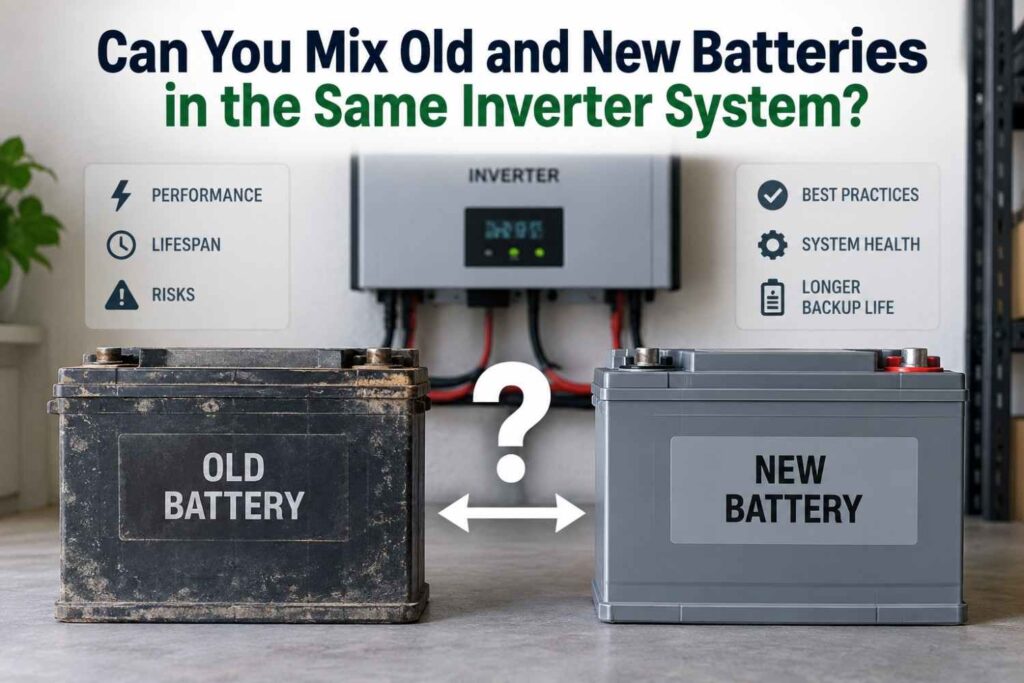
Unfortunately, this is one of the most common ways Nigerian households accidentally shorten the life of a perfectly good new battery.
This article explains exactly why mixing old and new batteries causes problems, what happens inside the battery bank when you do it, and what your realistic options are when only one battery in a bank has failed.
Why Age Mismatch Causes Problems
An older battery, even one that still holds a charge, has reduced capacity and higher internal resistance compared to a brand new battery of the same rated specification, a natural result of the aging process covered in our dedicated article on why batteries lose capacity over time.
When wired together in series or parallel, as explained in our series vs parallel connection article, batteries in a bank do not operate independently, they are forced to charge and discharge together as a single system, and the weaker, older battery drags down the performance of the newer one.
What Happens in a Series Connection
In a series-connected bank, the same current flows through every battery, so the weakest battery reaches its low-voltage cutoff point before the others during discharge, even though the newer batteries still have charge left to give.
During charging, that same weak battery tends to reach full charge first and can be pushed into overcharge while the other batteries are still catching up, unless the charging system is sophisticated enough to manage this, which most basic inverter chargers are not.
Over repeated cycles, this pattern accelerates wear on both the old battery, through repeated overcharge stress, and the new battery, which never gets to use its full capacity before the bank cuts off.
What Happens in a Parallel Connection
In a parallel-connected bank, batteries share the load based on their relative internal resistance and state of charge, and a newer, healthier battery will naturally try to supply more current and take on more of the charging current than an older, weaker one.
This sounds harmless at first, but it means the new battery works harder than its fair share while the old battery contributes less, effectively shortening the new battery’s expected lifespan since it experiences more cycling relative to its neighbor.
Comparing the Two Scenarios
| Connection Type | What the Old Battery Does | Effect on the New Battery |
|---|---|---|
| Series | Reaches cutoff early, may overcharge | Never fully utilized, bank capacity limited by weakest link |
| Parallel | Contributes less current and charge | Works harder, ages faster than expected |
Signs That Battery Mismatch Is Already Hurting Your Bank
- Backup time noticeably shorter than what a healthy bank of that total Ah rating should provide.
- One battery in the bank feeling warmer than the others after charging.
- Uneven voltage readings between batteries when measured individually with a multimeter.
- The newer battery showing signs of premature aging or reduced performance earlier than expected.
- The inverter cutting off under load sooner than it did when the bank was first installed.
What to Do When One Battery in a Bank Fails
The ideal solution is always to replace the entire bank with matched batteries of the same age, capacity, and brand, since this guarantees even performance and predictable lifespan across the whole system.
When budget genuinely does not allow this, the next best option is to isolate the old battery entirely and run a smaller bank on the remaining healthy batteries alone, accepting reduced total capacity rather than dragging good batteries down with a weak one.
Some households choose to keep the old battery as a separate, standalone backup for very light loads, rather than wiring it into the main bank at all.
A More Gradual Replacement Strategy
If replacing the whole bank at once is not financially realistic, consider a phased approach: remove the failed battery immediately rather than leaving it in the bank, run on reduced capacity for a period, and then replace the entire remaining bank together once you can afford it, rather than adding single new batteries one at a time to an aging set.
This avoids the repeated cycle of mixing ages that erodes new batteries prematurely, and while it costs more per naira spent at replacement time, it protects the investment in each new battery you buy going forward.
When Mixing Might Be Acceptable
There are limited situations where mixing is less risky, mainly when batteries are wired completely independently rather than into the same bank, such as separate battery sets powering separate circuits with their own charge controllers.
In these setups, one aging battery does not directly interact with a newer one during charge or discharge, so the usual mismatch problems do not apply in the same way. This is different from adding a battery into an existing wired bank, which is where the real risk lies.
Common Misconceptions
- “Adding just one new battery to an old bank is a cheap way to boost capacity.” The old batteries drag down the new one’s performance and lifespan, often making this a false economy over time.
- “As long as the voltage matches, age doesn’t matter when mixing batteries.” Voltage matching alone does not account for differences in internal resistance and capacity that cause uneven charge and discharge between old and new batteries.
- “A slightly older battery performs almost the same as a new one, so mixing is low-risk.” Even moderate aging changes internal resistance and capacity enough to create meaningful imbalance in a wired bank.
Frequently Asked Questions
How much age difference between batteries is considered safe to mix?
There is no universally safe threshold, but many technicians recommend against mixing batteries more than about six months to a year apart in age within the same wired bank.
Will mixing old and new batteries damage my inverter?
It is less likely to damage the inverter directly, but it can cause uneven charging and shortened battery life, which indirectly leads to more frequent and costly battery replacement.
Is it better to replace one battery or the whole bank at once?
Replacing the whole bank at once is generally better for long-term performance and battery lifespan, even though it costs more immediately than replacing a single unit.
Final Thoughts
Mixing old and new batteries in the same wired bank creates a mismatch in capacity and internal resistance that forces the healthier battery to compensate for the weaker one, whether in series or parallel wiring.
While replacing a whole bank at once costs more upfront, it protects your investment in new batteries and avoids the frustrating cycle of premature failures that mismatched aging causes. If full replacement is not immediately affordable, isolating the failed battery and running on reduced capacity is a safer interim step than wiring it in alongside a new purchase.
Treating your battery bank as a matched set, rather than a collection of individual units, is the habit that protects both your budget and your backup power reliability.