
Open up almost any lithium battery sold for home inverter use and you will find a small circuit board tucked inside the case, quietly doing a job most owners never think about until something goes wrong.
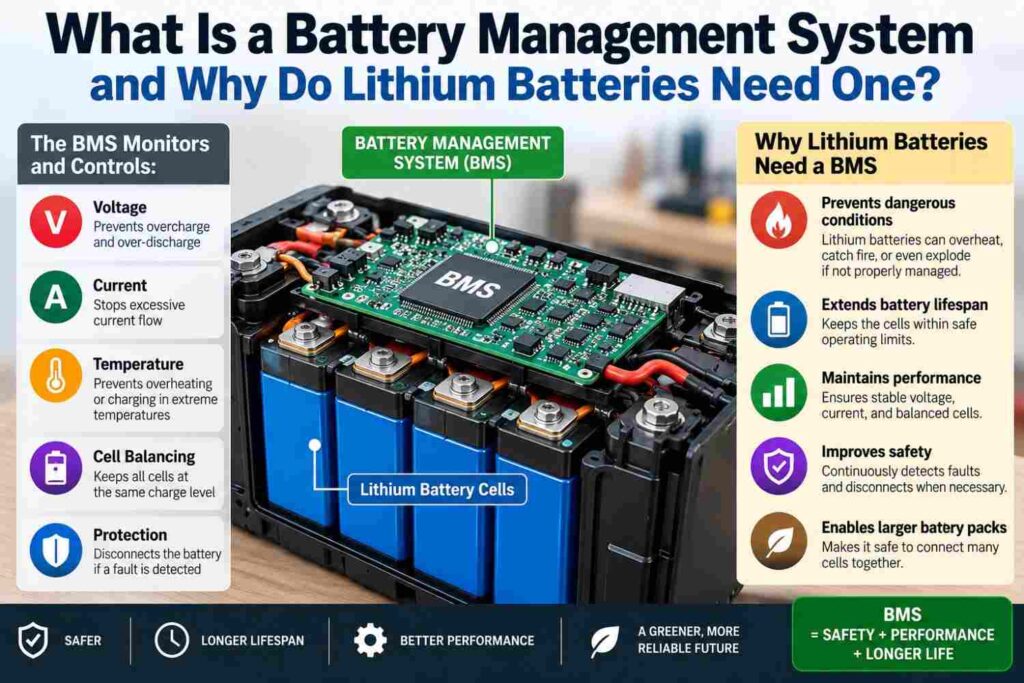
That board is the Battery Management System, or BMS, and it is arguably the single most important reason lithium batteries can be trusted in homes at all.
This article explains what a BMS actually does, why lithium chemistry cannot safely operate without one, and what to check for when buying a lithium battery in Nigeria.
What a Battery Management System Actually Is
A BMS is an electronic circuit built into (or attached to) a battery pack that constantly monitors and controls how the battery charges, discharges, and behaves under different conditions.
It sits between the individual battery cells and the outside world, acting as a gatekeeper that can cut off charging or discharging the instant it detects a condition that could damage the cells or create a safety hazard. Think of it as the battery’s built-in safety officer, watching voltage, current, and temperature every second the battery is in use.
Why Lithium Batteries Specifically Need One
Lithium battery cells, unlike lead-acid or tubular batteries, are far less tolerant of overcharging, over-discharging, and temperature extremes, a sensitivity discussed in general terms in our lithium vs lead-acid comparison article.
Push a lithium cell above its safe voltage limit and it can suffer permanent damage or, in extreme cases, thermal runaway, a dangerous chain reaction that generates heat and can lead to fire. Lead-acid batteries are far more forgiving of these same abuses; they may sulfate or lose capacity over time, but they do not carry the same fire risk.
This difference in risk tolerance is exactly why a BMS is considered mandatory equipment for lithium batteries but optional for lead-acid ones.
The Core Functions of a BMS
- Overcharge protection, cutting off charging current once cells reach their maximum safe voltage.
- Over-discharge protection, cutting off the load before cells drop below a safe minimum voltage.
- Cell balancing, redistributing small amounts of charge between individual cells so none becomes weaker than the others over time.
- Overcurrent and short-circuit protection, disconnecting the battery instantly if current draw exceeds safe limits.
- Temperature monitoring, halting charge or discharge if the battery gets too hot or too cold to operate safely.
- State of charge reporting, giving the user or inverter an estimate of remaining capacity.
Cell Balancing Explained
A lithium battery pack is made up of many individual cells wired together, and no two cells are perfectly identical even when they come from the same production batch. Without correction, small differences accumulate over repeated charge cycles, causing some cells to reach full charge before others, or to empty faster than others.
A BMS actively balances these cells during charging, either by bleeding off small amounts of energy from the fuller cells (passive balancing) or by shifting energy between cells (active balancing), keeping the whole pack working as a unit rather than being limited by its weakest cell.
What Happens Without a Functioning BMS
| Risk | Consequence Without BMS |
|---|---|
| Overcharging | Cell degradation, swelling, or thermal runaway risk |
| Over-discharging | Permanent capacity loss, cell damage |
| Cell imbalance | Reduced usable capacity, premature pack failure |
| Short circuit | Fire risk, damage to connected inverter |
| Extreme temperature charging | Accelerated aging, possible internal damage |
What to Check When Buying a Lithium Battery
Since the BMS is usually hidden inside the case, buyers cannot inspect it visually the way they might check the plates or casing of a lead-acid battery. Ask the seller directly whether the battery includes a BMS, and if possible, what protections it covers, overcharge, over-discharge, over-current, and temperature at minimum.
Reputable lithium battery brands sold in Nigeria will readily state their BMS specifications in their documentation, while unbranded or unusually cheap lithium packs sometimes cut costs by using a stripped-down BMS with fewer protections, which is a real risk given how popular lithium has become for home solar setups, a trend covered in our dedicated article on why lithium batteries have grown popular for home solar systems.
BMS and Battery Longevity
A well-functioning BMS does more than prevent disasters; it directly extends the battery’s usable life by keeping every cell operating within its ideal range and preventing the kind of abuse that accelerates capacity fade, a topic covered in more depth in our dedicated article on why batteries lose capacity as they age.
A battery that is allowed to overcharge or deep-discharge repeatedly will wear out its cells far faster than one properly managed by a good BMS, even if both batteries are the same size and chemistry on paper.
Common Misconceptions
- “All lithium batteries come with the same quality of BMS.” BMS quality varies significantly between brands, and cheaper units sometimes skip protections like active balancing or temperature monitoring.
- “A BMS is only needed for very large battery banks.” Even a single small lithium battery pack needs a BMS, since the risks of overcharge and cell imbalance exist regardless of battery size.
- “Lead-acid batteries need a BMS just as much as lithium ones.” Lead-acid chemistry is naturally more tolerant of overcharge and temperature swings, so it typically relies on simpler charge controllers rather than a full BMS.
Frequently Asked Questions
Can a lithium battery work at all without a BMS?
It can technically function briefly, but it becomes unsafe almost immediately, since there is nothing preventing overcharge, over-discharge, or short-circuit conditions.
Is the BMS the same thing as the battery’s inverter or charge controller?
No, the BMS protects the battery cells themselves, while the inverter or charge controller manages power flow to and from appliances and solar panels; they work together but perform different jobs.
Can a faulty BMS be repaired or replaced separately from the battery?
In some cases yes, a qualified technician can replace a failed BMS board, but this requires opening the sealed battery case and should only be attempted by someone experienced with lithium battery safety.
Final Thoughts
A Battery Management System is not an optional accessory on a lithium battery, it is the component that makes lithium safe and reliable enough to sit inside a Nigerian home in the first place.
It protects against overcharge, over-discharge, short circuits, and temperature extremes, while also balancing individual cells to keep the whole pack performing evenly over years of use.
When shopping for a lithium battery, treat the quality of its BMS as seriously as its Ah rating, since a weak BMS undermines everything else the battery promises. A little research at purchase time saves you from safety risks and disappointing battery life down the road.