
If you have ever opened up an inverter cabinet and seen wires connecting batteries in different patterns, you have seen series and parallel wiring in action, and getting this wrong can damage your batteries or your inverter.
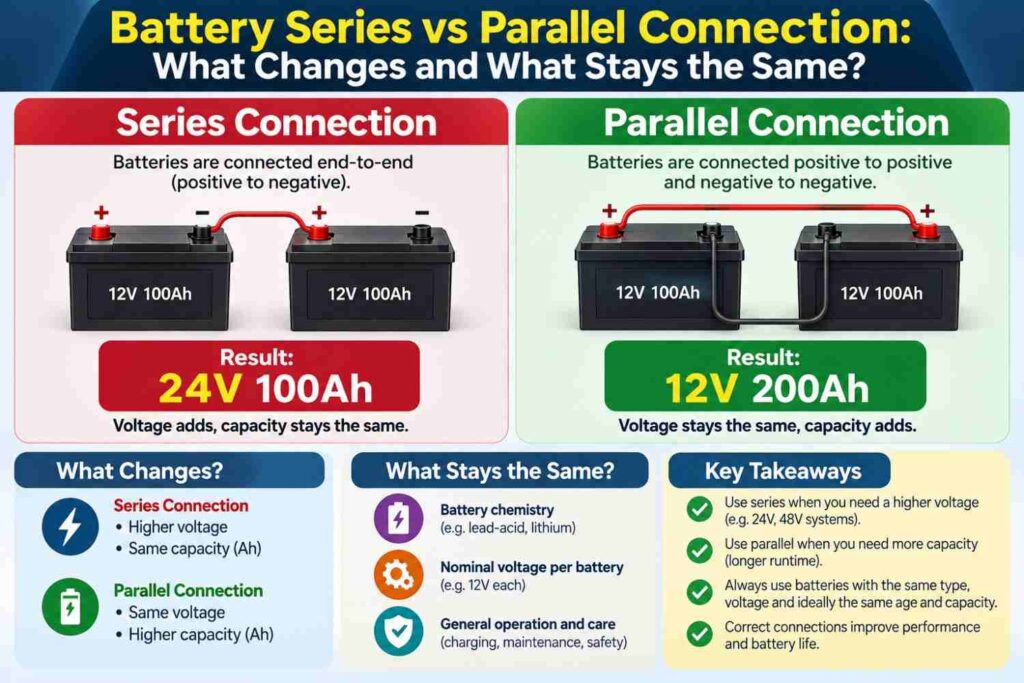
Series and parallel connections change the voltage and capacity of your battery bank in very different ways, even when you are using the exact same batteries.
This article explains what actually changes and what stays the same in each configuration, so you can wire your own bank correctly or at least understand what your installer is doing.
What Series Connection Does
In a series connection, you link the positive terminal of one battery to the negative terminal of the next, chaining them together. This adds the voltages of the batteries together while the Ah (amp-hour) capacity stays the same as a single battery.
Connect two 12V 200Ah batteries in series and you get a 24V 200Ah bank, not a 24V 400Ah bank. This is exactly how many 24V and 48V inverter systems are built from standard 12V batteries, a setup discussed more broadly in our dedicated 12V/24V/48V systems article.
What Parallel Connection Does
In a parallel connection, you link all the positive terminals together and all the negative terminals together. This adds the Ah capacity of the batteries together while the voltage stays the same as a single battery.
Connect two 12V 200Ah batteries in parallel and you get a 12V 400Ah bank, not a 24V bank. Parallel wiring is how you increase your backup runtime without changing your inverter’s voltage requirement.
Series vs Parallel at a Glance
| Configuration | Voltage Result | Capacity (Ah) Result | Wiring Pattern |
|---|---|---|---|
| Series (2 x 12V 200Ah) | 24V | 200Ah | Positive to negative, battery to battery |
| Parallel (2 x 12V 200Ah) | 12V | 400Ah | Positive to positive, negative to negative |
| Series-Parallel (4 x 12V 200Ah) | 24V | 400Ah | Two series pairs, then paralleled together |
Series-Parallel: Combining Both
Most real inverter battery banks in Nigerian homes use a combination of both, called series-parallel wiring. You first connect pairs of batteries in series to reach the voltage your inverter needs, then connect those pairs together in parallel to add capacity.
Four 12V 200Ah batteries wired as two series pairs, then paralleled, give you 24V at 400Ah, doubling both your inverter’s operating voltage requirement satisfaction and your runtime compared to a single pair.
What Stays the Same in Either Configuration
Regardless of how you wire batteries together, a few things never change. The total energy stored in Wh is identical either way, since Wh = Ah × V remains constant whether you got there through higher voltage or higher Ah, a relationship explained fully in our dedicated Ah vs Wh article.
The individual battery specifications, such as their chemistry, age, and health, also stay exactly as they were before wiring; connecting batteries together does not upgrade or repair a weak cell. Finally, the discharge characteristics of the weakest battery in the bank still influence the whole system’s behavior, which is why mismatched batteries cause problems regardless of wiring pattern.
Why Wiring Mistakes Are Dangerous
Connecting batteries in series when your inverter expects a parallel (single-voltage) setup will feed it double or triple the voltage it is rated for, which can damage the inverter’s electronics immediately. Connecting them in parallel when the inverter expects series voltage will starve it of the voltage it needs to start up properly.
Beyond equipment damage, wiring mistakes in high-Ah battery banks can cause serious short-circuit risks, since a mismatched or reversed connection can draw very high current through undersized cables, generating heat and posing a fire hazard. This is why it matters to always check your inverter’s rated input voltage before wiring, and to use cables rated for the expected current.
Step-by-Step: Wiring a Series-Parallel Bank Safely
- Confirm your inverter’s required input voltage (12V, 24V, or 48V) from its manual or nameplate.
- Use identical batteries in age, capacity, and brand wherever possible, since mismatched batteries in a bank cause uneven charging and drain.
- Wire the required number of batteries in series first to reach the target voltage.
- Repeat to create additional series strings if you need more capacity.
- Connect the series strings together in parallel, positive to positive and negative to negative.
- Use appropriately rated cables and secure all terminal connections tightly to avoid resistance and heat buildup.
- Double-check total voltage with a multimeter before connecting to the inverter.
Common Misconceptions
- “Connecting batteries in parallel always doubles the voltage.” Parallel connection increases Ah capacity, not voltage; voltage stays the same as a single battery.
- “You can mix series and parallel wiring with batteries of different Ah ratings freely.” Mismatched Ah ratings within the same bank cause uneven charge and discharge, which shortens battery life, as covered in our article on mixing batteries with different Ah ratings.
- “Wiring configuration can fix a weak or aging battery.” Series or parallel wiring only combines existing capacity and voltage; it cannot restore a battery that has already lost capacity.
Frequently Asked Questions
Does series or parallel wiring affect how fast batteries charge?
Charging speed depends more on your charger or inverter’s charging current and the battery’s Ah rating than on the wiring pattern itself, though a higher-Ah parallel bank generally takes longer to fully charge.
Can I connect a 24V system in parallel with a 12V system?
No, you should never connect battery banks of different voltages together in parallel, as this creates dangerous current flow between the mismatched banks.
Is series or parallel wiring better for a home inverter setup?
Neither is inherently better; the choice depends on your inverter’s required voltage, and most Nigerian home setups use a series-parallel combination to hit both the required voltage and desired capacity.
Final Thoughts
Series wiring adds voltage while keeping Ah the same, parallel wiring adds Ah while keeping voltage the same, and most practical inverter battery banks combine both to hit a target voltage and capacity at once. What never changes is the total stored energy in Wh and the underlying health of each individual battery, wiring pattern cannot fix a weak cell.
Before wiring any battery bank, confirm your inverter’s required voltage and use identical batteries throughout to avoid uneven wear. Getting the configuration right the first time protects both your investment in batteries and the inverter itself.