
Walk into any battery shop in Lagos or Kano and you will hear numbers thrown around like 200Ah, 220Ah, or 2.4kWh, and many buyers nod along without really knowing what separates one figure from the other.
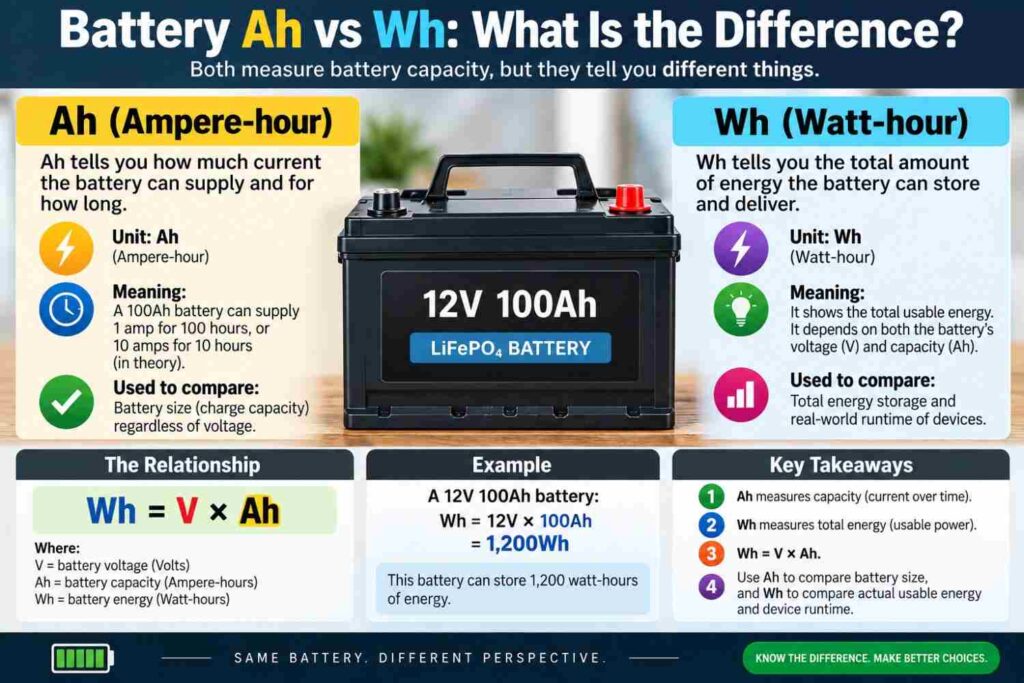
Ah and Wh both describe how much energy a battery can hold, but they measure it in different ways, and mixing them up is one of the most common reasons people buy the wrong battery for their inverter.
This article breaks down exactly what each unit means, how to convert between them, and why the difference matters when you are sizing a battery bank for your home or office.
What Ah (Amp-Hours) Actually Measures
Amp-hours describe how much current a battery can deliver over time, independent of voltage. A 200Ah battery can theoretically supply 200 amps for one hour, 100 amps for two hours, 20 amps for ten hours, and so on, although in practice the usable capacity changes slightly depending on how fast you draw the current.
Ah is the number printed on almost every inverter battery sold in Nigeria because it is easy to compare batteries of the same voltage against each other. The problem is that Ah alone tells you nothing about the actual energy stored unless you also know the voltage.
What Wh (Watt-Hours) Actually Measures
Watt-hours measure real energy, the same unit your electricity meter uses, just on a smaller scale. A watt-hour figure already accounts for voltage, so it gives you a true picture of how much power a battery can deliver over time regardless of whether it is a 12V, 24V, or 48V system.
This is why Wh (or kWh for larger banks) is the more reliable number when comparing batteries of different voltages or different chemistries, such as when weighing a 12V lead-acid unit against a 48V lithium pack.
The Formula That Connects Them
The relationship between the two is simple multiplication: Watt-hours equal Amp-hours multiplied by Voltage (Wh = Ah × V). So a 200Ah battery at 12V stores 2,400Wh, or 2.4kWh. The same 200Ah rating on a 24V battery would store 4,800Wh, double the energy, even though the Ah number on the label looks identical.
This is exactly why two batteries with the same Ah rating can perform very differently depending on their voltage, and why comparing Ah figures across different voltage systems is misleading.
A Worked Example
Suppose you are comparing three battery options for a home backup system and want to know which actually stores the most usable energy.
| Battery | Voltage | Ah Rating | Energy Stored (Wh) |
|---|---|---|---|
| Battery A | 12V | 200Ah | 2,400Wh |
| Battery B | 24V | 150Ah | 3,600Wh |
| Battery C | 48V | 100Ah | 4,800Wh |
Notice that Battery C has the lowest Ah rating of the three but actually stores the most energy, because its voltage is much higher. If you only looked at the Ah numbers, you would wrongly assume Battery A was the biggest.
Why This Matters When Sizing an Inverter Battery Bank
When you are trying to figure out how long your fridge, fans, television, and a few bulbs will run during a NEPA outage, you need to work in Wh or kWh, not raw Ah, because your appliance load is also measured in watts. Add up the wattage of everything you want to power, multiply by the hours you want backup for, and that gives you your target Wh figure.
From there you can work backward to figure out how many Ah you need at your chosen system voltage. Skipping this step is a major reason people underbuy battery capacity and then wonder why their inverter cuts off earlier than expected.
Ah and Wh Across Battery Chemistries
The conversion formula itself does not change between lead-acid and lithium batteries, but usable capacity does, which is a topic covered in more depth in our dedicated depth of discharge article.
A 200Ah lead-acid battery and a 200Ah lithium battery at the same voltage store the same total Wh on paper, but you can safely use far more of the lithium battery’s stored energy before it needs recharging.
So when comparing batteries for real-world use, always ask both the Ah/Wh figure and the recommended depth of discharge, not just one or the other.
How to Read a Battery Label Correctly
- Check the voltage first, since it is the multiplier that turns Ah into real energy.
- Check the Ah rating and the discharge rate it was tested at, usually written as C10 or C20 for Nigerian market batteries.
- Calculate Wh yourself using Ah × V if the label does not already state it.
- Compare batteries by Wh or kWh when their voltages differ, and only compare by Ah when voltage is identical.
- Note the battery chemistry, since usable Wh differs from stored Wh depending on lithium versus lead-acid, tubular, or gel construction.
Common Misconceptions
- “A higher Ah number always means a bigger battery.” Only true when comparing batteries of the same voltage; at different voltages, Wh is the fair comparison.
- “Ah and Wh are just two names for the same thing.” They measure different quantities, current over time versus actual energy, and only convert into each other once voltage is known.
- “Manufacturers always print Wh on the battery, so you never need to calculate it.” Most inverter batteries sold locally only print Ah and voltage, leaving the buyer to do the Wh calculation themselves.
Frequently Asked Questions
Can I compare a 12V 200Ah battery directly with a 24V 150Ah battery using Ah alone?
No, because the voltages differ. Convert both to Wh first (2,400Wh versus 3,600Wh) to see which actually stores more energy.
Does a higher Wh rating always mean longer backup time?
Generally yes for the same load, but actual backup time also depends on your appliance wattage, inverter efficiency, and the battery’s usable depth of discharge.
Why do some sellers only quote Ah and not Wh?
Ah is the traditional figure used across the Nigerian battery market and is simpler to print on a single-voltage product line, but it can be converted to Wh with a quick multiplication by voltage.
Final Thoughts
Ah tells you how much current a battery can push over time, while Wh tells you how much real energy it stores, and the two only become comparable once you factor in voltage. Getting this distinction right protects you from buying a battery bank that looks impressive on paper but underperforms once appliances are connected.
Whenever you are sizing a system, do the Ah × V = Wh calculation yourself rather than relying on Ah figures alone, especially when comparing batteries across different voltage systems. A few minutes with a calculator before you buy can save you from months of disappointing backup time.