
Many Nigerian homeowners deliberately start small with solar, covering just the essentials, with a plan to expand once budget allows or once household energy needs grow. The good news is that expanding an existing solar system is usually possible, but it is not always as simple as bolting on a few extra panels and calling it done.
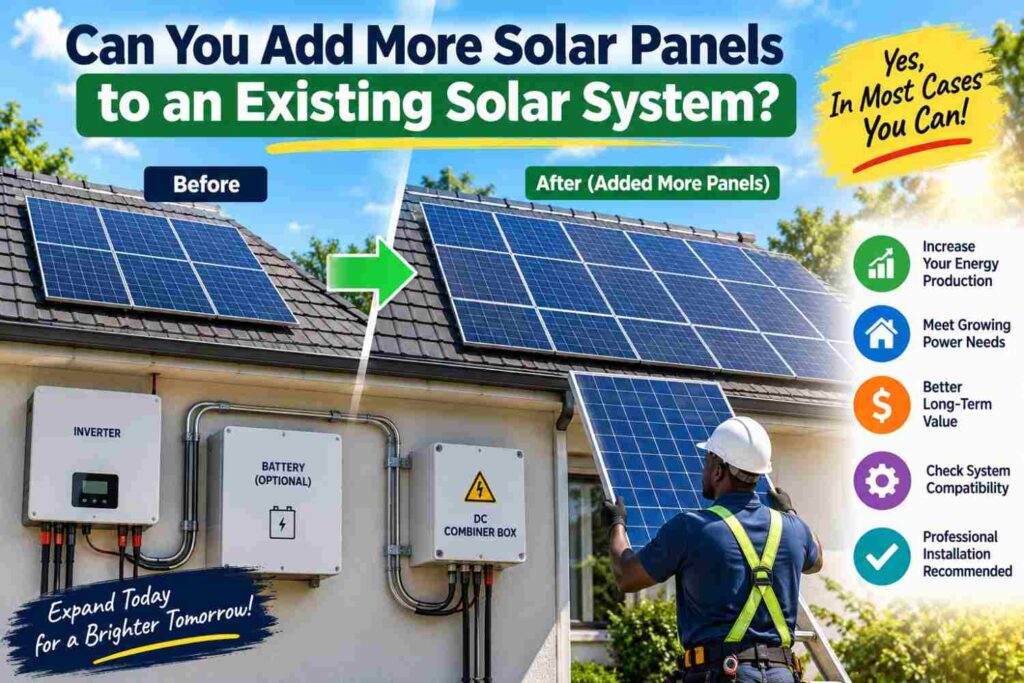
This article covers what actually needs to be checked before you add capacity, and when an expansion means upgrading more than just the panels.
Why Expansion Is a Common Path in Nigeria
Given the upfront cost of a full-capacity solar and battery setup, many households and small businesses install a smaller starter system first, covering lighting, fans, and essential appliances, then scale up over time as funds allow.
This staged approach makes solar more accessible without one large lump sum, but it only works smoothly if the components being reused have enough spare capacity to support additional panels.
What to Check Before Adding Panels
The single most important step before adding panels is confirming that your existing charge controller or inverter actually has room for the extra capacity.
Every charge controller has a maximum input current and voltage rating, and every inverter has a maximum DC input rating; exceeding either can damage the equipment or trigger the kind of clipping losses discussed in our dedicated clipping article.
You also need to revisit your battery bank capacity, since more panels producing more power is only useful if your batteries and household loads can actually absorb and use that extra generation.
Series and Parallel Considerations When Expanding
How you add the new panels matters just as much as how many you add. If you are extending an existing series string, the new panels must match the voltage and current specifications, Voc, Vmp, Isc and Imp as explained in our dedicated article, of the panels already in that string, otherwise the mismatch will drag down the whole string’s performance.
Adding a completely new parallel string is often the safer and more flexible route, since it keeps the new panels electrically independent of the existing ones, as long as the combined current from all strings together still stays within your charge controller’s rated limits, a topic covered in our series versus parallel wiring article.
| Component to Check | What to Verify | Risk if Ignored |
|---|---|---|
| Charge controller / inverter | Maximum input voltage and current headroom | Equipment damage or clipping losses |
| Battery bank | Enough capacity to store and use added generation | Wasted surplus energy, no real gain |
| Wiring and fusing | Cable gauge and fuse ratings for higher current | Overheating, fire risk |
| Combiner box (if used) | Spare input slots for new strings | Need for a box upgrade or replacement |
| Roof or mounting space | Physical room and structural capacity | Unsafe mounting or shading conflicts |
When You Need to Upgrade More Than Just Panels
Sometimes the honest answer to “can I add more panels” is yes, but only after upgrading other parts of the system first. If your existing charge controller or inverter is already close to its maximum rated capacity, adding panels without upgrading it will simply result in clipped, unused output rather than any real gain.
Similarly, if your battery bank is already undersized for your current panel array, adding more panels without also expanding storage mostly increases the amount of excess energy going unused during the day, a scenario explained in our excess solar energy article, rather than genuinely boosting how much usable power you get.
Matching New Panels to an Older Array
Solar panel models and specifications change over time, so it is common for a homeowner expanding a system a few years after the original installation to find that the exact original panel model is no longer available.
Mixing slightly different panel wattages or specifications within the same string is generally discouraged, since the string will perform at the level of its weakest panel, but adding a separate, independent string or a separate MPPT input specifically for the new panels sidesteps this problem entirely, as long as your charge controller supports multiple independent inputs.
Steps for a Smooth Expansion
- Get the datasheets for your existing panels, charge controller, and inverter before shopping for new equipment.
- Calculate your charge controller and inverter’s remaining spare capacity in watts, volts, and amps.
- Decide whether new panels will extend an existing string or form a new independent string or MPPT input.
- Confirm your battery bank has enough usable capacity to benefit from the added generation, upgrading it if necessary.
- Check that existing cabling, fuses, and any combiner box can safely handle the increased current.
- Have a qualified installer review the full plan before mounting new panels, especially if your original installation is more than a couple of years old.
Is It Cheaper to Expand or Start Fresh?
In most cases, expanding an existing system in stages works out cheaper overall than replacing everything from scratch, since you retain the value of your existing panels, mounting structure, and often the charge controller or inverter if it has spare capacity.
The exception is when your existing inverter is already near its limit and genuinely needs replacing anyway, in which case upgrading to a larger unit in one move can make more sense than patching around an undersized component.
Common Misconceptions
- “Any solar panel can simply be added to an existing string without checking specifications.” Mismatched panels within the same series string reduce the whole string’s performance to the level of the weakest panel.
- “More panels always mean more usable power immediately.” Extra generation only translates into real benefit if your charge controller, inverter, and battery bank have the spare capacity to accept and use it.
- “Expanding a solar system always requires replacing the entire setup.” In most cases only specific components, sometimes just the battery bank, need upgrading, while panels, mounting, and wiring can often be reused or extended.
Frequently Asked Questions
Can I add panels from a different brand than my original ones?
Yes, especially if wired as a separate independent string, though matching specifications closely still gives more predictable performance.
How do I know if my charge controller has room for more panels?
Compare its maximum rated input voltage and current against the combined totals of your existing panels plus the ones you plan to add.
Will adding more panels reduce how long my batteries last?
No, more generation capacity does not by itself harm battery lifespan; what matters is whether charging and discharging patterns stay within the battery’s recommended limits.
Final Thoughts
Adding more panels to an existing solar system is very often possible and is a genuinely practical way for Nigerian households and businesses to scale up their power supply over time rather than committing to a huge upfront cost.
The key is checking the real spare capacity of your charge controller, inverter, and battery bank before assuming the panels alone are all that need attention.
A little planning before expansion, ideally with a qualified installer reviewing the numbers, ensures your added panels actually translate into more usable power rather than wasted generation or, worse, damaged equipment.