Most solar conversations in Nigeria revolve around charge controllers and hybrid inverters for battery-based systems, but there is another inverter decision that matters just as much for how your panel array is wired and how it performs: microinverters versus string inverters.
This choice affects everything from installation cost to how your system handles shading and faults. This article breaks down how each approach works and which one tends to make more sense for different situations.
What a String Inverter Does
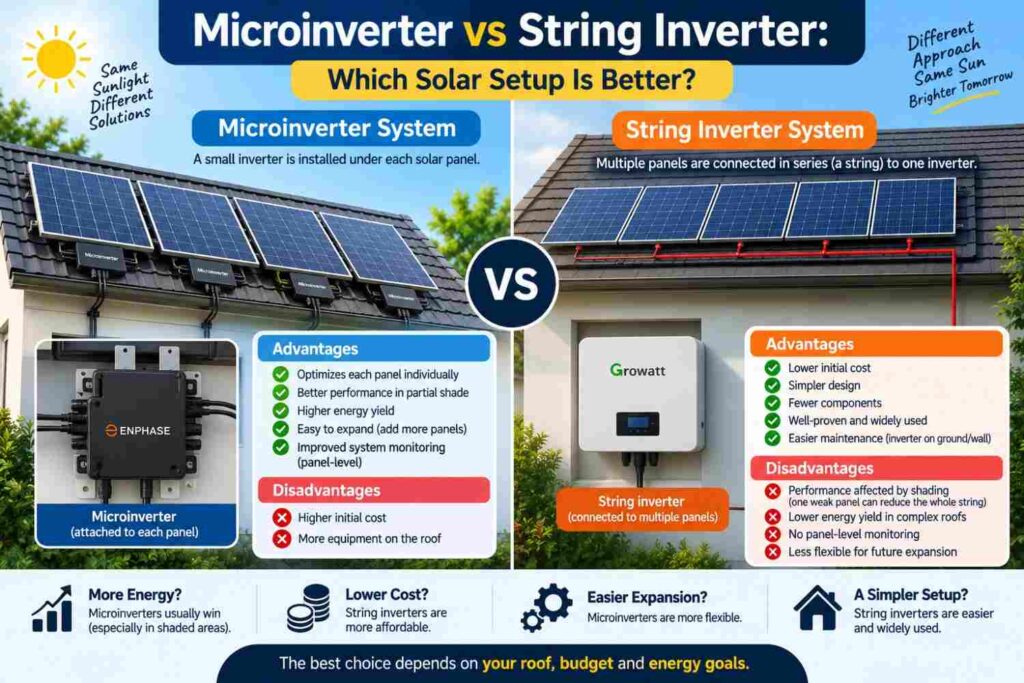
A string inverter is a single, centralized unit that takes the combined DC output from an entire string, or several strings, of panels wired together, and converts it all into usable AC power in one place. This is the traditional and still most common approach, especially for hybrid systems paired with battery banks.
Because all the panels in a string are electrically linked, the output of the whole string is influenced by the weakest-performing panel in that string, an effect closely related to the shading concerns covered in our dedicated shading article.
What a Microinverter Does
A microinverter takes a completely different approach by placing a small inverter on or near every individual panel, converting each panel’s DC output to AC right at the source rather than combining raw DC power first.
Because each panel operates independently, one shaded, dirty, or underperforming panel does not drag down the output of the others in the array, which can meaningfully improve total energy yield in installations where partial shading, mismatched panel angles, or uneven soiling is a recurring issue.
| Factor | String Inverter | Microinverter |
|---|---|---|
| Upfront cost | Lower | Higher, per-panel hardware cost |
| Shading tolerance | Weak, whole string affected | Strong, isolated per panel |
| Monitoring detail | System or string level | Individual panel level |
| Fault isolation | Harder to pinpoint faulty panel | Easy to identify exact panel |
| Compatibility with hybrid battery systems | Widely supported | More limited, fewer local options |
| Maintenance access | Ground-level, easier to service | On the roof, per unit |
Cost Differences and What They Mean in Nigeria
String inverters remain significantly cheaper to purchase and install in the Nigerian market, and they are also far more widely stocked and understood by local installers, particularly for hybrid systems that need to integrate with battery banks and charge controllers.
Microinverters carry a noticeably higher upfront cost since you are effectively buying one small inverter for every single panel, and finding installers with genuine microinverter experience and stock availability in Nigeria is still relatively limited compared to standard string and hybrid inverter setups.
Shading and Performance in Real Nigerian Conditions
Shading is one of the strongest arguments for microinverters, and it is a genuinely common issue on Nigerian rooftops crowded by water tanks, satellite dishes, neighbouring buildings, and trees. With a string inverter, even one consistently shaded panel can drag down the output of every other panel wired into that same string, sometimes disproportionately.
A microinverter setup isolates that loss to just the affected panel, letting the rest of the array continue performing at full capacity. If your roof has unavoidable partial shading at certain times of day, this difference alone can justify the extra cost.
Monitoring and Troubleshooting
Microinverters generally offer panel-level monitoring, meaning you or your installer can see exactly how each individual panel is performing through an app or monitoring portal, making it far easier to spot a failing or underperforming panel without physically testing each one.
With a string inverter, monitoring is typically limited to the string or system level, so diagnosing a specific weak panel usually requires manual testing with a multimeter, panel by panel, which takes more time and expertise.
Which Setup Fits Different Situations
- Choose a string inverter for straightforward installations with unobstructed sun exposure and a tight budget, especially where a hybrid battery-based system is the priority.
- Choose a string inverter when local installer support and spare parts availability matter more than squeezing out maximum shading tolerance.
- Choose microinverters when your roof has genuine, unavoidable partial shading from trees, tanks, or nearby structures at certain times of day.
- Choose microinverters when detailed panel-level monitoring and easier fault diagnosis are a priority for you or your maintenance team.
- Consider a middle-ground option, power optimizers, which sit between string and microinverter designs by improving per-panel performance while still using a centralized inverter, if available from your supplier.
Compatibility With Hybrid and Battery-Based Systems
It is worth being clear that most Nigerian solar installations are hybrid systems built around batteries, tubular or lithium as discussed in our inverter and battery articles, and string-based hybrid inverters are far more common and better supported for this purpose.
Microinverters are primarily designed for grid-tied AC-coupled systems, and while battery-compatible microinverter setups do exist, they are less common, generally pricier, and require more specialized integration in the Nigerian market.
This is a major reason string inverters remain the default recommendation for most homes prioritizing battery backup during outages.
Common Misconceptions
- “Microinverters are always the better choice regardless of cost.” String inverters remain the more practical and cost-effective choice for most hybrid battery-based systems, which is what most Nigerian homes actually need.
- “A string inverter setup cannot handle any shading at all.” Moderate shading is manageable with proper string design and bypass diodes, discussed in our shading article; microinverters simply handle it more gracefully in severe cases.
- “Microinverters and string inverters are interchangeable options for any budget.” The higher per-panel cost of microinverters and their more limited local availability make them a less accessible default option for typical Nigerian residential budgets.
Frequently Asked Questions
Are microinverters worth it for a typical Nigerian home?
Only if your roof has significant unavoidable shading or you specifically want panel-level monitoring; otherwise a string or hybrid inverter setup is usually more cost-effective.
Can I mix microinverters and a battery bank in one system?
It is possible with certain battery-compatible microinverter products, but options and local installer familiarity are limited compared to standard hybrid string inverter setups.
Do microinverters last as long as string inverters?
Both are generally built for long service life, though because microinverters sit exposed on the roof rather than in a sheltered equipment room, they can face harsher conditions over time.
Final Thoughts
The choice between microinverters and string inverters ultimately comes down to your roof conditions, your budget, and whether battery backup is central to your setup.
For most Nigerian households prioritizing hybrid systems with dependable backup during outages, a string or hybrid inverter remains the more practical, better-supported, and more affordable choice.
Microinverters earn their higher price tag specifically when shading is unavoidable or when granular panel-level monitoring is a genuine priority, so weigh your actual roof conditions honestly before choosing the pricier option.