
If you have ever noticed your solar system’s output flatline right around midday even though the sun is blazing and the sky is completely clear, you have probably witnessed solar clipping without knowing what to call it.
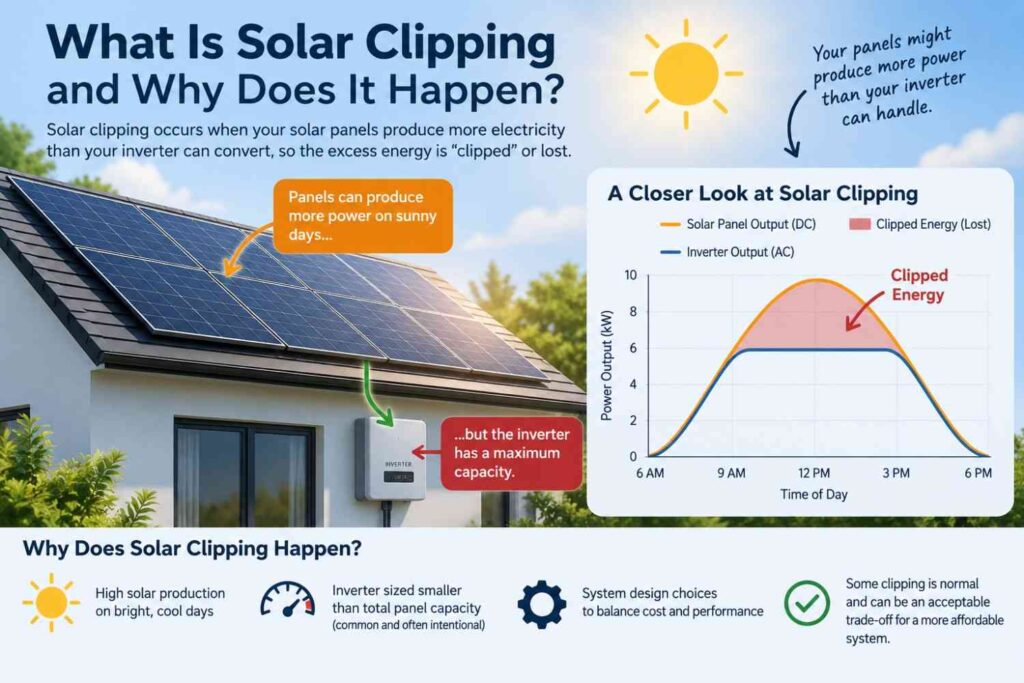
It sounds like a fault, but in most cases it is simply a design choice, intentional or not, in how the panel array was matched to the inverter or charge controller. This article explains what clipping is, why it happens, and whether it is actually something to worry about.
What Solar Clipping Means
Clipping happens when your solar array is capable of producing more power than your inverter or charge controller is rated to accept or convert, so the excess above that limit is simply discarded rather than used.
For example, if you have a 6kW array feeding a 5kW inverter, on a bright, cool, cloudless afternoon when the panels are producing at their peak, that extra 1kW does not disappear into storage somewhere, it is cut off, or “clipped,” at the inverter’s maximum input capacity.
The system does not crash or get damaged; it simply produces flat, capped output for that window of time.
Why Installers Deliberately Oversize Arrays
Clipping often is not a mistake at all. Installers frequently size the panel array slightly larger than the inverter’s rated capacity on purpose, a practice sometimes called DC-to-AC oversizing.
Panels rarely produce their full rated wattage in real-world conditions because of temperature losses, dust, less-than-ideal orientation, and the fact that peak sun conditions only occur for a limited window each day, all covered in more detail in our panels underperforming article.
By oversizing the array modestly, the system produces closer to the inverter’s full rated capacity for a longer stretch of the day, even though it means sacrificing a small amount of power during the very brightest hours.
| Scenario | Array Size | Inverter Size | Effect |
|---|---|---|---|
| Matched sizing | 5kW | 5kW | Rarely reaches full inverter capacity; less midday clipping |
| Moderate oversizing | 6kW | 5kW | Some midday clipping, but higher output across more of the day |
| Heavy oversizing | 7.5kW | 5kW | Noticeable clipping losses, only justified in specific cases |
When Clipping Becomes a Problem
A small amount of clipping, especially for an hour or two around solar noon on the clearest days, is generally accepted as a reasonable trade-off and often barely dents overall annual energy yield.
It becomes a genuine concern when the array is dramatically oversized relative to the inverter, causing significant power loss for large parts of the day rather than just the peak hour.
This usually points to a sizing mistake, either an installer miscalculating the array-to-inverter ratio or a homeowner adding extra panels later, discussed further in our article on expanding an existing system, without checking whether the existing inverter can handle the increased input.
Clipping vs Other Causes of Low Output
Clipping is easy to misdiagnose because it looks similar to other output problems. The key difference is timing and pattern: clipping shows up as a flat, capped ceiling on bright, sunny days specifically around midday, while shading, dust, or a failing panel tends to reduce output more broadly across the day or show up as inconsistent, unpredictable dips.
If your system output plateaus at a suspiciously round number, close to your inverter’s rated capacity, during the sunniest part of the day, that is a strong sign of clipping rather than a fault.
How to Reduce or Avoid Unwanted Clipping
- Ask your installer for the exact array-to-inverter sizing ratio before installation and confirm it is intentional.
- Keep the oversizing ratio modest, typically no more than 10 to 20 percent above the inverter’s rated capacity, unless there is a specific reason for more.
- If adding panels to an existing system, check the inverter’s maximum DC input rating first rather than assuming it can absorb unlimited extra capacity.
- Consider whether a larger inverter makes more sense than an oversized array if you expect to expand further in the future.
- Monitor your system’s output logs, where available, to see how often and how severely clipping actually occurs before deciding it is a problem worth fixing.
Is Clipping Actually Bad for Your System?
In most moderate cases, clipping is not harmful to your equipment at all. The inverter is designed to safely cap input at its rated limit rather than being damaged by excess supply. The real cost is simply lost potential energy during the clipped hours, which in Nigeria’s strong solar irradiance can still add up to a meaningful amount over a year if oversizing is aggressive.
For most households running a hybrid system where any midday surplus beyond inverter capacity would have gone toward battery charging or grid export anyway, a modest, well-planned amount of clipping is a reasonable and common engineering trade-off rather than a defect.
Common Misconceptions
- “Clipping means my solar panels or inverter are damaged.” Clipping is a normal capacity limit being reached, not a sign of equipment failure or damage.
- “An oversized array is always a wiring or sizing mistake.” Installers often oversize arrays intentionally to boost output during non-peak hours, accepting a small amount of midday clipping as a trade-off.
- “Clipped energy is stored somewhere and used later.” Clipped power above the inverter’s rated capacity is simply not converted at all in that moment; it is lost, not stored.
Frequently Asked Questions
How much clipping loss is considered normal?
Losses of around 1 to 3 percent of annual energy production are generally considered acceptable for a modestly oversized array.
Can I fix clipping without replacing my inverter?
Sometimes reducing the number of active panels or redistributing strings can help, but the most direct fix is upgrading to a larger inverter if clipping losses are significant.
Does clipping happen with charge controllers as well as inverters?
Yes, a charge controller also has a maximum input rating, and an array producing beyond that limit will be clipped in the same way, whether using MPPT or PWM as explained in our dedicated article.
Final Thoughts
Solar clipping sounds alarming the first time you notice it, but in the vast majority of cases it is simply the visible result of an inverter or charge controller doing exactly what it is designed to do: cap input at a safe limit.
Modest, intentional oversizing is a common and often sensible design choice that boosts output across more of the day at the cost of a small amount during peak hours. The only time to actually worry is when clipping losses are large and consistent, which usually signals a sizing mismatch worth revisiting with your installer rather than a fault to fix on your own.