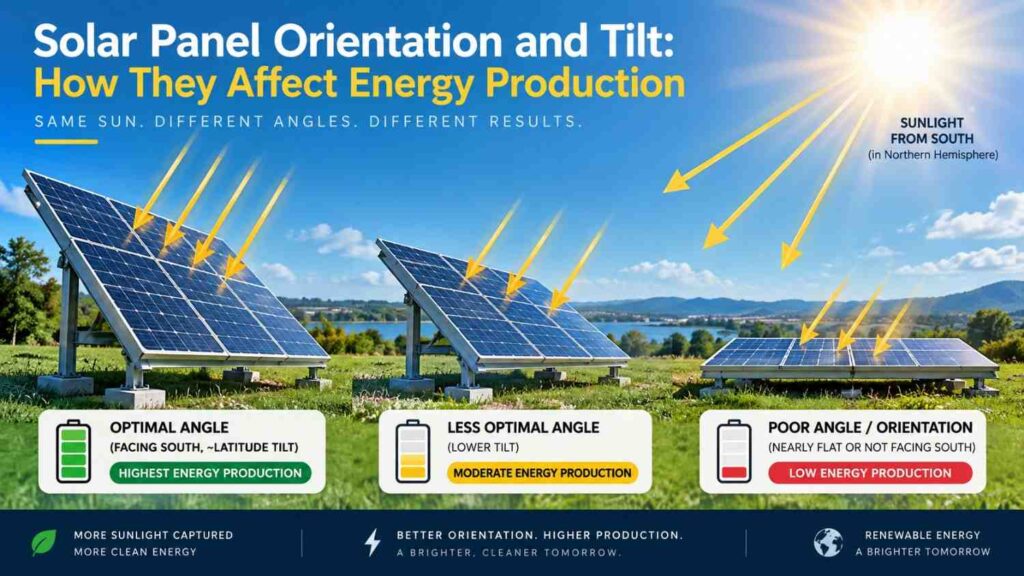
Two identical solar arrays, same panel count, same location, can produce noticeably different amounts of energy simply because of the angle they sit at and the direction they face. Orientation and tilt are two of the cheapest variables to get right during installation, yet they are frequently rushed or ignored because a roof only allows for so much flexibility.
This article walks through how direction and angle affect your energy yield and what practical choices Nigerian installers actually make when the “ideal” setup is not available.
Orientation: Which Direction Should Panels Face?
Orientation refers to the compass direction your panels face. Because Nigeria sits in the northern hemisphere, close to the equator, panels generally perform best when they face true south, since the sun tracks across the northern part of the sky for a large part of the year and swings slightly south during other months due to the country’s low latitude.
A south-facing array captures the most consistent sunlight across the full day and across the seasons. East-facing panels catch strong morning sun but taper off by early afternoon, while west-facing panels do the opposite, producing little in the morning and peaking later in the day.
In practice, many Nigerian rooftops do not offer a perfect south-facing surface, and that is fine. A deviation of up to 20 or 30 degrees from true south typically costs only a small percentage of annual output, which is a reasonable trade-off if it means the panels are easier to mount, less shaded, or structurally more secure.
Tilt: Why the Angle of the Panel Matters
Tilt is the angle between the panel surface and the horizontal ground. The general rule is that a panel performs best when sunlight hits it as close to perpendicular as possible.
Because Nigeria is close to the equator, the sun sits high overhead for much of the year, which means a fairly low tilt angle, often between 10 and 15 degrees, works well for most locations across the country.
A completely flat panel is not ideal either, since a slight tilt helps rainwater and dust run off the surface rather than pool and accumulate.
Fixed Roof Angles vs Adjustable Mounts
Most residential Nigerian installations use fixed-angle mounting brackets rather than seasonally adjustable racks, mainly because adjustable mounts add cost and complexity that rarely pays off given how little the sun’s angle swings near the equator compared to locations farther north or south.
Flat concrete roofs, common on many Nigerian homes, actually offer an advantage here since installers can build a frame to whatever tilt they choose rather than being locked into the pitch of a sloped roof. Sloped corrugated iron roofs limit the choice somewhat, and installers will sometimes accept a less-than-ideal tilt in exchange for a simpler, more secure mounting job.
| Roof Type | Typical Approach | Trade-off |
|---|---|---|
| Flat concrete roof | Custom frame built to ideal tilt | Slightly higher installation cost |
| Sloped iron roof | Panels follow existing roof pitch | May not match ideal tilt exactly |
| Ground mount | Frame built to ideal tilt and orientation | Requires available land space |
How Much Energy Is Really at Stake
Getting orientation and tilt exactly right typically improves annual yield by somewhere between 5 and 15 percent compared to a poorly oriented array, depending on how far off the original setup was.
That is a meaningful difference over the life of a system, but it is rarely worth compromising structural safety or drastically increasing installation cost to chase the last few percentage points.
Panel count sizing, discussed in our dedicated sizing article, and correct wiring configuration usually have a bigger overall impact on system performance than fine-tuning tilt by a few degrees.
Seasonal Adjustments and Rainy Season Considerations
Because Nigeria’s seasonal sun angle changes are relatively modest, most installers set a single fixed tilt rather than adjusting panels twice a year.
However, tilt does play a role during the rainy season: a panel with at least a 10-degree tilt sheds rainwater and washes away a good amount of surface dust naturally, while a nearly flat panel tends to collect standing water and grime in the gutters between cells.
This ties directly into the concerns raised in our rainy weather and panel cleaning articles, where a reasonable tilt angle is one of the simplest ways to reduce how often manual cleaning is needed.
Steps to Check Your Own Orientation and Tilt
- Use a compass app on your phone to check which direction your roof or mounting area actually faces.
- Note any large trees, water tanks, or neighbouring buildings that could cast shade at different times of day.
- Ask your installer to state the planned tilt angle in degrees before installation begins, not just describe it as “slightly angled.”
- If using a flat roof, request a custom frame rather than laying panels flat on the surface.
- Confirm the mounting structure is rated to withstand strong winds at the chosen tilt, especially during the rainy season.
Common Misconceptions
- “Panels must face exactly true south or they are wasted.” A moderate deviation from true south costs only a small percentage of output and is often an acceptable trade-off for a more practical installation.
- “Flat panels are always better because they get more direct overhead sun.” A completely flat panel collects dust and water more easily and does not shed rain the way a slightly tilted panel does.
- “Tilt angle should be adjusted every season for best results.” Near the equator, the sun’s angle changes so little across the year that most Nigerian installations use one fixed tilt without meaningful performance loss.
Frequently Asked Questions
What is the ideal tilt angle for solar panels in Nigeria?
Roughly 10 to 15 degrees works well for most parts of the country, though your installer may adjust slightly based on your exact location and roof type.
Can east or west facing panels still be worthwhile?
Yes, they still produce useful energy, just shifted toward morning or afternoon peaks, and can even be paired on both sides of a roof to spread generation across the day.
Does poor orientation damage the panels over time?
No, orientation only affects how much energy is produced, not the physical health or lifespan of the panels themselves.
Final Thoughts
Orientation and tilt are not the flashiest part of a solar installation, but getting them reasonably right costs nothing extra and pays back in real energy yield over the system’s lifetime.
In Nigeria’s near-equatorial climate, a south-facing array with a modest 10 to 15 degree tilt is a solid default for most rooftops, with sensible compromises made for flat versus sloped roofs.
Rather than obsessing over perfection, focus on avoiding shade, choosing a reasonable tilt that sheds rainwater, and letting your installer confirm the final numbers before the mounting brackets go up.