
“NEPA has taken light again” is one of the most familiar phrases in Nigerian households, but not every power problem is actually a full blackout. Sometimes the lights stay on but appear dim and weak, appliances struggle to start, and everything just feels underpowered, a condition known as a brownout.
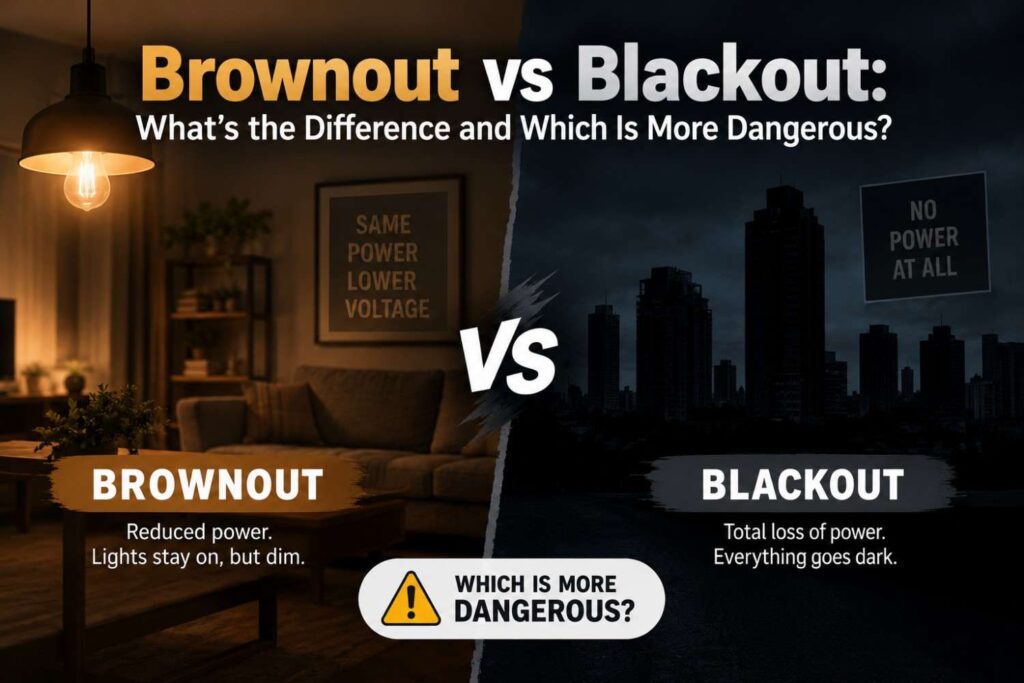
Understanding the difference between these two events, and which one poses the greater risk to your appliances, can change how you respond when power problems strike.
What a Blackout Is
A blackout is a complete loss of electrical supply, meaning voltage drops to zero and no power reaches the building at all. This can result from a fault on the local distribution line, scheduled or unscheduled load shedding by the distribution company, a transformer failure, or a wider event such as a grid collapse, discussed in more detail in our dedicated grid collapse article. During a blackout, appliances simply stop, since there is no voltage available to run them, and the main risk to equipment typically comes not from the blackout itself but from the surge that can occur when power is restored.
What a Brownout Is
A brownout is a sustained reduction in voltage below normal levels, without a complete loss of supply. Unlike an outage, power remains present throughout a brownout, but at a reduced voltage that can range from mildly low to dangerously low depending on the severity. Brownouts can happen deliberately, when a utility intentionally reduces voltage across a network to manage demand during periods of high stress on the grid, or unintentionally, as a result of an overloaded transformer or feeder struggling to supply all connected customers at once, closely related to the voltage drop mechanics covered in our dedicated voltage drop article.
Comparing Brownouts and Blackouts
| Feature | Brownout | Blackout |
|---|---|---|
| Voltage level | Reduced but present | Zero, no supply |
| Appliance behavior | Runs weakly, motors strain | Stops completely |
| Typical duration | Minutes to several hours | Minutes to days, depending on cause |
| Common cause | Overloaded transformer, deliberate demand management | Faults, load shedding, grid collapse |
| Main appliance risk | Sustained motor overheating and strain | Surge damage on power restoration |
Why Brownouts Can Be More Dangerous Than Blackouts
It might seem logical to assume a complete blackout, cutting power entirely, would be worse for appliances than a brownout that still provides some power, but the opposite is often true for equipment safety. During a blackout, appliances simply have no voltage to work with and stay off, causing essentially no stress to their internal components while the outage lasts. During a brownout, however, appliances remain switched on and try to keep operating at reduced voltage, and motor-driven equipment in particular compensates by drawing more current, generating extra heat that can build up over the sustained duration of the brownout. A refrigerator compressor or air conditioner running through hours of low voltage is under continuous thermal stress in a way that a completely powered-off appliance during a blackout simply is not.
Common Signs You Are Experiencing a Brownout
- Lights that glow visibly dimmer than usual but do not go off completely.
- Fans running noticeably slower without a corresponding drop in speed setting.
- A refrigerator or air conditioner compressor humming, struggling, or repeatedly attempting to start.
- Electronics that flicker, reset, or behave erratically without a full power loss.
- A generally weak, underpowered feeling across every appliance in the house at once.
How to Respond to Each Situation
- During a brownout, switch off sensitive and motor-driven appliances promptly rather than letting them continue struggling on low voltage.
- During a blackout, switch off or unplug sensitive electronics before power is restored, to avoid surge damage when supply comes back.
- Install a voltage stabilizer that can detect dangerously low voltage and automatically cut supply to protected appliances during a severe brownout.
- Use a generator with a working AVR, discussed in our dedicated AVR article, as a more stable alternative during either scenario.
- Keep a simple voltage indicator or multimeter on hand to quickly tell whether a dim lighting situation is a brownout or simply a lower wattage bulb.
The Nigerian Context
Both brownouts and blackouts are common experiences across Nigeria, though their frequency and severity vary considerably depending on location, feeder condition, and transformer loading, similar to the pattern discussed in our article on why power is available on one street but not the next. Brownouts are especially common during peak evening hours, when demand on a shared transformer rises sharply and voltage sags across the whole group of connected homes rather than cutting off entirely, a pattern also explored in our article on why appliances perform differently at different times of the day. Because brownouts are less dramatic than a full blackout, many households under-react to them, continuing to run appliances that would be safer switched off until voltage recovers.
Common Misconceptions
- “A blackout is always worse for my appliances than a brownout.” A sustained brownout often causes more cumulative motor and compressor stress than a blackout, where appliances are simply off and drawing no current at all.
- “Dim lights during a brownout are harmless as long as things still work.” Dim lighting is often a visible sign that motor-driven appliances elsewhere in the house are also straining under the same low voltage, even if that strain is less visible than a dim bulb.
- “Brownouts and blackouts have the same underlying cause.” They frequently arise from different mechanisms, with brownouts often tied to overload or deliberate voltage reduction, and blackouts tied to faults, load shedding, or wider grid events.
Frequently Asked Questions
Can a brownout turn into a blackout?
Yes, a severe or worsening brownout, particularly one caused by an overloaded transformer, can escalate into a full blackout if the equipment involved eventually fails or protective devices trip to prevent damage.
Should I turn off my refrigerator during a brownout?
If the brownout is severe and prolonged, switching off the refrigerator temporarily is a reasonable precaution to protect the compressor, especially if you notice it struggling to start or running unusually hot.
Does a stabilizer protect against both brownouts and blackouts?
A stabilizer helps significantly during a brownout by regulating low voltage within a safer range, but it cannot restore power during a genuine blackout since there is no incoming supply for it to regulate.
Final Thoughts
Brownouts and blackouts are often lumped together as simply “power problems,” but they behave very differently and carry different risks for household appliances. While a blackout is more disruptive in the moment, a brownout can be more damaging over time precisely because appliances keep running under stress rather than switching off completely.
Learning to recognize a brownout for what it is, rather than dismissing it as merely weak light, and responding by switching off vulnerable appliances promptly, is a simple habit that can meaningfully extend the working life of equipment in any Nigerian home.