
A refrigerator does not need to lose power completely to get damaged, sometimes just a few months of imperfect supply is enough to wear out its compressor early.
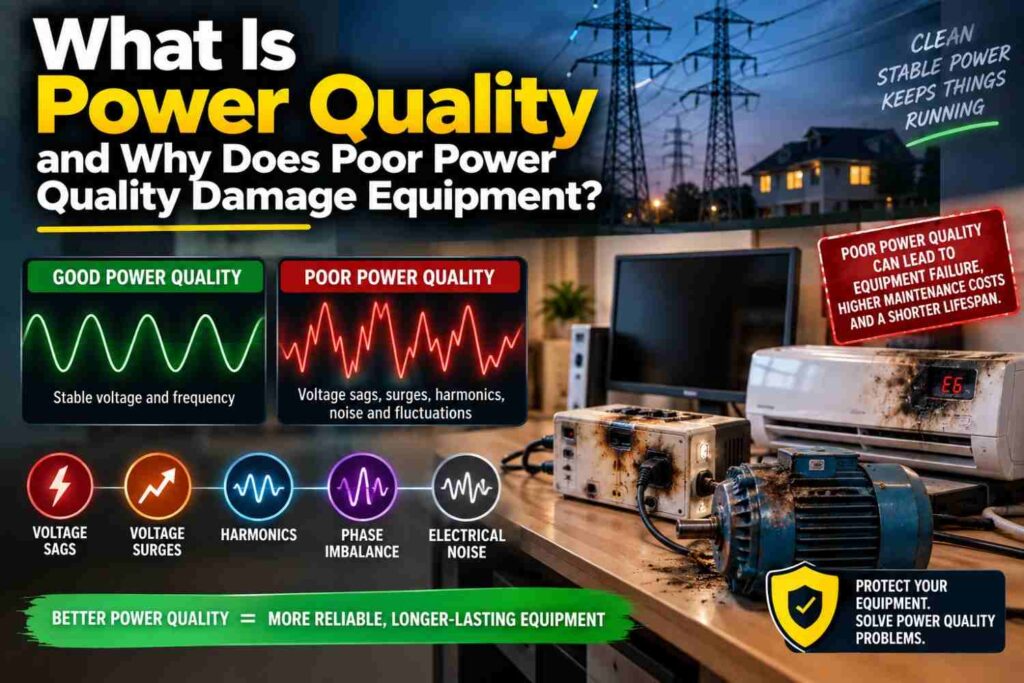
This is the essence of power quality, a term that goes beyond simply asking whether electricity is available, to asking whether the electricity delivered is actually clean, stable, and safe for the equipment using it.
This article explains what power quality really means, the main issues that fall under it, and why poor power quality is such a widespread cause of equipment damage in Nigeria.
What Power Quality Actually Means
Power quality refers to how closely the voltage, current, and frequency supplied to a building match the ideal, stable values that electrical equipment is designed to run on. Good power quality means voltage stays within a narrow acceptable range, the waveform is a clean sine wave, and frequency remains close to its nominal value, 50Hz in Nigeria. Poor power quality means one or more of these deviates from normal, whether through voltage drops, surges, harmonics, imbalance, or frequency fluctuation, even if the lights never actually go out.
The Main Types of Power Quality Problems
| Problem | What It Involves |
|---|---|
| Voltage drop | Sustained reduction in voltage below normal levels |
| Voltage surge or spike | Sudden increase in voltage above normal levels |
| Harmonics | Distortion of the clean sine waveform |
| Voltage or phase imbalance | Uneven voltage across the phases of a three-phase supply |
| Frequency fluctuation | Deviation from the standard 50Hz grid frequency |
| Flicker | Rapid, repeated small voltage changes causing visible light flicker |
Each of these is discussed in more depth in our dedicated articles on voltage drop, voltage surges, and electrical harmonics, but understanding them together as a single category, power quality, helps explain why equipment can fail even when it appears to be “getting power” the entire time.
Why Poor Power Quality Damages Equipment
Modern appliances, particularly those with motors, compressors, and electronic control boards, are designed to operate reliably only within a specific voltage and frequency range. When power quality is poor, equipment is forced to operate outside its designed parameters, often without the user even noticing anything unusual, since lights still turn on and appliances still technically run. Motors draw more current when voltage is low, generating extra heat that breaks down winding insulation over time. Surges stress capacitors and semiconductor components, sometimes causing immediate failure and sometimes just shaving years off an appliance’s expected lifespan. Harmonics add extra heating in transformers and neutral conductors, while phase imbalance in three-phase systems can cause certain motors to vibrate, overheat, and wear out asymmetrically.
Why Power Quality Is a Significant Issue in Nigeria
Nigeria’s electricity grid experiences frequent instability from causes including transmission and distribution constraints, occasional grid collapse events, aging infrastructure, and overloaded transformers, all of which directly affect power quality even when supply is technically available. The difference in power quality can vary noticeably between one area and another depending on the condition of the local feeder and transformer, and it often worsens during peak evening hours when demand across a shared transformer rises sharply, an issue explored further in our article on why appliances perform differently at different times of the day. Backup power sources such as generators and inverters can either help or worsen power quality depending on their design, which is why AVR-equipped generators and pure sine wave inverters are generally recommended over cheaper alternatives.
How to Recognise Poor Power Quality at Home
- Lights that flicker or dim noticeably when large appliances start.
- Appliances that seem to run weaker or slower during peak evening hours.
- Frequent, unexplained appliance failures despite apparently stable supply.
- Motors or transformers that feel unusually warm or make audible humming noise.
- Electronic devices that reset, glitch, or behave erratically without an obvious cause.
Practical Steps to Improve Power Quality
- Install a good quality voltage stabilizer to smooth out drops and moderate surges for sensitive equipment.
- Use a whole-house surge protector to guard against sudden voltage increases.
- Choose pure sine wave inverters over modified sine wave types for homes with motor-driven or sensitive appliances.
- Ensure your generator has a working automatic voltage regulator, as covered in our dedicated AVR article.
- Have an electrician check for phase imbalance if you run a three-phase supply.
- Schedule periodic checks of your wiring, earthing, and distribution board connections.
Common Misconceptions
- “As long as the lights come on, power quality is fine.” Lights are a poor indicator; many power quality problems affect motors and electronics long before they become visible in ordinary lighting.
- “Power quality is only a concern for factories and large businesses.” Ordinary homes with refrigerators, air conditioners, and electronics are just as exposed to power quality damage, often more so given the age and type of equipment typically used.
- “A generator automatically guarantees good power quality.” A poorly maintained generator or one without a functioning AVR can introduce its own voltage instability, sometimes worse than the grid supply it is replacing.
Frequently Asked Questions
Is power quality the same thing as power reliability?
No, reliability refers to whether power is available at all, while power quality refers to how clean and stable that power is while it is available; you can have reliable but poor quality power.
Can poor power quality increase my electricity or fuel costs?
Yes, motors and appliances operating under poor power quality typically draw more current to compensate, increasing energy consumption and, for generator users, fuel consumption as well.
How can I measure power quality at home?
A basic multimeter can check voltage levels, but a full power quality assessment, including harmonics and waveform analysis, requires a power quality analyzer, usually brought in by a qualified electrician or engineer.
Final Thoughts
Power quality is the quieter, less discussed cousin of power availability, but it is arguably just as important for protecting appliances and equipment over the long term.
In a country where grid instability is common and backup power sources are the norm rather than the exception, understanding power quality helps homeowners and technicians make smarter decisions about stabilizers, generators, and wiring.
Treating power quality seriously, rather than only worrying about outages, is one of the most cost-effective ways to extend the life of household and industrial equipment alike.