
People often use “surge” and “spike” interchangeably when describing sudden power problems, but electrically they are two different events with different causes, different durations, and different ways of protecting against them.
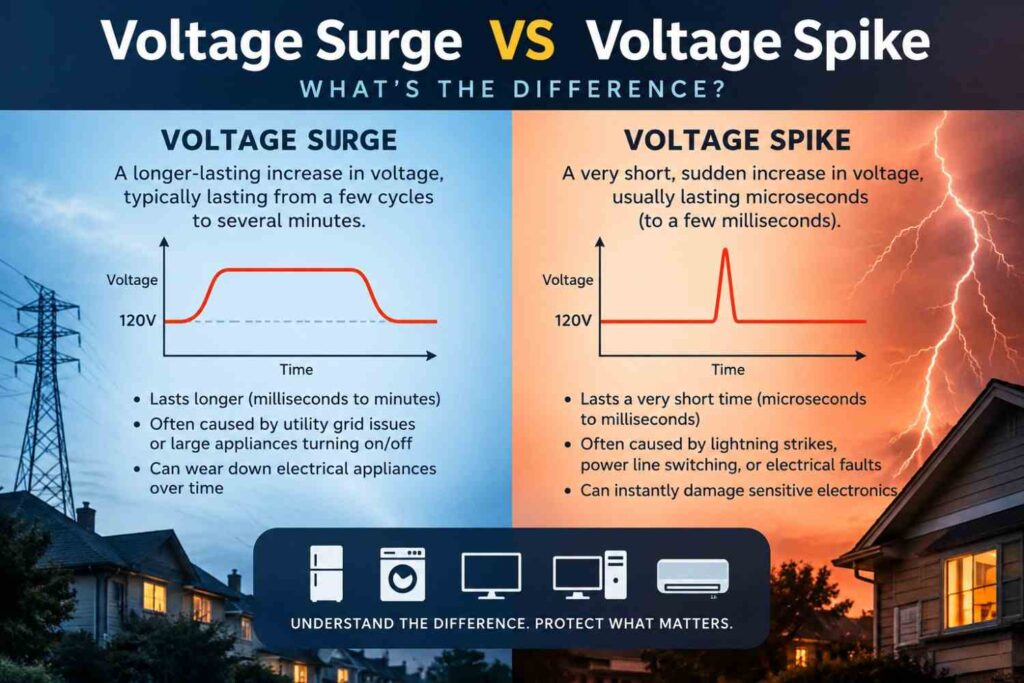
If you have ever wondered why a surge protector is rated differently from a stabilizer, or why lightning damage looks different from ordinary power restoration damage, the distinction between these two terms is the answer.
This article breaks down exactly how a voltage surge differs from a voltage spike and what that means for protecting your home.
Defining Voltage Surge and Voltage Spike
A voltage surge, as covered in our dedicated voltage surge article, is a sustained increase in voltage above normal levels that lasts from a fraction of a second up to a few seconds. A voltage spike, by contrast, is an extremely brief but very high increase in voltage, typically lasting only microseconds to a couple of milliseconds. Both push voltage above the safe operating range of appliances, but the difference in duration changes how much energy is actually delivered and how appliances respond to each.
Key Differences Between a Surge and a Spike
| Feature | Voltage Surge | Voltage Spike |
|---|---|---|
| Duration | Fraction of a second to several seconds | Microseconds to a few milliseconds |
| Typical cause | Power restoration, load switching, transformer issues | Lightning, sudden short circuits, static discharge |
| Voltage rise | Moderate to significant, sustained | Extremely high, momentary |
| Common effect | Overheating, gradual component stress | Instant component breakdown, burnt boards |
| Best protection | Stabilizer, whole house surge protector | Dedicated surge arrester, fast-acting suppressor |
What Causes Each One
Surges tend to come from events that unfold over a short but noticeable period, such as when the utility restores supply after an outage and voltage temporarily overshoots before settling, or when a large appliance elsewhere on the same transformer switches off and the shared voltage rebounds upward. Spikes, on the other hand, are almost always associated with extremely fast events, most notably lightning strikes on or near overhead power lines, even without a direct hit, as well as sudden short circuits or arcing faults within the network. A poorly earthed building is more vulnerable to both, since a good earthing system gives excess voltage a safe path to ground instead of through appliances.
Why the Difference Matters for Protection
Because a spike delivers an enormous amount of voltage in an extremely short time, protecting against it requires a device that reacts within microseconds, typically a surge arrester or a metal oxide varistor built into a proper surge protection device. A stabilizer, which works by continuously monitoring and adjusting voltage, is generally too slow to respond to a spike but is well suited to handling a surge, which unfolds over a longer window that gives the stabilizer’s regulating mechanism time to act. This is why relying on a stabilizer alone, without a dedicated surge protector, leaves a gap in protection against fast lightning-induced spikes.
How These Play Out on the Nigerian Grid
Surges are the more common of the two events on Nigeria’s grid, largely due to how often power is restored following outages, load shedding, or partial grid collapse, a topic explored in our dedicated grid collapse article. Spikes, while less frequent, are a serious risk during the rainy season, when thunderstorms are common across much of the country and lightning can travel considerable distances along overhead distribution lines before reaching a home. Homes closer to substations or transformers with poor earthing tend to experience more severe spikes when lightning does strike nearby, which is why earthing quality is just as important as any protective device installed indoors.
Recognising Which One Damaged Your Appliance
- If the damage happened right after power was restored following an outage, it was most likely a surge.
- If the damage happened suddenly during a thunderstorm, especially with visible lightning nearby, it was most likely a spike.
- If the appliance shows gradual performance decline before finally failing, a surge or repeated smaller surges are the more likely cause.
- If the appliance failed instantly and completely, with a burnt smell or visibly damaged internal board, a spike is more likely responsible.
- If damage repeatedly affects appliances on one particular circuit, checking the wiring and earthing on that circuit specifically is worthwhile.
Protecting Your Home Against Both
The most complete protection combines several layers rather than relying on a single device. A whole-house surge protector at the main distribution board catches larger surges before they spread through the building’s wiring, while a dedicated lightning or spike arrester, often installed closer to the incoming supply line, is designed specifically for the extremely fast response that a spike demands. A good earthing system, checked periodically by a qualified electrician, works alongside both, giving excess voltage from either event a safe path away from appliances. For particularly sensitive equipment, plug-level surge protected sockets add a final layer of defense.
Common Misconceptions
- “A surge and a spike are basically the same thing.” They differ mainly in duration and energy, and this difference determines which protective device actually stops them.
- “Only lightning causes voltage spikes or surges.” Most surges in Nigerian homes come from ordinary power restoration and load switching rather than lightning, which mainly causes the faster spikes.
- “A surge protector will stop every kind of power problem.” A basic surge protector may not react fast enough for a genuine lightning-induced spike, which needs a dedicated fast-acting arrester for full protection.
Frequently Asked Questions
Which is more damaging to appliances, a surge or a spike?
A spike often causes more immediate and severe damage due to its extremely high voltage, but a surge causes more cumulative damage over time because it happens far more frequently.
Can one protective device handle both surges and spikes?
Some combined surge protection devices are designed to handle both, but it is important to check the response time and energy rating on the product specification rather than assuming any surge protector covers spikes as well.
Does unplugging appliances during a storm actually help?
Yes, unplugging sensitive electronics during a thunderstorm remains one of the most reliable ways to avoid spike-related damage, since it physically removes the appliance from the path a spike would travel.
Final Thoughts
Surge and spike sound similar but behave very differently, and knowing which one you are protecting against changes what equipment you actually need.
Surges are the more frequent visitor in Nigerian homes, tied closely to how the grid restores and redistributes power, while spikes, though rarer, tend to strike harder and faster, particularly during thunderstorms.
A layered approach that combines good earthing, a whole-house surge protector, and a dedicated arrester for lightning-prone areas gives appliances the broadest protection against both.