
One moment the television is working fine, and the next it switches off with a faint burning smell after the power comes back from an outage. This scenario is painfully familiar to many Nigerian households, and it is often the result of a voltage surge.
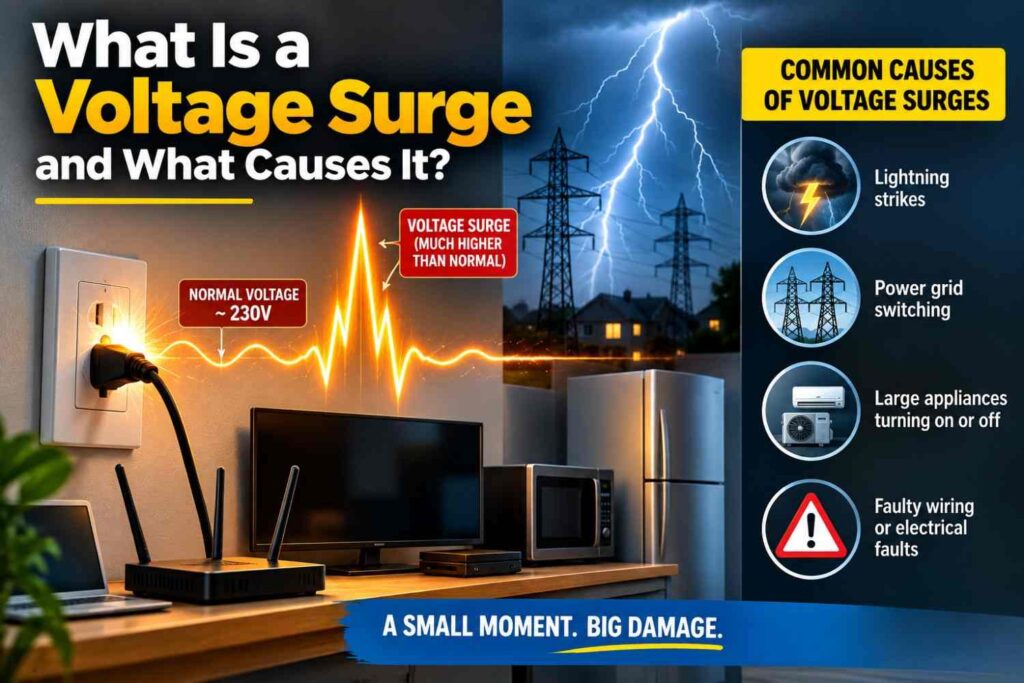
This article explains what a voltage surge actually is, what causes it, why it is so common on the Nigerian grid, and how to protect your appliances from it.
What Is a Voltage Surge
A voltage surge is a sudden and significant increase in voltage above the normal level a circuit is designed to carry, lasting anywhere from a fraction of a second to several seconds. Unlike a brief spike, which is over almost instantly, a surge tends to last a little longer and can push a noticeably higher voltage through appliances during that window. Because most household appliances are built to operate within a fairly narrow voltage range, a surge can overwhelm internal components, particularly ones without built-in protection.
What Causes Voltage Surges
Voltage surges have both external causes, originating from the power supply itself, and internal causes, originating from within the building’s own wiring.
- Power restoration after an outage, when voltage briefly overshoots normal levels as the grid or a transformer stabilizes.
- Lightning strikes near overhead lines, which can induce very high voltage even without a direct hit.
- Sudden switching off of large loads elsewhere on the same feeder or transformer, causing voltage to rebound upward.
- Faulty or aging transformers that fail to regulate voltage properly, a topic explored further in our dedicated transformer article.
- Generator issues, particularly a malfunctioning or absent automatic voltage regulator, which we cover in our AVR article.
- Poor neutral connections at the transformer or within the building, which can cause voltage on one phase to rise sharply when a neutral fault occurs.
Why Voltage Surges Are Common in Nigeria
Nigeria’s power grid experiences frequent instability, including sudden load shedding, transformer switching, and occasional grid collapse events, all of which create conditions favorable to surges, a subject discussed more fully in our dedicated grid collapse article. When power is restored after an outage, whether from the utility or after a generator restart, the initial voltage can overshoot before settling, and this restoration surge is one of the most common causes of appliance damage reported across Nigerian homes. Areas served by older or overloaded transformers, and feeders with poor maintenance, tend to experience this more frequently than newer, well-managed distribution networks.
How Surges Differ From Related Power Quality Problems
| Problem | Duration | Typical Cause |
|---|---|---|
| Voltage surge | Fraction of a second to a few seconds | Power restoration, load switching, transformer faults |
| Voltage spike | Microseconds to milliseconds | Lightning, sudden short circuits |
| Voltage drop | Sustained, ongoing | Long cables, overloaded circuits, weak supply |
| Brownout | Minutes to hours | Deliberate load reduction, grid stress |
A more detailed comparison between surges and spikes specifically is covered in our dedicated voltage surge versus voltage spike article, since the two terms are often confused despite meaning slightly different things.
How Voltage Surges Damage Appliances
Most household electronics are built with internal components rated for a specific voltage range, and pushing voltage well above that range, even briefly, can breach the insulation inside capacitors, transformers, and semiconductor components. This can cause immediate visible failure, such as a burnt smell or a device that no longer powers on, or it can cause hidden internal damage that only shows up as reduced lifespan or intermittent faults weeks or months later. Appliances with motors, compressors, and sensitive electronic control boards, such as refrigerators, air conditioners, and televisions, are particularly vulnerable because they combine both a wound coil and delicate control circuitry in one unit.
How to Protect Your Home From Voltage Surges
- Install a whole-house surge protector at the main distribution board to catch surges before they reach individual circuits.
- Use surge-protected extension sockets for sensitive electronics such as televisions, computers, and routers.
- Switch off and unplug sensitive appliances during known instability, such as when power is expected to be restored after a long outage.
- Ensure your generator has a properly functioning automatic voltage regulator to avoid self-inflicted surges from the generator itself.
- Have an electrician check earthing and neutral connections regularly, since a poor neutral connection is a common hidden cause of surges.
- Consider a voltage stabilizer for appliances that have already shown sensitivity to previous power fluctuations.
Common Misconceptions
- “Voltage surges only happen during storms and lightning.” Most surges in Nigerian homes actually occur during ordinary power restoration or load switching, not lightning, which is a less frequent cause.
- “A stabilizer alone is enough protection against surges.” Stabilizers regulate ongoing voltage fluctuations well but are not always fast enough or rated to absorb the very sudden, high energy of a genuine surge; a proper surge protector serves a different purpose.
- “If an appliance still works after a surge, it was not damaged.” Internal insulation and components can be weakened by a surge without immediate failure, leading to a shorter lifespan or a fault appearing much later.
Frequently Asked Questions
How can I tell if a power problem was a surge and not something else?
A surge typically coincides with a specific event, such as power being restored, a large appliance switching off nearby, or a storm, and often leaves visible damage such as a burnt smell or a tripped breaker right after that event.
Can a voltage surge come from within my own house?
Yes, switching off a very large internal load, such as an air conditioner or welding equipment, can cause a brief internal voltage surge that affects other appliances on the same circuit.
Is a surge protector the same as an inverter or stabilizer?
No, they serve different purposes; a surge protector absorbs sudden voltage spikes and surges, while a stabilizer regulates ongoing voltage within a safer range, and an inverter provides backup power during an outage.
Final Thoughts
Voltage surges are one of the most common and most preventable causes of appliance damage in Nigerian homes, largely because of how frequently the grid experiences outages, restorations, and load switching.
Understanding what causes a surge, and recognising that most of them happen around power restoration rather than storms, puts you in a better position to protect your investment in home appliances.
A combination of surge protection at the distribution board, careful generator maintenance, and sensible habits like unplugging sensitive electronics during known instability will handle the vast majority of surge-related risk affordably.