
Every electrician and electrical engineering student eventually needs to answer one practical question: will this cable be thick enough for the distance and load involved? Guessing leads to overheating cables, dim lighting, and struggling motors, while calculating it properly takes only a few minutes with a simple formula.
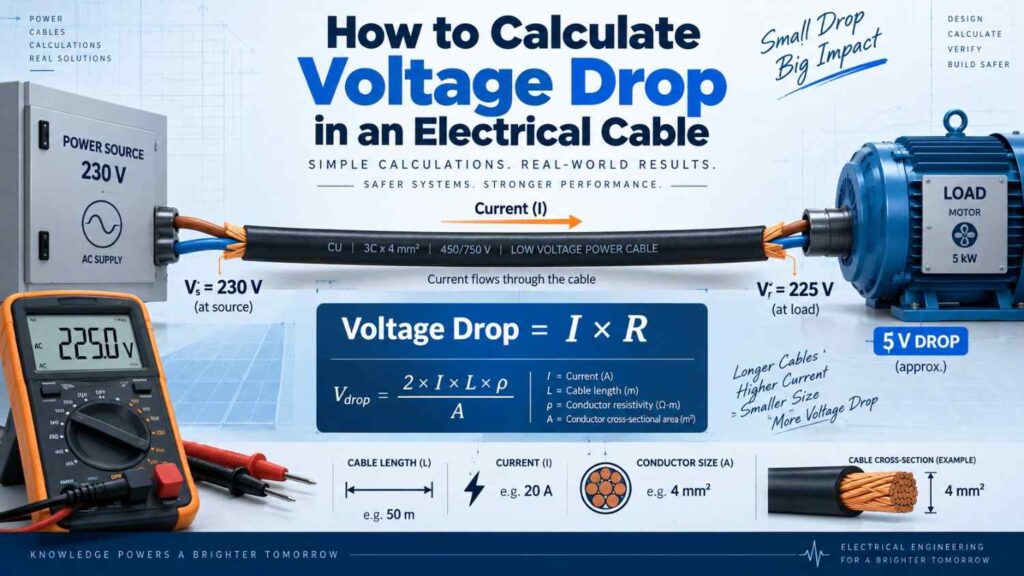
This article walks through what voltage drop calculation involves, the formula used, a worked example, and how to apply it to real wiring decisions.
Why Calculating Voltage Drop Matters
As explained in our dedicated voltage drop article, every cable has resistance, and that resistance causes some voltage to be lost between the source and the appliance. If a cable is too thin for the distance it covers or the current it carries, the voltage drop can become large enough to affect appliance performance, cause overheating in the cable itself, or trip protective devices. Calculating voltage drop in advance lets you choose the correct cable size before installation, rather than discovering the problem after appliances start misbehaving.
The Basic Voltage Drop Formula
For a single-phase circuit, the standard formula used in practice is:
Voltage Drop (V) = (2 x L x I x R) / 1000
- L = length of the cable run in metres, one way, not there and back.
- I = current in amperes that the circuit will carry.
- R = resistance of the cable per kilometre, in ohms, based on the cable’s cross-sectional area, taken from a standard cable data table.
- The factor of 2 accounts for the fact that current travels out through the live conductor and back through the neutral, doubling the effective length.
For three-phase circuits, the formula changes slightly because the return path calculation is different, and it becomes Voltage Drop = (1.732 x L x I x R) / 1000, where 1.732 represents the square root of three used in three-phase calculations.
A Worked Example
Suppose you are wiring a 2.5 square millimetre copper cable to supply an air conditioner drawing 10 amps, and the distance from the distribution board to the socket is 25 metres. A typical resistance value for 2.5mm squared copper cable is about 7.41 ohms per kilometre.
| Step | Calculation | Result |
|---|---|---|
| Formula | (2 x L x I x R) / 1000 | – |
| Substitute values | (2 x 25 x 10 x 7.41) / 1000 | – |
| Multiply | 3705 / 1000 | 3.7V |
| Percentage of 230V supply | (3.7 / 230) x 100 | 1.6% |
A drop of 3.7 volts, or about 1.6 percent of a 230V supply, is well within acceptable limits, so 2.5mm squared cable is suitable for this run. If the distance were 60 metres instead, the drop would rise to roughly 8.9 volts, close to 4 percent, at which point a thicker cable would be the safer choice.
What Percentage of Voltage Drop Is Acceptable
Most electrical wiring standards recommend keeping voltage drop within about 3 percent for lighting circuits and around 5 percent for power circuits, measured from the origin of the supply to the furthest point on the circuit. Beyond these limits, appliances begin to perform poorly and motors run hotter than they should, shortening their working life, an issue covered in more detail in our voltage drop and appliance damage article.
Choosing the Right Cable Size Using Voltage Drop
In practice, most electricians work backward from a target voltage drop rather than forward. You decide the maximum acceptable drop, then rearrange the formula to solve for the required resistance, and pick the cable size whose resistance per kilometre is equal to or lower than that value from the cable data table. This is why cable manufacturers and wiring regulation tables publish maximum recommended run lengths for each cable size and current rating, saving you from doing the full calculation every single time.
- Determine the load current the circuit will carry.
- Measure the actual one-way cable length required.
- Decide the acceptable voltage drop percentage, typically 3 to 5 percent.
- Use the formula or a cable sizing table to find a cable whose resistance keeps the drop within that limit.
- Round up to the next available standard cable size if the calculation falls between two sizes.
Practical Nigerian Wiring Considerations
In Nigerian residential compounds, it is common to run cables long distances to gate houses, boys’ quarters, or outdoor pumping machines, and these are exactly the situations where voltage drop calculations matter most. Combined with supply-side voltage that may already be lower than standard, especially during peak evening hours, undersized cables compound the problem and make appliances at the far end of a compound the first to suffer. Where the incoming supply itself is unreliable, pairing correctly sized cabling with a stabilizer for sensitive loads gives the most complete protection.
Common Misconceptions
- “A thicker cable is always better, so just use the biggest one available.” Oversized cable wastes money and is harder to terminate properly; the goal is a cable sized correctly for the load and distance, not simply the largest.
- “Voltage drop calculation is only necessary for very long cable runs.” Even relatively short runs can exceed acceptable drop limits if the current is high enough, such as with air conditioners or pumping machines.
- “If the cable does not feel hot, the voltage drop must be fine.” A cable can run within safe temperature limits while still causing a voltage drop large enough to affect appliance performance.
Frequently Asked Questions
Do I need special equipment to calculate voltage drop?
No special equipment is needed for the calculation itself, just the cable length, expected current, and the cable’s resistance value from a standard data table. A multimeter is only needed to verify the actual drop after installation.
Does voltage drop calculation differ for AC and DC circuits?
The basic resistance-based approach is similar, but AC circuits, particularly with larger cables, can also be affected by reactance, which adds a small additional factor not present in simple DC calculations.
What happens if I ignore voltage drop and use an undersized cable anyway?
Appliances at the end of the run will underperform and run hotter than normal, and in severe cases the cable itself can overheat, posing a fire risk over time.
Final Thoughts
Calculating voltage drop is a straightforward exercise once you know the formula, and it is one of the most useful habits an electrician or engineering student can build. It turns cable sizing from guesswork into a defensible, calculated decision, protecting both the appliances connected to the circuit and the wiring itself from unnecessary stress.
Given how common long cable runs and heavy appliance loads are in Nigerian homes, taking a few minutes to run this calculation before installation is a small effort that prevents years of avoidable appliance problems.