
Flip on a pumping machine while the pressing iron is running and you might notice the bulbs in the sitting room dim for a second, or the fan slows down before picking back up. That dip is voltage drop, and it happens in almost every Nigerian home at one time or another.
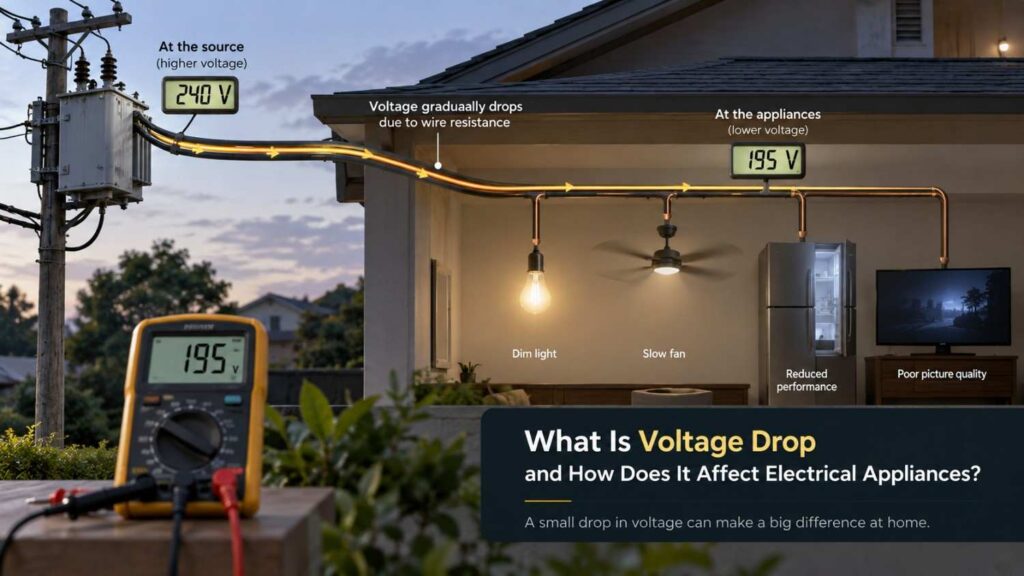
This article explains what voltage drop actually is, why it happens, how it damages or shortens the life of household appliances, and what you can practically do about it.
What Voltage Drop Actually Means
Voltage drop is the reduction in electrical voltage that occurs as current travels through a conductor, such as a cable, a wire, or even a long extension cord. Every conductor has some resistance, and whenever current flows through that resistance, some of the voltage is used up simply pushing the current along, leaving less voltage available at the appliance end. In simple terms, the electricity that leaves your meter is not always the same voltage that reaches your refrigerator or television, especially if the wiring run is long, thin, or overloaded.
What Causes Voltage Drop in a Circuit
Several factors combine to cause voltage drop, and understanding them helps you spot the problem before it damages equipment.
- Long cable runs, such as wiring from the meter box to a boys’ quarters or a gate house at the far end of a compound.
- Undersized cables that are too thin for the current they are expected to carry.
- Loose or corroded connections at sockets, distribution boards, or joints, which add unwanted resistance.
- Too many appliances drawing current on the same circuit at once.
- Poor quality supply from the utility itself, where the voltage arriving at the property is already lower than standard before it even reaches the internal wiring.
Why Voltage Drop Is So Common Across Nigeria
In many parts of Nigeria, voltage drop is not only an internal wiring issue, it is also a supply-side reality. Distribution feeders can be long, overloaded, or poorly maintained, and the quality of supply often varies noticeably from one street to the next, a phenomenon we explore more closely in our dedicated article on why power is available on one street but not the next. Customers at the tail end of a feeder, far from the injection substation, typically receive lower voltage than those closer to it. This is worsened during peak evening hours, roughly 6pm to 10pm, when everyone on the same transformer switches on lighting, television, air conditioners, and freezers at the same time, pulling the shared voltage down for the whole neighborhood.
How Voltage Drop Affects Different Appliances
Not every appliance reacts to voltage drop the same way. Some simply run weaker, while others suffer real internal damage over time.
| Appliance Type | Typical Effect of Voltage Drop |
|---|---|
| Incandescent or filament bulbs | Dimmer light, generally not harmful |
| Fans and blenders (induction motors) | Slower speed, motor runs hotter, increased wear |
| Refrigerators and air conditioners (compressor motors) | Compressor struggles to start, overheats, may trip or burn out |
| Television and electronics | Flickering, resets, or reduced lifespan of internal components |
| Pumping machines | Reduced water pressure, motor strain, overheating |
Motor-driven appliances are usually the biggest concern. When voltage drops, a motor draws more current to try to produce the same amount of work, and that extra current generates heat. Over months and years, this heat breaks down winding insulation and shortens the appliance’s working life, even if it never breaks down suddenly.
Signs You Are Dealing With a Voltage Drop Problem
Voltage drop rarely announces itself loudly. It usually shows up as small, repeated inconveniences that people learn to live with instead of investigating. Lights that dim whenever a heavy appliance starts, fans that spin noticeably slower in the evening than in the afternoon, a refrigerator compressor that hums and struggles before it kicks in, or sockets and switches that feel warm to the touch are all worth paying attention to. A simple multimeter reading at the socket compared to the reading at the meter can confirm whether the drop is happening inside your building or is arriving that way from the utility supply.
How to Reduce Voltage Drop in Your Building
- Use correctly sized cables for the distance and load, thicker cable for longer runs and higher current appliances.
- Split heavy appliances such as air conditioners and pumping machines onto their own dedicated circuits rather than sharing sockets.
- Have an electrician check and tighten all connections at the distribution board and sockets periodically.
- Avoid running extension cords over long distances for high-power appliances.
- Install a voltage stabilizer or automatic voltage regulator for sensitive equipment, similar in principle to the AVR used on generators, which we cover in our dedicated generator AVR article.
- Where supply-side drop is the real culprit, consider a stabilizer sized for the whole house rather than trying to fix it appliance by appliance.
Common Misconceptions
- “Voltage drop only happens with NEPA or DisCo supply, not with a generator.” A poorly maintained or undersized generator, or one without a working AVR, can produce just as much voltage drop as the public grid.
- “If the bulb looks normal, there is no voltage drop.” Filament bulbs are a poor indicator; motor-driven appliances often suffer damage from drop long before lighting shows any visible change.
- “Voltage drop is the same as a power outage.” Voltage drop means reduced voltage while current still flows, whereas an outage means no voltage at all; they are different problems with different causes.
Frequently Asked Questions
What voltage level is considered a harmful drop for home appliances?
Most household appliances in Nigeria are designed to tolerate voltage roughly between 200V and 240V. Sustained voltage below about 190V is generally considered risky, especially for compressor-based appliances.
Can voltage drop damage a phone charger or laptop adapter?
It rarely damages these directly because most modern chargers have wide input tolerance, but repeated severe drops combined with surges when power returns can shorten their lifespan over time.
Does a bigger generator solve voltage drop problems?
Not automatically. A generator that is undersized for the load, or lacks a functioning AVR, can produce the same drop as a weak public supply, regardless of its physical size.
Final Thoughts
Voltage drop is one of those problems that quietly costs Nigerian households money over time, through shortened appliance lifespan, higher repair bills, and inefficient energy use, long before it causes an obvious breakdown. Understanding whether the drop originates inside your wiring or from the supply itself is the first step to fixing it properly.
With correctly sized cables, dedicated circuits for heavy appliances, and a good stabilizer where needed, most of the everyday damage caused by voltage drop can be avoided. If you are unsure where your drop is coming from, a qualified electrician with a simple multimeter test can usually point you in the right direction within minutes.