
Of all the safety rules taught to electrical technicians, few are repeated as insistently as this one: never open the secondary circuit of a current transformer while its primary is carrying current. It sounds like a minor wiring detail, but getting it wrong can produce dangerously high voltages, destroy equipment, and injure whoever is standing nearby.
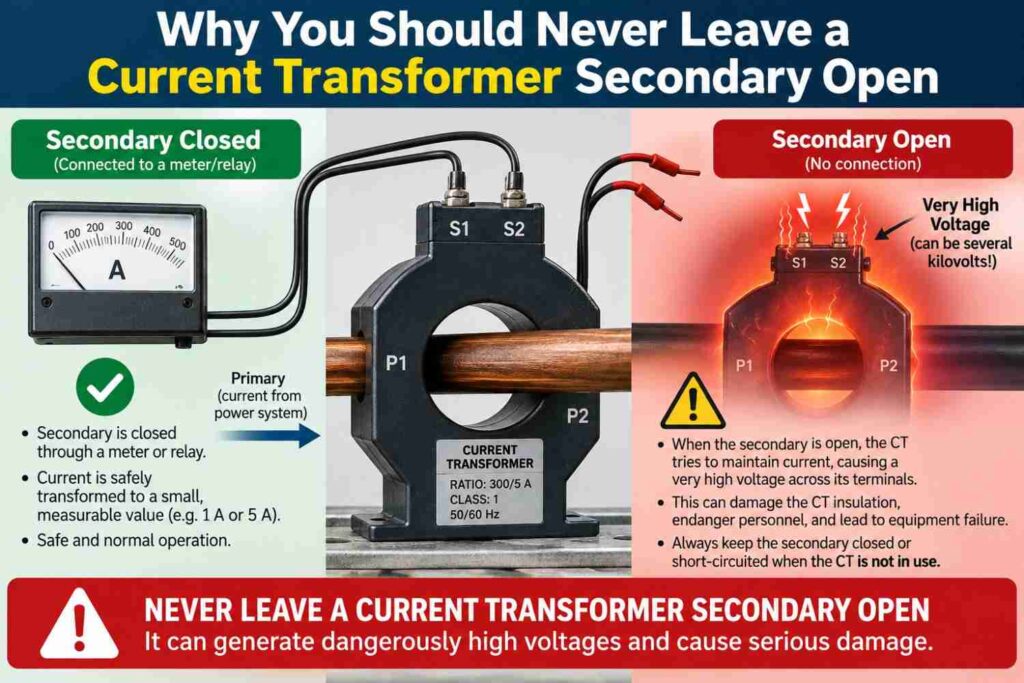
This article explains exactly why leaving a current transformer secondary open is so hazardous and how to work safely around CT circuits.
A Quick Recap of How a CT Behaves
As explained in our dedicated article on what a current transformer is, a CT’s primary winding sits in series with the circuit being measured, so the primary current is fixed entirely by the load, completely independent of what is connected to the secondary.
Under normal operation, the secondary current flows through a low-impedance burden, typically a meter coil or relay, and the magnetic fields produced by the primary and secondary largely cancel each other out inside the core, keeping the core’s flux at a modest, manageable level.
What Happens When the Secondary Is Opened
Open the secondary circuit while the primary still carries current, and that cancellation disappears. The secondary can no longer produce a current to oppose the primary’s magnetising effect, so the full primary ampere-turns now act on the core with nothing to balance them. This drives the core into deep magnetic saturation, and because the rate of change of that saturated flux is extreme, the secondary winding develops an extremely high induced voltage across its open terminals. Depending on the CT’s size and the primary current at the time, this voltage can reach several hundred to several thousand volts.
Why This Voltage Is So Dangerous
A CT secondary is normally treated as a low-voltage circuit, rated for a modest 1 or 5 amp signal at low voltage, so the wiring, terminal blocks, and test equipment around it are not built with high-voltage insulation in mind. The sudden high voltage from an open secondary can:
- Cause a severe electric shock to anyone touching the open terminals or nearby exposed wiring
- Puncture the insulation of the CT’s secondary winding, permanently damaging the device
- Arc across terminal blocks or test switches, causing burns, fire, or equipment damage
- Generate excessive heat in the saturated core, degrading the CT over time even without an immediate visible failure
- Produce a sharp, audible buzzing or crackling sound as an early warning sign that something is badly wrong
How This Situation Happens in Real Installations
Nobody sets out to open a live CT secondary deliberately, but it happens through a handful of common, entirely avoidable mistakes. Disconnecting a meter or relay for testing or replacement without first shorting the CT secondary is the most frequent cause.
Loose or corroded terminal connections on the secondary wiring can work themselves open over time, especially in poorly maintained panels exposed to Nigeria’s humidity and dust. Removing a test plug from a switchgear panel’s test block without engaging the shorting mechanism first is another common cause in substations.
In each case, the underlying mistake is the same: breaking the secondary circuit’s continuity while the primary conductor is still carrying load current.
The Correct Way to Work on a CT Secondary Circuit
Whenever a CT secondary circuit must be opened for testing, meter replacement, or relay maintenance, the secondary must first be short-circuited using a proper shorting link, shorting switch, or shorting-type test block. This gives the induced current a safe, low-impedance path to flow through even while the meter or relay is temporarily disconnected, keeping the core out of saturation and the terminal voltage low.
- Identify the correct CT secondary circuit and confirm the primary is still energised.
- Install or engage the shorting link or shorting-type test block across the CT secondary terminals.
- Verify with a clamp meter or test instrument that current is now flowing through the short, not through the device being removed.
- Disconnect or service the meter, relay, or wiring safely with the short in place.
- Reconnect the device, then remove the short only after confirming the new connection is secure and continuous.
Comparing Correct and Incorrect Practice
| Situation | Result |
|---|---|
| Secondary shorted before disconnecting device | Safe, current flows through the short, no dangerous voltage builds up |
| Secondary opened without shorting first | Dangerous high voltage develops, risk of shock, arcing, and CT damage |
| Secondary accidentally opens due to loose terminal | Same hazard as intentional opening, often discovered by unusual heat or noise |
| Shorting link removed before new connection is secure | Momentary open circuit risk if the new connection is not yet continuous |
Why This Matters Especially in Field and Substation Work
Many CT secondary circuits in TCN and DisCo installations feed protection relays that must never be interrupted without careful planning. Technicians performing routine relay testing, meter calibration, or CT ratio checks in the field need to treat the shorting step as non-negotiable, not an optional precaution, particularly given how easy it is to underestimate the voltage a small CT can produce under saturation.
Common Misconceptions
- “A CT secondary is low voltage, so it’s always safe to disconnect.” The secondary is low voltage only while closed through its normal burden; opening it while the primary is energised can produce dangerously high voltage almost instantly.
- “This only matters on large power transformers’ CTs.” The hazard applies to CTs of any size wherever primary current is flowing, including small distribution and metering CTs.
- “If nothing visibly sparks, the open secondary wasn’t dangerous.” Damage to the winding insulation and core can occur silently, without any visible arc, shortening the CT’s life or causing later failure.
Frequently Asked Questions
What should I do if I discover a CT secondary is already open while the primary is live?
Short the secondary terminals immediately using appropriate insulated tools and proper safety precautions, or if unsafe to do so directly, de-energise the primary circuit first if that option is available.
Is it safe to leave a CT secondary open if nothing is connected to it at all?
No, the CT still needs to be shorted whenever it is not connected to its normal burden and the primary is energised, since the hazard comes from the open condition itself, not from what was previously connected.
Can an open CT secondary damage the current transformer permanently?
Yes, the high voltage and heat from core saturation can degrade or puncture the winding insulation, sometimes destroying the CT even if no external injury or visible fault occurs.
Final Thoughts
The rule against opening a live CT secondary is one of the simplest and most important habits in electrical maintenance work, precisely because the danger is invisible until something goes wrong. A shorting link takes seconds to install and removes the hazard entirely, while skipping that step turns a routine task into a genuine electrical safety incident.
Anyone working around metering panels, protection relays, or switchgear test blocks should treat this rule as fixed and automatic, not something to judge case by case.