
Overheating is the single most common thread running through transformer failures, whether the end result is a tripped protection relay, a slowly degraded winding, or in severe cases a catastrophic fault.
Heat itself is not the enemy, transformers are designed to run warm, but heat beyond design limits quietly destroys insulation and shortens equipment life long before any obvious symptom appears.
This article walks through the specific causes of transformer overheating and what each one looks like in practice.
Why Heat Is the Root of Most Transformer Damage
Transformer insulation, whether paper insulation soaked in oil or resin coatings in dry-type units, ages chemically over time, and that ageing process accelerates sharply with temperature. As a widely used industry rule, every sustained rise of roughly 8 to 10 degrees Celsius above rated operating temperature cuts insulation life in half. This means overheating rarely causes an immediate, dramatic failure; instead it quietly consumes years of expected service life, which is one reason transformers that “run fine for years” while chronically overheated often fail without much warning once insulation finally gives way.
Overloading Beyond Rated Capacity
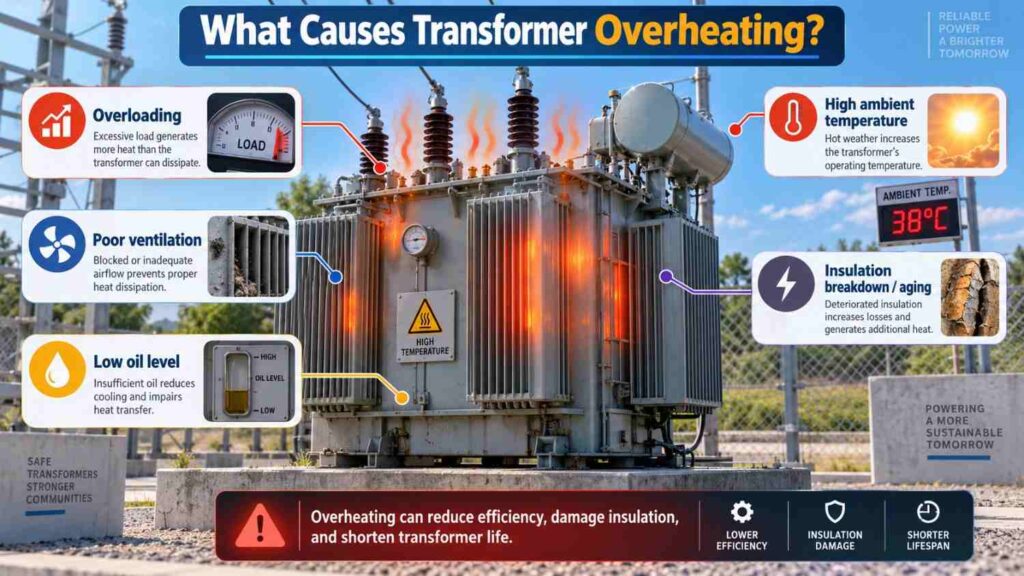
The most common and most preventable cause of overheating is simply asking the transformer to carry more load than it was designed for. Copper losses in the windings rise with the square of current, so even a moderate overload produces a disproportionate rise in heat generation. In Nigeria, this is a widespread and well-documented problem on DisCo distribution transformers, where illegal connections, unmetered tapping, and organic growth in a neighbourhood’s electricity demand routinely push transformers well past their nameplate rating without any corresponding upgrade in capacity.
Poor or Failed Cooling
Even a correctly loaded transformer will overheat if its cooling system cannot do its job. This connects directly to the cooling mechanisms explained in our dedicated article on why transformers need cooling systems: dust-clogged radiators, failed cooling fans, low oil level, or blocked ventilation louvres on dry-type enclosures all reduce the transformer’s ability to shed the heat it generates. A transformer running exactly at its rated load but with a cooling fault can overheat just as badly as one that is genuinely overloaded.
High Ambient Temperature
Transformer ratings assume a specific ambient temperature, commonly 20 to 40 degrees Celsius depending on the standard applied. When ambient temperature rises well above that design assumption, as happens during Nigeria’s hottest months or inside poorly ventilated substation kiosks with direct sun exposure, the transformer has less thermal headroom to work with even at normal load. Two identical transformers loaded the same way can run at meaningfully different internal temperatures purely because of where they are sited and how they are shaded or ventilated.
Harmonics and Poor Power Quality
Modern loads such as variable speed drives, computers, LED lighting drivers, and other electronic equipment draw current in non-sinusoidal waveforms rich in harmonics. These harmonic currents cause additional heating in transformer windings and core beyond what the fundamental load current alone would produce, an effect that standard transformer ratings do not always account for unless the transformer was specifically specified as a K-rated or harmonic-mitigating unit. Facilities with heavy non-linear loads, such as industrial sites or data centres, can see meaningfully elevated transformer temperatures purely from harmonic content even without exceeding the rated current.
Internal Faults and Insulation Breakdown
Loose connections, partial winding shorts, or degraded insulation can create localised hot spots inside a transformer well before the overall temperature reading looks abnormal. These faults often produce gases detectable through dissolved gas analysis of the oil, discussed in more detail in our dedicated article on transformer oil, long before the fault becomes severe enough to trip protection. Left unchecked, a localised hot spot can progressively damage more insulation until a larger fault develops.
Quick Reference: Overheating Causes and Warning Signs
| Cause | Typical Warning Sign | First Response |
|---|---|---|
| Overloading | Consistently high load readings, warm tank surface | Load survey, capacity upgrade or load shedding |
| Cooling failure | Uneven radiator temperature, silent fans | Clean radiators, check fans and oil level |
| High ambient temperature | Seasonal temperature spikes correlating with alarms | Improve ventilation, add shading |
| Harmonics | Higher than expected heating at moderate load | Power quality survey, harmonic filtering |
| Internal fault | Rising dissolved gas levels, localised hot spots | Detailed inspection, possible rewinding |
Practical Steps to Prevent Overheating
A structured approach catches most overheating causes before they become failures:
- Compare actual load readings against the transformer’s nameplate rating on a regular schedule.
- Inspect and clean radiators, fans, and ventilation louvres, especially after dusty seasons.
- Check oil level and condition where applicable, since low or degraded oil reduces cooling effectiveness.
- Monitor temperature readings where instrumentation is available, watching for gradual upward trends.
- Investigate and disconnect illegal or unmetered connections that push load beyond design capacity.
- Schedule dissolved gas analysis or thermal imaging on critical transformers to catch developing internal faults early.
Common Misconceptions
- “A transformer that isn’t smoking or tripping is fine.” Chronic overheating causes gradual insulation damage that shows no obvious external symptom for years before a failure occurs.
- “Overheating only happens in old transformers.” New transformers overheat just as readily when overloaded, poorly cooled, or sited in excessive ambient heat.
- “A slightly overloaded transformer just runs a bit warmer, no real harm done.” Even a modest sustained overload measurably shortens insulation life due to the exponential relationship between temperature and ageing rate.
Frequently Asked Questions
How can I tell if a transformer is overheating without special equipment?
Touching the tank surface cautiously for unusual heat, listening for cooling fans that should be running, and checking for a burnt smell around vents are useful basic indicators, though instrumented monitoring is far more reliable.
Does overheating always lead to explosion?
No, overheating usually causes gradual insulation ageing and reduced lifespan rather than immediate catastrophic failure, though it can be one contributing factor among several that are covered in our dedicated article on why transformers explode.
Can overheating be reversed once it happens?
The immediate temperature can be brought back down by fixing the cause, but any insulation ageing that already occurred during the overheating period is permanent and cannot be undone.
Final Thoughts
Transformer overheating rarely has a single dramatic cause; it usually results from a combination of everyday, preventable factors like overloading, dirty radiators, and poor siting, compounded over months or years.
Recognising these causes early and building simple inspection habits around them protects both the transformer’s lifespan and the reliability of the network it serves.
For technicians and facility managers in Nigeria managing equipment under real-world heat, dust, and load pressures, treating temperature as a routine metric to monitor, not just a symptom to react to, is the most effective way to avoid costly failures.