
Every transformer wastes a small percentage of the power that passes through it as heat, and if that heat is not removed fast enough, the transformer’s insulation ages rapidly and eventually fails. Cooling is not a bonus feature bolted onto a transformer, it is a core part of the design that determines how much load the unit can safely carry.
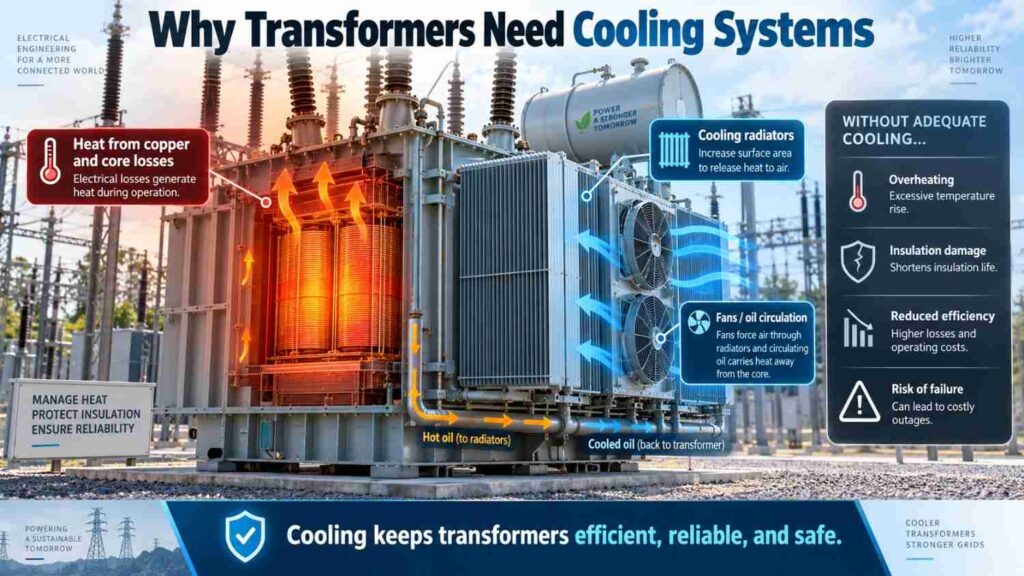
This article looks at why cooling matters so much, the main cooling methods used, and what happens when cooling falls short.
Where the Heat Actually Comes From
Transformers generate heat from two main sources. Copper losses come from current flowing through the resistance of the winding conductors, and these losses rise sharply with load, following a square relationship with current. Core losses, sometimes called iron losses, come from the constantly reversing magnetic field in the core material and stay roughly constant regardless of load.
Together these losses convert a small fraction of the transformer’s throughput into heat that must be continuously removed, or the internal temperature will climb until insulation breaks down, a process explored in more detail in our dedicated article on transformer overheating.
Why Excess Heat Is So Damaging
Transformer insulation, whether paper wrapped around windings in an oil-immersed unit or the resin and varnish coatings in a dry-type unit, has a rated temperature limit. As a rough rule of thumb used across the industry, every roughly 8 to 10 degrees Celsius of sustained temperature rise above the rated limit cuts the insulation’s useful life in half. This means a transformer that regularly runs even moderately hotter than it should is quietly ageing years faster than its nameplate rating suggests, even if it never trips or fails outright in the short term.
Cooling Methods for Oil-Immersed Transformers
Oil-immersed transformers use a naming system that describes how the oil and any external air or water are moved. The simplest method, natural convection with natural air cooling, relies purely on the oil circulating by density difference and radiators shedding heat to still air. Larger transformers add fans to force air across the radiators, increasing the cooling capacity substantially.
The largest power transformers may use pumps to force oil circulation as well, sometimes combined with water-cooled heat exchangers in industrial settings where water is available. Each step up in cooling method allows the transformer to carry more load within safe temperature limits.
Cooling Methods for Dry-Type Transformers
Dry-type transformers depend entirely on air movement around the windings. Naturally air-cooled units rely on convection currents drawing air upward through the winding ducts, which works well at lower ratings but limits how much load the transformer can carry.
Forced-air cooled units add fans that push air through the same ducts, boosting capacity significantly, sometimes by 30 percent or more over the natural rating. Because dry-type units have no oil to help spread heat internally, keeping the surrounding space clean and well ventilated matters even more than it does for oil-immersed transformers.
How Cooling Method Affects Rated Capacity
Transformer nameplates often list more than one capacity rating depending on which cooling stage is active, since adding forced cooling genuinely increases how much load the transformer can carry continuously.
| Cooling Class | Description | Typical Effect on Capacity |
|---|---|---|
| ONAN | Oil Natural, Air Natural | Baseline rating |
| ONAF | Oil Natural, Air Forced | Adds roughly 15-25% capacity |
| OFAF | Oil Forced, Air Forced | Adds further capacity for large units |
| AN | Dry-type, Air Natural | Baseline rating for dry-type |
| AF | Dry-type, Air Forced | Adds roughly 30% capacity |
Common Causes of Cooling Failure in the Field
Cooling systems fail for practical, preventable reasons far more often than for exotic technical ones. The most common culprits in real installations include:
- Radiator fins clogged with dust, especially during Nigeria’s harmattan season
- Cooling fans that have failed or lost power without anyone noticing
- Low oil level reducing the surface area available for heat exchange
- Blocked or restricted ventilation louvres in transformer rooms or kiosks
- Overloading beyond the transformer’s rated capacity, often from illegal connections tapping into distribution transformers
- Ambient temperature far above design assumptions, common during Nigeria’s hottest months
Why This Matters More for Nigerian Distribution Networks
Distribution transformers feeding Nigerian neighbourhoods often run in high ambient heat, with dust exposure and, in many areas, chronic overloading from unmetered or illegal connections. Since cooling capacity and load capacity are directly linked, an overloaded transformer in a hot, dusty environment ages far faster than the same unit properly loaded in a temperate climate.
This combination is a significant contributor to the shortened service life seen on many DisCo distribution transformers, and it is part of why routine cleaning and load monitoring matter as much as electrical maintenance.
Monitoring Cooling Performance
Modern transformers, particularly larger power transformers, are fitted with temperature gauges and sometimes automatic controls that switch on forced cooling stages once the oil or winding temperature crosses a set threshold.
Simple visual checks, such as feeling for even radiator temperature across all panels or listening for fans that should be running, can catch cooling problems before they become failures.
For critical installations, continuous monitoring with alarms tied to a control room allows operators to reduce load or intervene before insulation damage occurs.
Common Misconceptions
- “A transformer will just shut off if it gets too hot.” Most transformers have no automatic shutdown for overheating alone; they keep running while insulation quietly degrades unless protection relays or operators intervene.
- “Bigger transformers don’t need as much cooling.” Larger transformers generate more total heat and often rely on more sophisticated cooling stages, not less, to stay within safe limits.
- “Cooling fans are optional extras.” On forced-air rated transformers, the fans are part of the design’s rated capacity; running without them means the transformer can only safely carry its lower natural-cooling rating.
Frequently Asked Questions
Can a transformer run without its cooling fans working?
It can, but only up to its natural-cooling rating, which is significantly lower than the rating achieved with forced cooling active.
How do I know if a transformer’s cooling system is failing?
Watch for unusually high oil or winding temperature readings, uneven radiator heat, silent fans that should be running, or oil level dropping below the sight glass minimum.
Does dust really affect transformer cooling that much?
Yes, a layer of dust on radiator fins or ventilation louvres acts as insulation itself, significantly reducing how efficiently heat escapes to the surrounding air.
Final Thoughts
Cooling is not a side feature of transformer design, it is the mechanism that makes the transformer’s rated capacity achievable and sustainable over decades of service.
Understanding how oil and air cooling stages work, and recognising the everyday problems that quietly degrade cooling performance, gives technicians and engineers a practical edge in preventing premature failures.
In Nigeria’s climate and grid conditions, keeping cooling systems clean, monitored, and matched to actual load is one of the simplest ways to extend transformer life.