
Inside every oil-immersed transformer, a straw-coloured liquid quietly does two of the most important jobs in the entire machine: keeping the windings insulated from each other and carrying away the heat they generate. Most people who see a transformer only notice the steel tank and the porcelain bushings, never the oil doing the real work inside.
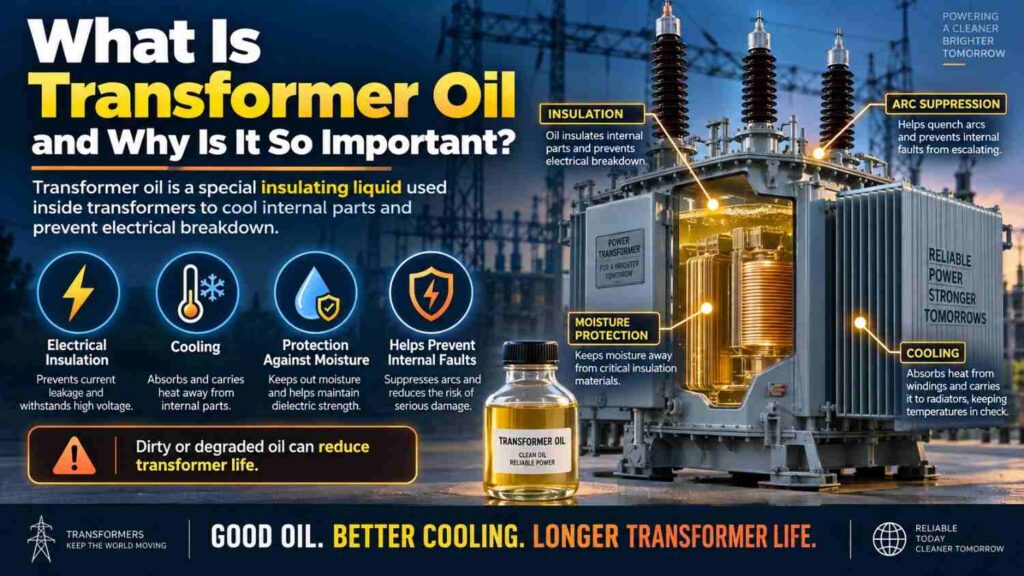
This article explains what transformer oil is, why it matters so much, and how to recognise when it needs attention.
What Transformer Oil Is
Transformer oil, also called insulating oil, is a highly refined liquid designed to have strong dielectric properties, meaning it resists electrical breakdown even under high voltage stress. Most transformers still in service use mineral oil refined from crude petroleum, though synthetic and natural ester oils are increasingly used where fire resistance or biodegradability matters.
The oil fills the space around the core and windings inside the sealed tank, in contact with every insulated surface, which is why its condition directly reflects the health of the transformer as a whole, a relationship covered more broadly in our dedicated article on what a transformer is.
The Dual Role: Insulation and Cooling
Transformer oil does not just sit still. As the windings heat up during operation, the oil nearest them warms, becomes less dense, and rises, setting up a natural circulation that carries heat toward the tank walls or external radiators, where it cools and sinks back down.
At the same time, the oil fills every gap between windings, between windings and the core, and between windings and the tank, preventing arcing and flashover that air alone could not reliably prevent at the same clearances. This combination is what allows oil-immersed transformers to be built more compactly than dry-type units, as explained in our dedicated article comparing dry-type and oil-immersed transformers.
Types of Transformer Oil in Use
Mineral oil remains the most common choice because it is cheap, widely available, and performs well under normal conditions. Synthetic ester oils and natural ester oils, often derived from vegetable sources, are gaining ground because they have much higher fire and flash points and biodegrade if they leak, which matters for transformers installed near sensitive environments or inside buildings.
Silicone-based fluids are used in some specialised applications for their fire resistance and stability at high temperature, though at a higher cost than mineral oil.
Why Oil Quality Degrades Over Time
Transformer oil ages through oxidation, moisture absorption, and thermal stress. Every time the transformer runs hot, particularly during overloading or poor cooling, the oil breaks down slightly faster.
Moisture is a particular enemy: even small amounts of water dissolved in the oil sharply reduce its dielectric strength and accelerate the ageing of the paper insulation wrapped around the windings.
In humid Nigerian climates, and especially where transformer tanks have worn seals or breather units filled with saturated silica gel, moisture ingress is a common and often overlooked cause of premature oil failure.
Signs the Oil Needs Attention
Technicians rely on a mix of visual inspection and laboratory testing to judge oil condition. Fresh oil is pale yellow and clear; oil that has darkened, turned cloudy, or developed a burnt smell has usually already suffered significant degradation.
A transformer that runs hotter than normal, discussed in our dedicated article on transformer overheating, often has oil that has lost much of its cooling and insulating effectiveness. Sludge formation, visible as a dark sediment at the bottom of the tank, is a late-stage sign that oxidation has gone too far without correction.
Standard Oil Tests and What They Reveal
Utilities and industrial maintenance teams run a standard battery of tests on sampled oil to catch problems before they cause failures.
| Test | What It Checks | Why It Matters |
|---|---|---|
| Breakdown Voltage (BDV) | Dielectric strength | Low values signal contamination or moisture |
| Moisture Content | Water dissolved in oil | Moisture sharply lowers insulation strength |
| Acidity (Neutralisation Value) | Oxidation level | High acidity accelerates ageing and corrosion |
| Dissolved Gas Analysis (DGA) | Gases from internal faults | Reveals arcing, overheating, or partial discharge |
| Interfacial Tension | Contamination by polar compounds | Early indicator of oil deterioration |
Oil Sampling and Testing Procedure
Getting a reliable oil sample matters as much as the testing itself. A typical field sampling procedure follows these steps:
- Ensure the transformer has been running long enough for the oil to reach a representative temperature.
- Clean the sampling valve thoroughly to prevent contamination from dust or debris.
- Flush a small amount of oil through the valve before collecting the actual sample.
- Fill a clean, dry sample bottle without trapping air, sealing it immediately.
- Label the sample with the transformer identity, date, and load condition at the time of sampling.
- Send the sample to a laboratory promptly to avoid moisture absorption from the atmosphere.
Maintaining and Restoring Oil Condition
When test results show early degradation, oil can often be reconditioned rather than replaced outright. Filtration and vacuum dehydration remove moisture and particulate matter, restoring dielectric strength without draining the transformer.
In more advanced stages, regeneration using fuller’s earth can remove oxidation by-products and acidity. Only when oil has degraded beyond practical recovery, or when internal faults have contaminated it badly, does full replacement become necessary.
Regular testing on a fixed schedule, rather than waiting for visible problems, remains the most cost-effective way to catch trouble early, particularly for DisCo distribution transformers that often go years between formal inspections due to deferred maintenance budgets.
Common Misconceptions
- “Transformer oil only cools the transformer.” It performs two jobs at once, insulation and cooling, and losing either function can lead to failure.
- “Dark oil always means the transformer is about to fail.” Darkening indicates ageing, but many transformers with slightly darkened oil still test within acceptable limits and continue running safely.
- “All transformer oils are the same.” Mineral, synthetic ester, and natural ester oils differ significantly in fire resistance, cost, and environmental impact.
Frequently Asked Questions
How often should transformer oil be tested?
Most utilities test critical transformers annually, with dissolved gas analysis done more frequently on larger or older units, though schedules vary by transformer size and criticality.
Can transformer oil be reused after filtering?
Yes, filtering and dehydration can restore oil that has only mild moisture or particulate contamination, extending its service life significantly.
What happens if transformer oil is never checked?
Undetected moisture and oxidation can silently weaken insulation until a fault occurs, which is one of several factors that can contribute to catastrophic failure.
Final Thoughts
Transformer oil is easy to overlook because it works silently, hidden inside a sealed tank, yet it is one of the clearest windows into a transformer’s true health. Routine sampling and testing catch problems long before they become expensive failures, and simple measures like maintaining dry breathers and tight seals go a long way toward protecting oil quality.
For anyone responsible for transformer maintenance in Nigeria, where climate and deferred servicing both work against oil condition, treating oil testing as a routine task rather than an afterthought is one of the most cost-effective habits a maintenance programme can build.