
Walk into any substation or industrial plant in Nigeria and you will find transformers built in one of two fundamentally different ways: some are sealed steel tanks full of oil, others are open, resin-coated coils with no liquid in sight at all.
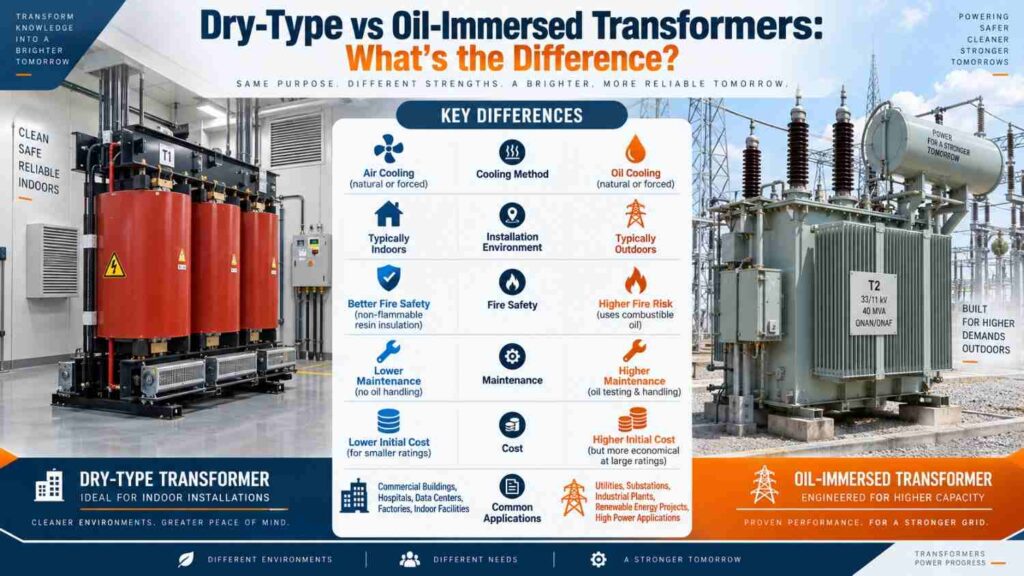
Both do the same basic job of stepping voltage up or down, a process we cover in our dedicated article on what a transformer is and how it works, but the way each type handles insulation, cooling, and safety is completely different.
This article breaks down dry-type and oil-immersed transformers side by side so you can understand why one is chosen over the other for a given job.
What “Dry-Type” and “Oil-Immersed” Actually Mean
The terms describe how the transformer’s windings are insulated and cooled. In an oil-immersed transformer, the core and windings sit inside a sealed tank filled with mineral or synthetic transformer oil. The oil serves two jobs at once: it insulates the windings from each other and from the tank, and it carries heat away from the core to the tank walls or external radiators.
In a dry-type transformer, there is no liquid at all. The windings are either open to air and coated with varnish, or cast solid inside epoxy resin. Cooling happens purely through air, either natural convection or forced ventilation from fans.
Construction and Insulation Differences
Oil-immersed units rely on the oil’s high dielectric strength, which allows the windings to be built more compactly for a given voltage rating. Dry-type transformers need more physical spacing between windings and phases because air is a far weaker insulator than oil, which tends to make them bulkier for the same capacity. Cast-resin dry-type units close that gap somewhat, since the resin itself adds insulation strength, but they still generally cost more to manufacture at higher ratings.
Where Each Type Is Typically Used
Oil-immersed transformers dominate outdoor and utility applications: TCN transmission substations, DisCo distribution transformers mounted on poles or in ground-mounted kiosks across Nigerian cities, and large industrial power transformers.
Dry-type transformers are favoured indoors, in confined spaces, and anywhere fire risk or oil leakage would be unacceptable, such as hospitals, high-rise buildings, shopping malls, data centres, and underground vaults. A dry-type unit inside a building’s electrical room avoids the need for oil containment pits, fire walls, and the ventilation rules that come with flammable liquids.
Fire Safety and Environmental Considerations
This is often the deciding factor. Mineral transformer oil is combustible, and a serious internal fault can lead to an oil fire, which is part of why transformer explosions are covered as their own topic in our dedicated article on why transformers explode.
Dry-type transformers carry a much lower fire load since there is no oil to ignite or spill. They also eliminate the environmental risk of oil leaking into soil or drainage systems, which matters in densely populated Nigerian neighbourhoods where transformers sit close to homes, markets, and water sources.
Oil-immersed transformers can still be made safer with fire barriers, containment bunds, and less-flammable synthetic ester oils, but these add cost.
Cooling Efficiency and Loading
Oil is a far better heat conductor than air, so oil-immersed transformers generally handle higher continuous loads and short-term overloads more gracefully for their physical size, a factor explored in our dedicated article on transformer overheating.
Dry-type transformers depend more heavily on adequate airflow around the enclosure, so poor ventilation or dusty, badly maintained switch rooms can push winding temperatures up quickly.
Maintenance and Lifespan
Oil-immersed transformers need periodic oil testing, covered in more detail in our dedicated article on transformer oil, to check for moisture, acidity, and dissolved gases that reveal internal problems early. They also need gasket and seal checks to prevent leaks and moisture ingress.
Dry-type transformers avoid oil sampling entirely, but they still need regular cleaning of dust and debris from the windings, since accumulated dirt traps heat and can eventually track across insulation surfaces. In Nigeria’s dusty harmattan season, this cleaning schedule matters more than many facility managers assume.
Cost Comparison
At lower voltage and capacity ratings, dry-type transformers can be price-competitive, especially cast-resin types used indoors. At higher ratings, oil-immersed transformers are usually cheaper to manufacture and install because oil cooling allows a smaller physical footprint and simpler winding design. The table below summarises the main trade-offs.
| Factor | Dry-Type | Oil-Immersed |
|---|---|---|
| Cooling medium | Air (natural or forced) | Oil (natural or forced circulation) |
| Fire risk | Low | Higher, requires containment |
| Typical location | Indoors, confined spaces | Outdoors, substations, poles |
| Maintenance | Cleaning, insulation checks | Oil testing, seal checks |
| Size for same rating | Larger | More compact |
| Typical rating range | Low to medium voltage | Low voltage to transmission voltage |
Choosing Between Them
The decision usually comes down to a short checklist that engineers work through during design:
- Is the installation indoors, underground, or in a space with restricted ventilation?
- Are there strict fire codes or proximity to occupied areas that rule out oil?
- What voltage and capacity is required, and does that favour the compact size of oil cooling?
- What is the maintenance capacity of the team who will service it long-term?
- Is environmental exposure, such as flooding risk or soil contamination rules, a concern?
In practice, most utility-scale distribution work in Nigeria still leans on oil-immersed units, while dry-type transformers are increasingly specified for new commercial buildings, hospitals, and data centres where indoor safety takes priority.
Common Misconceptions
- “Dry-type transformers never need maintenance.” They still require regular cleaning and periodic insulation testing to prevent dust buildup and moisture-related failures.
- “Oil-immersed transformers are always more dangerous.” With proper containment, fire barriers, and maintenance, oil-immersed units operate safely in the vast majority of installations worldwide.
- “Dry-type transformers can replace oil-immersed ones everywhere.” At high voltage and large capacity, oil cooling remains more practical and cost-effective, which is why transmission-level equipment stays oil-filled.
Frequently Asked Questions
Can a dry-type transformer be installed outdoors?
Yes, with a weatherproof enclosure rated for outdoor use, though oil-immersed units remain more common outdoors because of their durability and cooling efficiency.
Which type lasts longer?
Both can last 25 to 40 years or more with good maintenance; oil-immersed units depend on oil condition, while dry-type units depend on insulation cleanliness and ambient temperature control.
Is a dry-type transformer more expensive than an oil-immersed one?
At higher capacities, yes, dry-type units generally cost more due to the extra insulation clearance required; at lower ratings the cost gap narrows considerably.
Final Thoughts
Dry-type and oil-immersed transformers are not competing designs so much as tools suited to different environments. Oil-immersed transformers remain the backbone of outdoor distribution and transmission because of their compact size and efficient cooling, while dry-type units earn their place indoors where fire safety and clean installation matter more than raw cost.
Understanding this distinction helps engineers, students, and facility managers make sensible specification choices rather than assuming one type is universally “better.” The right choice always comes down to where the transformer will sit, what it will carry, and who will maintain it.