
Bearings rarely get the attention windings and starters do, yet bearing failure is one of the most common reasons electric motors end up pulled from service, and it is often preventable with basic care that costs far less than the motor itself.
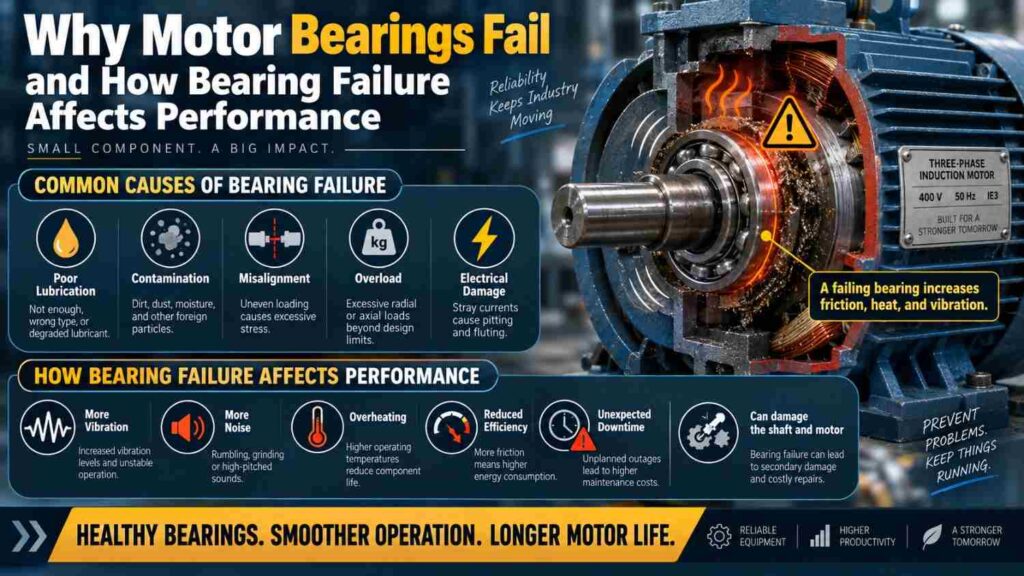
Understanding why bearings fail, what the warning signs sound and feel like, and how a failing bearing quietly drags down a motor’s electrical performance long before it seizes completely gives technicians a genuine head start on catching the problem early.
What Motor Bearings Actually Do
Every electric motor rotor spins on a pair of bearings, one at each end of the shaft, that hold the rotor precisely centered within the stator bore while allowing it to turn with minimal friction. This precise centering matters more than it might seem, because the air gap between rotor and stator in a healthy motor is only a fraction of a millimeter, and bearings are what keep that gap uniform all the way around the rotor’s circumference as it spins at full speed. Once a bearing starts to wear, that precise centering is the first thing to be lost, well before the bearing fails completely enough to stop the motor outright.
The Main Causes of Bearing Failure
Bearing failure is rarely a single sudden event, it is typically the end result of a slow degradation process caused by one or more contributing factors building up over time.
- Inadequate or excessive lubrication, since over-greasing can churn and overheat the grease just as under-greasing starves the bearing of protection.
- Contamination from dust, moisture, or corrosive vapor entering the bearing housing, a genuine concern in dusty industrial and agricultural environments common across Nigeria.
- Misalignment between the motor shaft and the driven equipment, placing uneven side-loading on bearings never designed to absorb it.
- Electrical bearing currents, small circulating currents induced onto the shaft, particularly common on VFD-driven motors without proper shaft grounding, that pit and erode the bearing races over time.
- Simple age and normal wear, since every bearing has a finite service life even under ideal conditions.
How a Failing Bearing Affects Electrical Performance
A worn bearing lets the rotor drift slightly off center within the stator bore, creating an uneven air gap that is narrower on one side and wider on the other as the rotor turns. This uneven gap disturbs the otherwise smooth, symmetrical magnetic field the stator is designed to produce, leading to uneven torque production, increased vibration, and often a measurable rise in current draw as the motor works less efficiently to deliver the same output. In more advanced cases, a badly worn bearing can let the rotor actually contact the stator laminations, a condition that can severely damage both the stator windings and the rotor in a single incident, turning what started as a bearing problem into a full motor rewind or replacement.
Recognizing the Warning Signs Early
The earliest and most reliable warning sign of a developing bearing problem is usually sound, a grinding, rumbling, or high-pitched whining noise coming specifically from the bearing housing area rather than the motor body generally, often most noticeable right after startup or when listening close to the shaft ends. Increased vibration, noticeably warmer than normal bearing housings to the touch, and a subtle but real rise in running current for the same load are all corroborating signs worth checking together rather than relying on any single symptom alone.
| Symptom | Likely Stage of Bearing Wear |
|---|---|
| Faint high-pitched whine, motor otherwise normal | Early wear, lubrication or contamination beginning |
| Noticeable grinding or rumbling noise | Moderate wear, races and rollers degrading |
| Visible vibration, hot bearing housing | Advanced wear, failure approaching |
| Shaft play, rotor rubbing stator | Failure imminent or already causing collateral damage |
Practical Maintenance That Actually Extends Bearing Life
- Follow the manufacturer’s specific lubrication schedule and grease type rather than a generic interval, since over-lubrication is just as harmful as under-lubrication.
- Keep bearing housings and shaft seals in good condition to prevent dust and moisture ingress, especially on motors installed in dusty or exposed industrial settings.
- Check and correct shaft alignment whenever a motor is reinstalled or coupled to new or serviced driven equipment.
- Fit shaft grounding rings or insulated bearings on VFD-driven motors where electrical bearing currents are a known risk, a detail worth discussing with the drive supplier during specification.
- Listen and feel for early warning signs during routine rounds rather than waiting for a scheduled shutdown to check bearing condition.
Why Catching It Early Saves Real Money
A bearing replacement, including the labor to open the motor and press the old bearing off and the new one on, is a modest cost compared to what happens once a neglected bearing progresses to rotor-to-stator contact. At that point the repair shifts from a straightforward bearing swap to a full rewind, plus the production downtime of an unplanned failure rather than a scheduled maintenance window. For facilities running critical pumps, fans, or conveyors, a basic condition-monitoring routine, even a weekly listen-and-feel check, pays for itself many times over.
Common Misconceptions
- “Bearing problems are purely mechanical and have nothing to do with electrical performance.” A worn bearing disturbs the air gap and directly affects current draw and torque smoothness, making it a genuinely electrical issue as much as a mechanical one.
- “More grease is always safer than too little.” Over-greasing can churn and overheat the bearing just as effectively as running it dry, so following the correct quantity and interval matters as much as the lubrication itself.
- “Bearing noise can wait until the next scheduled maintenance shutdown.” Bearing wear tends to progress quickly once it becomes audible, and delaying action risks the far more expensive outcome of rotor-to-stator contact.
Frequently Asked Questions
Can a bad bearing cause a motor to trip on overload?
Yes, the added friction and uneven air gap from a worn bearing can raise current draw enough to trip a correctly set overload relay, even though the underlying fault is mechanical rather than electrical in origin.
How often should motor bearings be greased?
It depends on the motor size, speed, and operating environment, so the manufacturer’s specific recommendation should be followed rather than a generic rule, since intervals vary considerably between applications.
Is it possible to detect bearing wear before it becomes audible?
Yes, vibration analysis equipment can detect developing bearing defects well before they produce noticeable noise, though for many smaller facilities, regular manual listening and touch checks remain a practical and reasonably effective alternative.
Final Thoughts
Bearing failure is one of the most preventable causes of motor downtime, yet it is also one of the easiest to ignore because early symptoms are subtle and the motor often keeps running, just less efficiently, for a while before anything dramatic happens. Paying attention to lubrication, alignment, and the early warning signs of noise and vibration is a small, low-cost habit that consistently prevents the far larger expense of a rotor-to-stator failure and an unplanned production stoppage.