
Single phasing is one of the leading causes of premature motor failure across Nigerian industry, yet the term itself is often misunderstood as simply “a phase went off” without appreciating exactly how that translates into burnt windings and an expensive rewind bill.
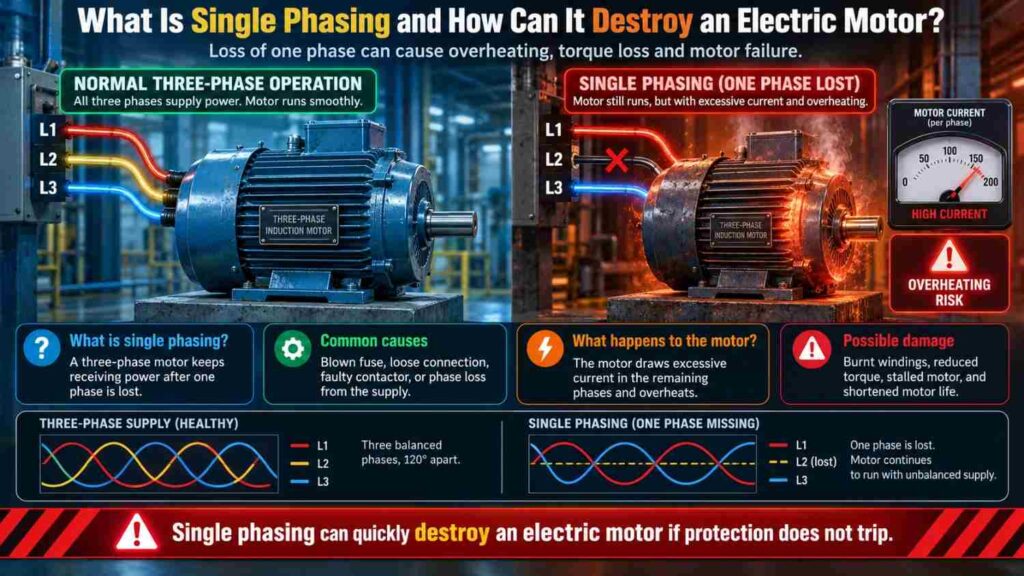
This article looks specifically at the underlying physics of why single phasing is so destructive, what causes it beyond the obvious blown fuse, and the practical steps that actually prevent it rather than just reacting after the damage is done.
Defining Single Phasing Precisely
Single phasing describes any condition where a three-phase motor is operating, or attempting to operate, with only two of its three intended supply phases actually present, whether that loss happens somewhere upstream in the supply network, at a protective device, or at a connection point closer to the motor itself.
It is a distinct condition from a motor simply losing a phase while running, which is covered separately in our dedicated article on motors that keep running after losing a phase; single phasing is the broader term covering that scenario along with failed starting attempts and partial-voltage conditions that produce a similar destructive effect on the windings.
The Heat Math That Actually Destroys the Motor
Motor winding damage from single phasing comes down to basic resistive heating, where heat generated is proportional to the square of the current flowing through a winding.
When one phase is lost, the remaining two windings must together carry roughly the total power the motor was drawing across three windings, so current in those two active windings rises substantially, commonly well past the winding’s rated current under load.
Because heat scales with current squared, even a moderate current increase produces a disproportionately large heat increase, and insulation rated for continuous exposure at normal operating temperature degrades rapidly, sometimes within minutes, once that rating is significantly exceeded.
Where Single Phasing Actually Originates
It is easy to assume single phasing only happens at the motor or its starter, but the fault frequently originates much further upstream.
A blown fuse or nuisance-tripped breaker on one phase at the distribution board is the most commonly cited cause, but supply-side issues genuinely matter too, particularly in areas of Nigeria where DisCo three-phase feeders can suffer a broken conductor or a failed connector on one phase while the other two remain energized and appear normal on a quick voltage check.
Generator-fed sites add another layer of risk, since an internally failed phase winding or simply poor phase balancing under an uneven load can effectively deliver a single-phasing condition to every motor connected downstream.
| Origin Point | Typical Cause |
|---|---|
| DisCo supply network | Broken conductor or failed connector on one phase upstream |
| Site distribution board | Blown fuse or tripped single-pole breaker on one phase |
| Contactor or starter | One pole fails to close or contact has burnt away |
| Generator supply | Internal fault or severe phase imbalance under load |
| Cable and terminations | Loose, corroded, or burnt joint on one conductor |
Devices That Specifically Guard Against It
Standard thermal overload relays eventually respond to the elevated current single phasing causes, but they are not designed specifically to detect the imbalance itself, and depending on the load and trip curve, meaningful damage can occur before a general overload relay finally trips.
Purpose-built phase failure relays, sometimes combined with phase sequence and voltage unbalance monitoring in one device, watch all three phases continuously and are built to detect a missing or severely unbalanced phase within seconds rather than minutes. On larger or critical motors, pairing this with standard overload protection, discussed in our motor protection article, gives genuinely layered coverage.
Steps to Reduce Single Phasing Risk on a Site
- Install a dedicated phase failure or phase unbalance relay ahead of critical motors, particularly larger ones where rewind cost is significant.
- Schedule regular inspection of fuses, contactor contacts, and terminal connections rather than waiting for a failure to prompt a check.
- Balance generator loading across all three phases as evenly as practical to reduce the risk of an internally stressed or unbalanced generator output.
- Train site staff to check current on all three phases with a clamp meter periodically, not just voltage, since voltage alone can look deceptively normal.
- Replace aging or corroded terminal connections proactively at motor terminal boxes and distribution panels before they fail outright.
The Real Cost of Ignoring It
A dedicated phase failure relay is a relatively small one-time cost, while a burnt motor means the direct cost of a rewind or replacement plus the indirect cost of downtime on whatever process, pump, or production line it was driving.
For small business owners running boreholes, workshops, or light manufacturing on a tight margin, an unplanned motor failure from single phasing is usually a far more expensive event than the modest investment in proper protection would have been.
Common Misconceptions
- “Single phasing only happens when a fuse blows at the motor’s own panel.” The lost phase can originate anywhere upstream, including the DisCo supply network or a generator fault, well before it reaches the motor’s local panel.
- “Checking voltage on all three phases is enough to rule out single phasing.” Voltage can still read close to normal on a lightly loaded circuit even with a genuinely weak or failing phase connection, so checking current under actual load gives a more reliable picture.
- “A motor that survives one single-phasing event is fine going forward.” Insulation damage from overheating is cumulative, and a motor that survived one incident may already have reduced remaining life even if it currently still runs.
Frequently Asked Questions
Is single phasing the same thing as a motor simply losing one phase while running?
They overlap heavily, but single phasing is the broader term covering any two-phase operating condition, including failed starts, while a motor continuing to run after losing a phase is one specific scenario within that broader category.
Can single-phase motors be affected by single phasing too?
No, the term specifically applies to three-phase motors and systems; single-phase motors have their own separate failure modes related to their single live conductor and starting components.
Does a phase failure relay cost significantly more than a standard overload relay?
It typically costs somewhat more than a basic overload relay alone, but the added cost is modest compared to the potential cost of a motor rewind, making it a genuinely worthwhile investment on any motor of meaningful size.
Final Thoughts
Single phasing destroys motors through a straightforward but unforgiving chain of events: one phase is lost, the remaining two windings carry disproportionately more current, and that current squared translates into heat that insulation was never designed to survive for long.
Because the fault can originate anywhere from a DisCo feeder to a corroded terminal at the motor itself, the most reliable defense is not vigilance alone but dedicated phase failure protection paired with routine inspection, an investment that consistently costs far less than the rewind it prevents.