
One of the more dangerous quirks of three-phase induction motors is that they do not always stop when one of the three supply phases fails.
A motor already running when it loses a phase will often keep turning, sometimes with barely a noticeable change in sound or speed, which is exactly what makes this condition so hazardous, because the motor can quietly cook itself from the inside while appearing to work normally from the outside.
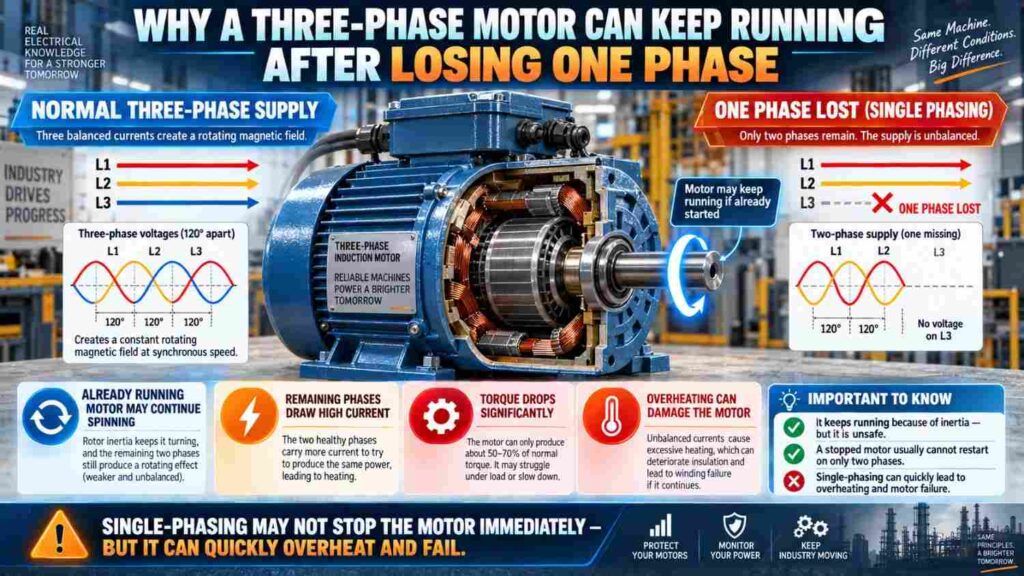
Why the Motor Does Not Simply Stop
A three-phase motor that is already running and up to speed has significant rotational momentum and a rotor magnetic field already established through induction.
When one phase is lost, the remaining two phases can still produce a rotating, though distorted and unbalanced, magnetic field, and this is often enough to keep the rotor turning and delivering some torque, especially if the mechanical load is light relative to the motor’s rated capacity.
This differs sharply from a motor that has not yet started, which generally cannot start at all on only two phases because the starting torque produced under that condition is usually too weak and erratic to overcome the rotor’s initial inertia.
What Happens Electrically Inside the Motor
With one phase missing, the remaining two phase windings have to carry the entire electrical load between them instead of sharing it three ways, so current in those two windings rises substantially above their normal rated value, often by 50% to well over 100% depending on the load the motor is still trying to drive.
This condition is closely related to single phasing, covered in full detail in our dedicated single phasing article, and the practical result is the same regardless of exactly how the phase loss occurred: two windings are now significantly overheating while the third sits comparatively cool, and that uneven heating is what ultimately destroys the winding insulation.
Why This Is Genuinely Dangerous to Leave Running
The insidious part of this fault is that a lightly loaded motor can continue running for minutes or even longer on two phases without an obvious sign of trouble, no dramatic noise, no immediate stall, sometimes barely a change in speed that an operator would notice by ear.
Meanwhile the overloaded windings are heating well beyond their design limits, and insulation damage from sustained overheating is cumulative and generally irreversible.
By the time the motor does eventually trip, stalls under load, or fails outright, meaningful and sometimes total damage has already been done to the winding insulation, and the motor typically needs a rewind rather than a simple repair.
Common Causes of Phase Loss in Nigerian Installations
- A blown fuse or tripped single-phase breaker on one leg of the supply while the other two remain live.
- A loose, corroded, or burnt connection at a terminal, contactor contact, or cable joint on one phase.
- A broken conductor in overhead DisCo supply lines, a recognized contributor to single-phasing events during unstable grid conditions.
- A contactor with one pole that fails to close properly or whose contact has worn on just one phase.
- A generator running with one phase overloaded or unbalanced beyond its capability, particularly on poorly maintained generator sets.
How to Detect the Condition Before It Causes Damage
The most reliable protection is a dedicated phase failure or phase loss relay, which continuously monitors all three phases and trips the motor’s contactor the instant one phase drops out or becomes significantly unbalanced, working alongside the standard overload protection discussed in our motor protection article rather than replacing it.
Where dedicated phase failure relays are not fitted, technicians can watch for a combination of clues: unusually loud humming, a subtle change in motor sound or vibration, one phase reading current noticeably different from the other two on a clamp meter, or unexplained heat at the motor terminal box or nearby contactor.
| Clue | What It Suggests |
|---|---|
| Louder than normal humming | Unbalanced magnetic field from lost phase |
| Two phases reading high current, one reading zero | Confirmed phase loss on the zero-current leg |
| Motor terminal box unusually hot | Overheating windings on the remaining two phases |
| Motor stalls under load it previously handled fine | Reduced torque capability from missing phase |
What to Do Immediately If You Suspect Phase Loss
The correct response is always to stop the motor immediately and isolate it from supply, rather than letting it continue running while you investigate, since every additional minute running unbalanced adds more heat damage to the windings.
Once safely isolated, check each phase at the supply, the contactor, and the motor terminals in sequence to locate exactly where the phase is missing, whether that is a blown fuse, a loose terminal, a failed contactor pole, or an upstream supply fault.
Only restore power once the actual cause has been found and corrected, and if the motor ran unbalanced for any meaningful length of time before being caught, it is worth having the windings tested for insulation resistance before returning it to full service.
Common Misconceptions
- “A three-phase motor automatically stops if it loses a phase.” A motor already running can often keep turning on the remaining two phases, which is precisely what makes this fault so dangerous rather than self-announcing.
- “If the motor sounds normal, it is not a problem.” Winding damage from phase loss builds up silently through heat well before any dramatic change in sound or performance becomes noticeable.
- “Standard overload protection alone is enough to catch this fault quickly.” Depending on how lightly loaded the motor is, overload protection may take a long time to trip or may not trip at all, which is why a dedicated phase failure relay offers faster, more reliable protection.
Frequently Asked Questions
Can a three-phase motor start on only two phases?
Generally no, most motors cannot reliably start with a phase already missing, since the starting torque produced is weak and inconsistent, though there are edge cases with very light loads where a motor may lurch into rotation.
How quickly can damage occur once a motor loses a phase?
It depends heavily on the load and motor size, but meaningful winding heat damage can begin within minutes under moderate to heavy load, which is why fast detection and immediate shutdown matter so much.
Does a phase failure relay replace the need for overload protection?
No, the two protect against different failure modes and work best together, with the overload relay catching general overcurrent conditions and the phase failure relay specifically catching the loss of one supply phase.
Final Thoughts
A three-phase motor continuing to run after losing a phase is one of the more deceptive failure modes in electrical machines, because nothing about the motor’s outward behavior necessarily signals the damage happening inside the windings.
Fitting dedicated phase failure protection, checking connections regularly, and reacting immediately to any sign of current imbalance are the practical habits that separate a quick fuse replacement from an expensive motor rewind.