
Every motor needs some way to be switched on and off safely, but once you move beyond small fractional-horsepower motors, a simple switch is no longer enough.
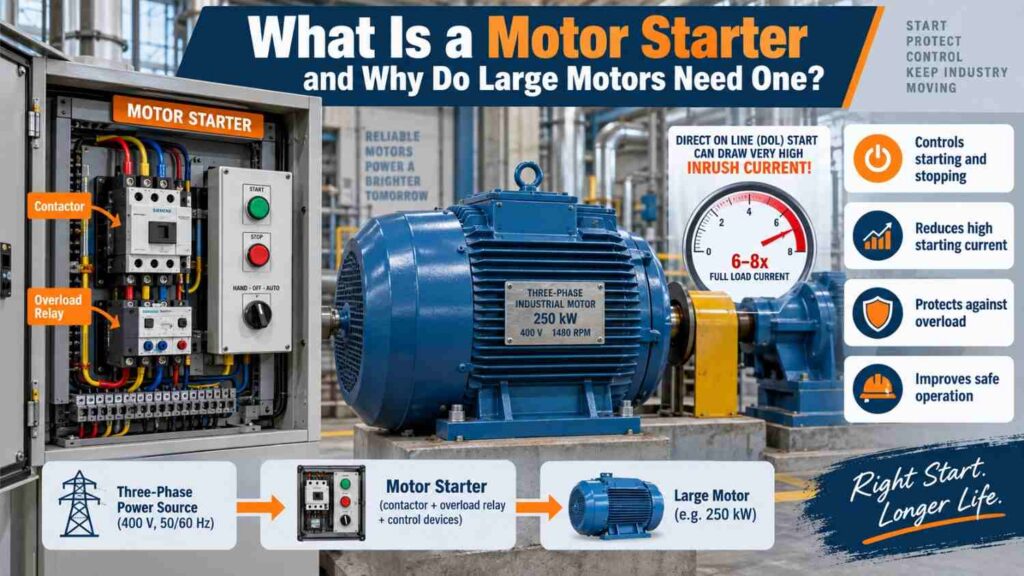
Large motors need a motor starter, a piece of equipment that does far more than just make and break the circuit, and understanding what a starter actually does helps explain why it is treated as essential rather than optional equipment on any sizeable industrial motor.
What a Motor Starter Actually Does
A motor starter combines at minimum two functions in one assembly: a switching device to connect and disconnect the motor from supply, usually a contactor, and an overload protection device that disconnects the motor if it draws more than its rated running current for too long.
Many starters add a third function, controlling how the motor is brought up to speed, whether that is direct-on-line, star-delta, or soft starting. In short, a starter is the combined switching, protection, and often acceleration-control package that lets a motor start and run safely.
Why Large Motors Cannot Simply Use a Switch
A basic isolator or switch can make and break a circuit, but it has no built-in intelligence to detect an overload condition before winding insulation is damaged by heat.
Large motors also draw several times their running current at the moment of starting, discussed fully in our dedicated starting current article, and a plain switch offers no way to manage that surge or protect against a stalled rotor condition that would otherwise let dangerously high current flow indefinitely.
The starter’s overload relay is specifically what closes this gap, tripping the motor off before sustained overcurrent turns into burnt windings.
The Core Components Inside a Typical Starter
- Contactor: an electromagnetically operated switch that makes and breaks the main circuit, rated to handle running and starting currents repeatedly without damage, distinct in duty from the general-purpose relays discussed in our contactors and relays article.
- Overload relay: monitors current on each phase and trips the contactor open if current stays above the set threshold for too long.
- Control circuit: low-voltage push buttons, interlocks, or automation signals that command the contactor, kept separate from the high-power main circuit.
- Isolator or circuit breaker: provides a means of isolating the circuit for maintenance and, for a breaker, short-circuit protection the overload relay alone does not provide.
Direct-On-Line Starters Versus Reduced-Voltage Starters
The simplest type is a direct-on-line, or DOL, starter, which applies full supply voltage to the motor the instant it is switched on. This is fine for smaller motors where the resulting starting current surge is manageable for the supply and the driven equipment can tolerate the sudden mechanical jolt of full starting torque.
As motor size increases, reduced-voltage starting becomes more important, and this is where star-delta starters, covered in our dedicated star-delta starting article, and soft starters come in, both reducing the electrical and mechanical shock of starting compared to DOL.
| Starter Type | Typical Use | Key Characteristic |
|---|---|---|
| Direct-on-line (DOL) | Small to medium motors | Simplest, full voltage and torque at start |
| Star-delta | Medium to large motors | Reduced starting current, reduced starting torque |
| Soft starter | Medium to large motors, sensitive loads | Smooth, adjustable voltage ramp |
| VFD-based starting | Motors needing speed control | Full torque, controllable speed and acceleration |
Why Nigerian Sites Often Need Starters More, Not Less
In facilities running partly or fully on generator power, a common reality across Nigerian industry, motor starters do double duty protecting both the motor and the fragile generator supply from an unmanaged direct start.
A generator already working near its capacity limit is far more likely to stall or trip when a large motor slams on at full voltage than when it starts through a star-delta or soft starter arrangement.
Overload protection also matters more where supply voltage is less stable, since low or fluctuating voltage forces a motor to draw higher current for the same torque, exactly the condition a properly set overload relay is built to catch.
Sizing and Setting a Starter Correctly
A starter is only as protective as its settings are accurate. The overload relay should be set to the motor’s actual rated full-load current from the nameplate, discussed in detail in our dedicated nameplate reading article, not left at a factory default or an arbitrary round number.
Contactor ratings need to account for both running current and starting duty cycle, since a contactor undersized for frequent starting wears out prematurely even if it survives the current on paper. This is not a one-time installation task either, since a rewound motor or a changed duty cycle both call for the settings to be reviewed again.
Common Starter Problems Technicians See in the Field
- Overload relays set too high, allowing the motor to run overheated for extended periods without tripping.
- Overload relays set too low or too sensitive, causing nuisance tripping during normal starts or brief load spikes.
- Worn or pitted contactor contacts, leading to voltage drop, arcing, or single-phasing risk if one contact fails to close properly.
- Star-delta timer settings left at default rather than tuned to the actual acceleration time the motor and load need.
Common Misconceptions
- “A motor starter is just a fancy switch.” A starter’s overload protection function is arguably more important than its switching function, since it is what actually prevents winding damage from sustained overcurrent.
- “Any contactor rated for the motor’s running current is good enough.” Contactors must also handle repeated starting duty and inrush current without excessive wear, which is why motor-rated contactors are selected differently from general switching contactors.
- “Once a starter is installed and working, it never needs attention again.” Overload settings, contact condition, and timer settings all need periodic review, especially after a motor is rewound or a load changes.
Frequently Asked Questions
Is a contactor the same thing as a motor starter?
No, a contactor is one component inside a starter; a complete starter also includes overload protection and, often, control circuitry that the contactor alone does not provide.
Do small single-phase motors need a full motor starter?
Small single-phase motors often use simpler protection built into the motor itself or a basic manual starter, while larger three-phase motors are where a full contactor-and-overload starter arrangement becomes standard practice.
Can a VFD replace a traditional motor starter entirely?
A VFD, discussed further in our dedicated VFD article, can take over both the starting and running control functions, though many installations still include an isolator and sometimes a bypass contactor arrangement alongside it for maintenance and backup purposes.
Final Thoughts
A motor starter earns its place in any serious motor installation by doing three jobs at once: switching the motor safely, protecting it from sustained overcurrent, and in many cases managing how it accelerates up to speed.
Skipping proper starting equipment on a large motor is a false economy that shows up later as burnt windings, nuisance generator trips, or premature contactor failure, all problems a correctly specified and properly set starter is built to prevent.