
If you have ever checked an induction motor’s nameplate and noticed the rated speed reads something like 1450 RPM instead of a clean 1500 RPM, you have already seen slip in action without necessarily knowing the term.
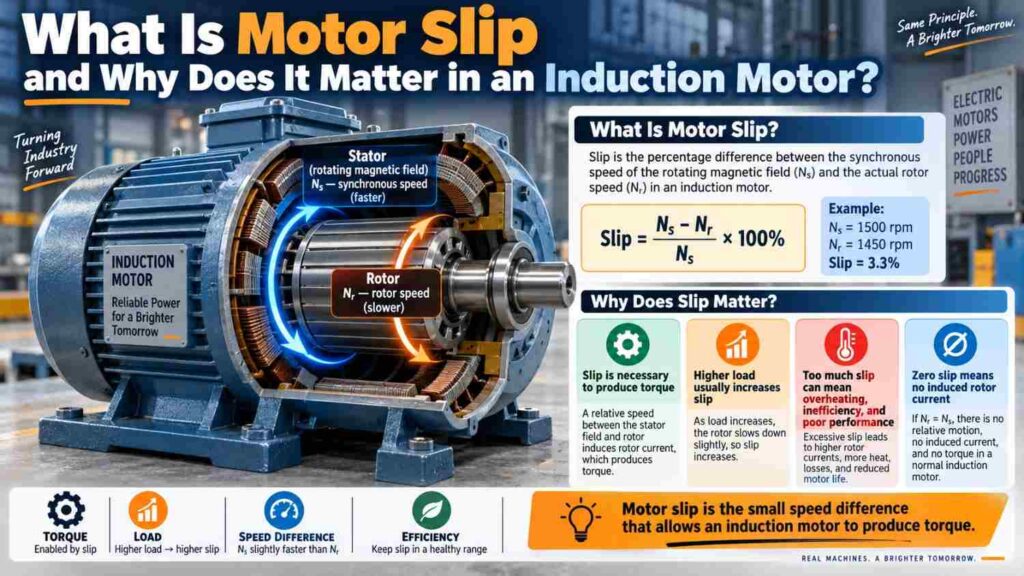
Slip is not a defect or a sign of inefficiency, it is the fundamental mechanism that makes an induction motor work at all, and understanding it helps explain motor speed behavior, torque production, and even some diagnostic clues when something is wrong.
What Slip Actually Is
Slip is the difference between the synchronous speed of the stator’s rotating magnetic field and the actual mechanical speed of the rotor, expressed as a percentage of synchronous speed. Synchronous speed itself is fixed by supply frequency and the number of poles wound into the stator, calculated as 120 times frequency divided by number of poles.
A four-pole motor on a 50Hz supply, standard across Nigeria, has a synchronous speed of 1500 RPM, but the actual rotor speed under load will always be somewhat less than that, and that gap is the slip.
Why the Motor Needs Slip to Work at All
An induction motor generates rotor current, and therefore torque, purely through electromagnetic induction, the same principle that makes a transformer work. Induction only happens when there is relative motion between the rotating stator field and the rotor conductors.
If the rotor somehow reached exactly synchronous speed, there would be no relative motion left, no voltage would be induced into the rotor bars, and the motor would produce zero torque. So the rotor must always run slightly slower than the field, and it automatically settles at whatever slip is needed to produce enough torque to match the load, more slip under heavier load, less slip when lightly loaded.
How Slip Changes With Load
At no load, a typical induction motor might run at 99% or more of synchronous speed, with slip below 1%. As mechanical load increases, the rotor slows slightly, increasing slip, which in turn increases the induced rotor current and the torque produced, until torque matches the new load.
Rated full-load slip for most general-purpose induction motors falls somewhere between about 2% and 5%, though smaller motors and certain designs can run at the higher end of that range. This relationship is why motor speed under real working conditions always reads a little below the theoretical synchronous figure on the nameplate.
| Poles | Synchronous Speed (50Hz) | Typical Full-Load Speed | Approx. Slip |
|---|---|---|---|
| 2 | 3000 RPM | 2900-2950 RPM | ~2-3% |
| 4 | 1500 RPM | 1440-1470 RPM | ~2-4% |
| 6 | 1000 RPM | 950-970 RPM | ~3-5% |
| 8 | 750 RPM | 710-730 RPM | ~3-5% |
Calculating Slip From the Nameplate
Slip is easy to calculate once you know synchronous speed and rated speed, both of which are either printed or derivable from the nameplate, a skill covered more broadly in our dedicated nameplate reading article. The formula is straightforward:
- Find synchronous speed: 120 times supply frequency, divided by number of poles.
- Subtract the nameplate rated speed from synchronous speed to get the speed difference.
- Divide that difference by synchronous speed, then multiply by 100 to express it as a percentage.
For example, a four-pole motor on 50Hz supply with a nameplate speed of 1440 RPM has a synchronous speed of 1500 RPM, a speed difference of 60 RPM, and a slip of 4%, which is a perfectly normal figure for that class of motor.
What Abnormal Slip Tells You
Slip that is noticeably higher than the nameplate value under the same load condition is a useful diagnostic signal rather than something to ignore. Common causes of elevated slip include low supply voltage, which reduces the torque the motor can produce for a given slip and forces it to slip more to compensate, broken or cracked rotor bars, which reduce the rotor’s ability to carry induced current efficiently, and a mechanical load that has increased beyond what the motor was originally sized for, perhaps due to a failing bearing on the driven equipment or a pump running against unexpectedly high back-pressure. In Nigerian facilities dealing with voltage fluctuations from the grid or from an undersized generator, excessive slip under otherwise normal load is often one of the earliest signs that supply voltage quality, not the motor itself, is the underlying issue.
Slip Frequency and Rotor Currents
The frequency of the current actually induced in the rotor is not the supply frequency, it is the slip frequency, calculated as slip times supply frequency. At standstill, slip is 100% and rotor frequency equals the full supply frequency, which is part of why starting current is so high, a topic explored in our dedicated article on motor starting current. As the rotor accelerates and slip falls toward its normal running value of a few percent, rotor frequency falls proportionally, and this is genuinely useful to understand when working with wound-rotor motors or interpreting rotor-side measurements during commissioning or fault-finding.
Common Misconceptions
- “Slip means the motor is losing efficiency or wasting energy.” Slip is the necessary physical mechanism that lets the motor generate torque at all; a motor with zero slip would produce zero torque.
- “All motors of the same pole count run at exactly the same speed.” Actual running speed depends on slip, which varies with load, supply voltage, and the specific motor’s design, so two nominally identical motors can run at slightly different speeds under different conditions.
- “Slip only matters for engineers, not for practical troubleshooting.” Comparing actual running speed to the expected nameplate value is a quick, genuinely useful field check for detecting supply voltage problems or developing mechanical and electrical faults.
Frequently Asked Questions
Does a VFD change how slip works?
A VFD changes the supply frequency itself, which shifts synchronous speed up or down, but the motor still operates with the same small percentage slip relative to whatever synchronous speed the drive is currently producing.
Can slip ever be zero in a standard induction motor?
No, a standard induction motor always needs some slip to produce torque; only a synchronous motor, discussed in our dedicated synchronous versus induction comparison, can run at exactly zero slip.
Is higher slip always a bad sign?
Not necessarily on its own, since slip naturally rises with load, but slip that is noticeably higher than the nameplate figure for a given load is worth investigating as a possible sign of low voltage, rotor damage, or excess mechanical load.
Final Thoughts
Slip is easy to overlook because it is a small percentage buried in a nameplate speed figure, but it is genuinely the mechanism that makes induction motors function, and it doubles as a handy diagnostic number once you know how to read it.
Learning to calculate expected slip and compare it against actual running speed gives technicians a quick, low-cost way to catch supply voltage problems and developing motor faults well before they turn into a full breakdown.