
Anyone who has watched the lights dim for a second when a large pump or compressor kicks on, or heard a generator strain and briefly stumble at motor start-up, has witnessed inrush current firsthand.
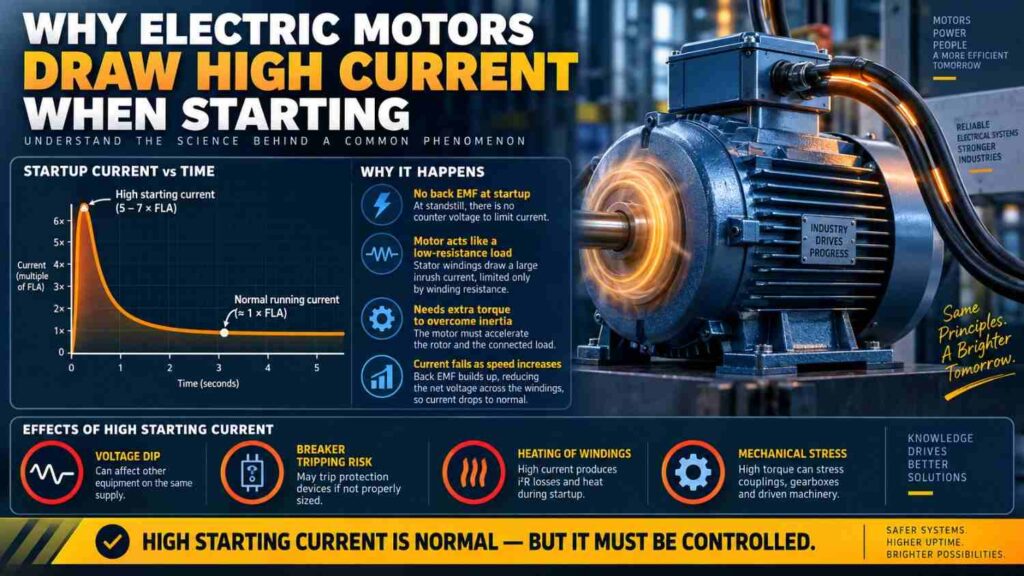
This is completely normal motor behavior, not a fault, but it has real consequences for wiring, protection settings, and generator sizing that every technician and facility owner in Nigeria should understand before it causes a nuisance trip or a damaged supply.
What Is Actually Happening at the Moment of Start
When a motor is first energized, the rotor is stationary while the stator’s magnetic field is already rotating at full speed, meaning the relative speed difference between the two is at its absolute maximum.
This large relative speed induces very high current in the rotor, and by transformer-like action, correspondingly high current is drawn from the supply into the stator windings.
As the rotor accelerates and slip decreases, the induced current and the current drawn from the supply both fall rapidly, until the motor settles into its normal running current once it reaches operating speed.
How Much Higher Is Starting Current, Really
For a standard squirrel-cage induction motor started directly across the line, starting current typically runs between five and eight times the motor’s rated running current, though some designs can reach even higher multiples. This means a motor rated at 20 amps running current might briefly draw 100 to 160 amps at the instant of starting.
That surge only lasts a few seconds for most loads as the motor accelerates, but a few seconds of that much current is more than enough to cause voltage sag, trip protective devices, or stall a marginally sized generator if nothing is done to manage it.
Why This Matters for Wiring and Protection Sizing
Standard fuses or circuit breakers sized purely for running current would trip every single time the motor starts, so motor circuits are deliberately protected with time-delay devices, motor-rated fuses, or overload relays that tolerate a brief high-current surge while still protecting against a sustained overload or locked rotor condition.
Cable sizing also has to account for this starting surge to avoid excessive voltage drop at start, since a long or undersized cable run can itself cause the motor to struggle to reach full speed if the voltage at the motor terminals sags too much during the inrush period.
The Generator and Voltage Dip Problem in Nigerian Facilities
This inrush issue is especially pronounced for facilities that rely partly or fully on generator power, a common reality across Nigerian industry given inconsistent DisCo supply.
A generator that is comfortably sized for a motor’s running load can still stall, trip on its own protection, or produce a severe voltage and frequency dip when that motor starts directly across the line, because the generator’s instantaneous capacity is what gets tested during the surge, not its average rated output.
This is one of the most common reasons a generator that “should be big enough” on paper still struggles every time a borehole pump or compressor starts.
| Starting Method | Typical Starting Current | Typical Starting Torque |
|---|---|---|
| Direct-on-line (DOL) | 5-8x running current | Full rated torque |
| Star-delta | Roughly 1/3 of DOL current | Roughly 1/3 of DOL torque |
| Soft starter | 2-4x running current, adjustable | Reduced, ramped smoothly |
| VFD | Close to rated current | Full torque available, controlled ramp |
Practical Ways to Reduce Starting Current Impact
Several established methods exist to reduce the electrical shock of motor starting, and choosing between them depends on load size, torque needs, and budget.
- Star-delta starting, covered in depth in our dedicated star-delta starting article, reduces starting current by initially connecting windings in star before switching to delta for running.
- Soft starters ramp voltage up gradually rather than applying full voltage instantly, smoothing both current and mechanical shock to the driven load.
- Variable frequency drives, discussed in our dedicated VFD article, control both voltage and frequency during acceleration, achieving the lowest starting current impact of the common methods while also enabling speed control during normal running.
- Simply oversizing the generator or supply capacity, though this is the most expensive option and does not address the underlying mechanical stress on the driven equipment.
When High Starting Current Signals an Actual Problem
Ordinary inrush current is brief and self-resolving as the motor accelerates. A genuine problem exists when the high current persists well beyond the normal few-second window, which usually points to a locked or mechanically obstructed rotor, a badly worn bearing, a load that is too heavy for the motor to accelerate, or low supply voltage preventing the motor from developing enough torque to speed up. In these cases the motor essentially stays in its starting condition indefinitely, and left unprotected this will overheat the windings quickly, which is exactly the failure mode that overload and stall protection, discussed further in our motor protection article, is designed to catch.
Common Misconceptions
- “High starting current means the motor is faulty.” Elevated current for a brief moment at start is completely normal induction motor behavior, not evidence of a defect.
- “A bigger generator always solves motor starting problems.” While oversizing helps, using a reduced-voltage starting method is often a more practical and cost-effective fix than continually increasing generator capacity.
- “Star-delta and soft starters reduce starting current without any tradeoff.” Both methods reduce starting torque along with current, so they are unsuitable for loads that need high torque to get moving, such as loaded conveyors or positive-displacement pumps.
Frequently Asked Questions
How long does motor starting current normally last?
For most correctly loaded motors, the current surge lasts only a few seconds, typically less than five to ten seconds, as the rotor accelerates up to running speed.
Can starting current damage a motor over time?
Occasional normal starts do not damage a healthy motor, but frequent repeated starting, or starts that take unusually long to complete, generate excess heat in the windings that can shorten motor life.
Do all motors need a reduced-voltage starter?
No, smaller motors are commonly started direct-on-line without issue; reduced-voltage or soft-starting methods become necessary mainly as motor size increases or when the supply, whether grid or generator, cannot comfortably absorb the inrush.
Final Thoughts
Starting current is not a flaw in motor design, it is an unavoidable consequence of how induction motors generate torque from a standstill, and understanding the multiple involved helps explain why motor circuits, cabling, and protection are all deliberately designed differently from simple resistive loads.
For Nigerian facilities juggling grid and generator power, respecting this surge with proper starting methods and correctly sized protection is often the difference between smooth operation and a frustrating cycle of nuisance trips and stressed equipment.