
Most electric motors you will encounter in Nigerian factories, water plants, and workshops are induction motors, but synchronous motors show up in specific roles where precise speed or power factor correction matters, and the two are often confused because they look almost identical from the outside.
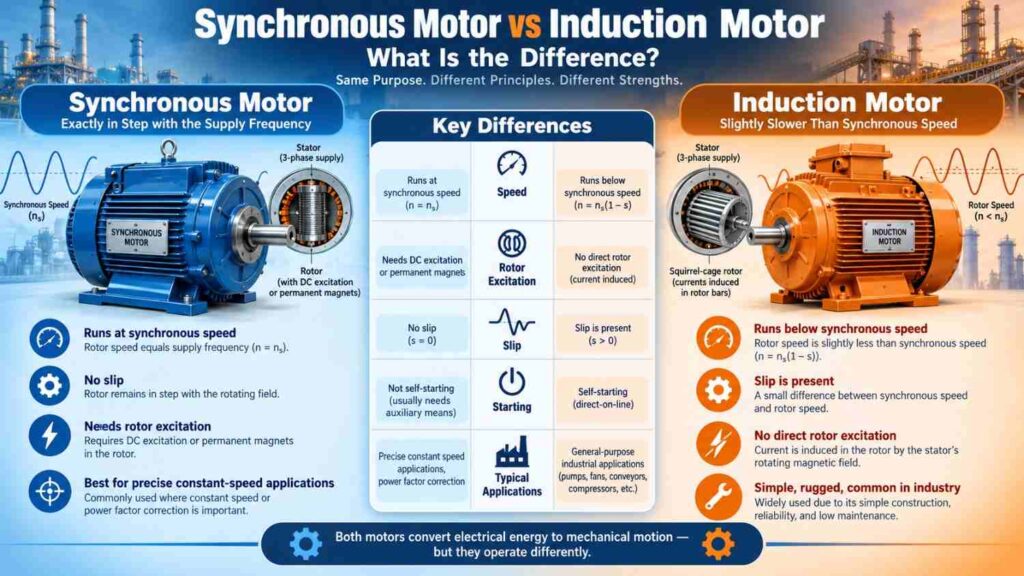
Understanding what actually separates them, how the rotor gets its magnetic field, and why that changes speed behavior and starting method, helps you pick the right machine and avoid misapplying one where the other belongs.
The Core Difference: Where the Rotor’s Magnetism Comes From
In an induction motor, the rotor has no independent source of magnetism. Current is induced into the rotor bars by the stator’s rotating magnetic field, the same way a transformer induces current into a secondary winding, and this induced current creates the rotor’s own magnetic field. In a synchronous motor, the rotor’s magnetic field is created independently, either by a separate DC field winding supplied through slip rings, or by permanent magnets mounted on the rotor. That rotor field locks onto the stator’s rotating field and turns in step with it, which is where the name synchronous comes from.
Speed Behavior: Locked-Step Versus Slightly Behind
A synchronous motor’s rotor turns at exactly the same speed as the stator’s rotating magnetic field, the synchronous speed determined purely by supply frequency and the number of poles, and it holds that speed regardless of load, right up until it is overloaded enough to fall out of step entirely and stall. An induction motor’s rotor always turns slightly slower than the rotating field, a difference known as slip, discussed in full in our dedicated article on motor slip, and that slip is actually necessary because without a speed difference no current would be induced into the rotor at all.
Starting Behavior and Why It Differs
Induction motors are inherently self-starting because the relative motion between the stator field and a stationary rotor is exactly what induces current and produces starting torque. Synchronous motors are not naturally self-starting, since a stationary rotor with a fixed field simply gets pulled back and forth by the rotating stator field rather than accelerating with it. Practical synchronous motors solve this by including damper windings that behave like an induction motor cage during startup, bringing the rotor up to near-synchronous speed before the DC field is applied and the rotor locks into step.
Power Factor: The Synchronous Motor’s Real Advantage
One of the biggest practical reasons synchronous motors are chosen at all is power factor control. By adjusting the DC excitation current on the rotor field, a synchronous motor can be made to operate at unity power factor, or even run overexcited to supply leading reactive power to the system, effectively acting like a capacitor bank that also does mechanical work. Induction motors, by contrast, always draw lagging reactive power from the supply to build their magnetic field, which is one reason large industrial sites with many induction motors often need separate power factor correction equipment.
Cost, Complexity, and Maintenance
Induction motors, especially the squirrel-cage type, are simpler, cheaper, and more rugged, with no slip rings, brushes, or separate excitation supply to maintain, which explains why they dominate general-purpose industrial and commercial applications. Synchronous motors are more complex and expensive for a given power rating, requiring an excitation system and more careful control, and this added cost is usually only justified for large constant-speed loads or where the power factor benefit itself has real economic value.
| Characteristic | Induction Motor | Synchronous Motor |
|---|---|---|
| Rotor field source | Induced by stator field | DC winding or permanent magnets |
| Speed vs. load | Drops slightly with load (slip) | Constant regardless of load, up to pull-out |
| Self-starting | Yes | No, needs damper winding or drive assistance |
| Power factor control | Not possible, always lagging | Adjustable, can lead or lag |
| Typical cost | Lower | Higher for same power rating |
| Common application | Pumps, fans, conveyors, general industry | Large compressors, power factor correction duty |
Where Each Type Actually Gets Used in Practice
Induction motors handle the overwhelming majority of pumping, ventilation, conveying, and general mechanical drive work found in Nigerian industrial and commercial facilities, usually controlled through contactors, soft starters, or VFDs as discussed elsewhere on this site. Synchronous motors show up in more specialized roles: large compressors in process plants where exact constant speed matters, and installations where a facility deliberately runs an overexcited synchronous motor to correct a poor plant-wide power factor and reduce reactive power charges. Outside these specific cases, most engineers default to induction motors simply because they are cheaper, easier to maintain, and perfectly adequate for the job.
- Confirm whether the application genuinely needs constant, load-independent speed, which favors a synchronous motor.
- Check whether power factor correction has real economic value on the site, since that often tips the decision toward synchronous.
- Weigh the added maintenance and excitation system complexity against the induction motor’s simplicity.
- For most general pumping, fan, and conveyor duty, default to the induction motor unless a specific reason says otherwise.
Common Misconceptions
- “Synchronous motors always run faster than induction motors of the same size.” Speed is set by supply frequency and pole count for both types; the synchronous motor simply holds that exact speed while the induction motor runs marginally slower under load.
- “An induction motor’s slip means it is somehow less efficient or faulty.” Slip is a normal, necessary part of how induction motors generate torque, not a sign of a problem.
- “Synchronous motors are always the better choice for industrial use.” For most general-purpose loads, the added cost and complexity of a synchronous motor is not justified, which is exactly why induction motors remain the industry default.
Frequently Asked Questions
Can a synchronous motor lose synchronism while running?
Yes, if the load exceeds the motor’s pull-out torque, it falls out of step with the supply frequency and typically stalls or trips on protection rather than continuing to run at a reduced speed.
Do synchronous motors need a VFD or soft starter to start?
Many synchronous motors start using their built-in damper winding acting like an induction motor, though large units are sometimes started with a VFD or dedicated starting method for smoother, lower-stress startup.
Are synchronous motors common in small workshops in Nigeria?
No, they are mostly found in larger industrial and utility-scale applications; small workshops almost exclusively use induction motors due to their lower cost and simpler maintenance.
Final Thoughts
The synchronous versus induction question really comes down to how the rotor gets magnetized and what that means for speed stability, starting, and power factor. Induction motors remain the practical, low-maintenance default for the vast majority of pumping, fan, and general drive applications across Nigerian industry, while synchronous motors earn their higher cost only in specific roles demanding constant speed or active power factor correction.
Knowing this distinction helps you read a nameplate or a spec sheet correctly and avoid specifying the wrong machine for the job.